
Defining the Gradient: Levels Editing Urban Birds and Habitat Selection
When we talk about levels editing urban birds, we are essentially looking at how different species “sort” themselves across the city based on the amount of concrete versus canopy. In scientific terms, this is often measured by the imperviousness index—the percentage of land covered by surfaces that don’t absorb water, like asphalt and rooftops.
Our research shows that this isn’t a random process. In fact, 81% of bird species in a major Italian study showed a significant response to these levels of urbanization. Some love the heat and height of the city core, while others are strictly tied to the few green “islands” left in the sea of gray.
Interestingly, this choice of level isn’t just a temporary summer vacation. A fascinating study on the Eurasian coot revealed that migratory waterbirds show long-term consistency in their habitat selection. If a bird breeds in an urban environment, it is statistically more likely to choose an urbanized area for its wintering grounds too. This “personality-matching” suggests that once a bird adapts to the hustle and bustle, it sticks with it throughout its annual cycle.
For those of us capturing these moments through a lens, understanding these levels helps us predict where to find specific subjects. Just as we use color grading for urban bird photography to separate a subject from a busy background, nature uses urbanization levels to separate species. When you are out in the field, look for the transition zones—the places where the city skyline begins to give way to parkland. These “intermediate” levels often hold the highest diversity of species, which provides a great opportunity to practice natural-looking edits for bird photos that highlight both the animal and its unique urban home.

Identifying Winners, Losers, and Adapters Across Seasons
In urban ecology, birds are generally categorized into three groups: Winners, Losers, and Adapters.
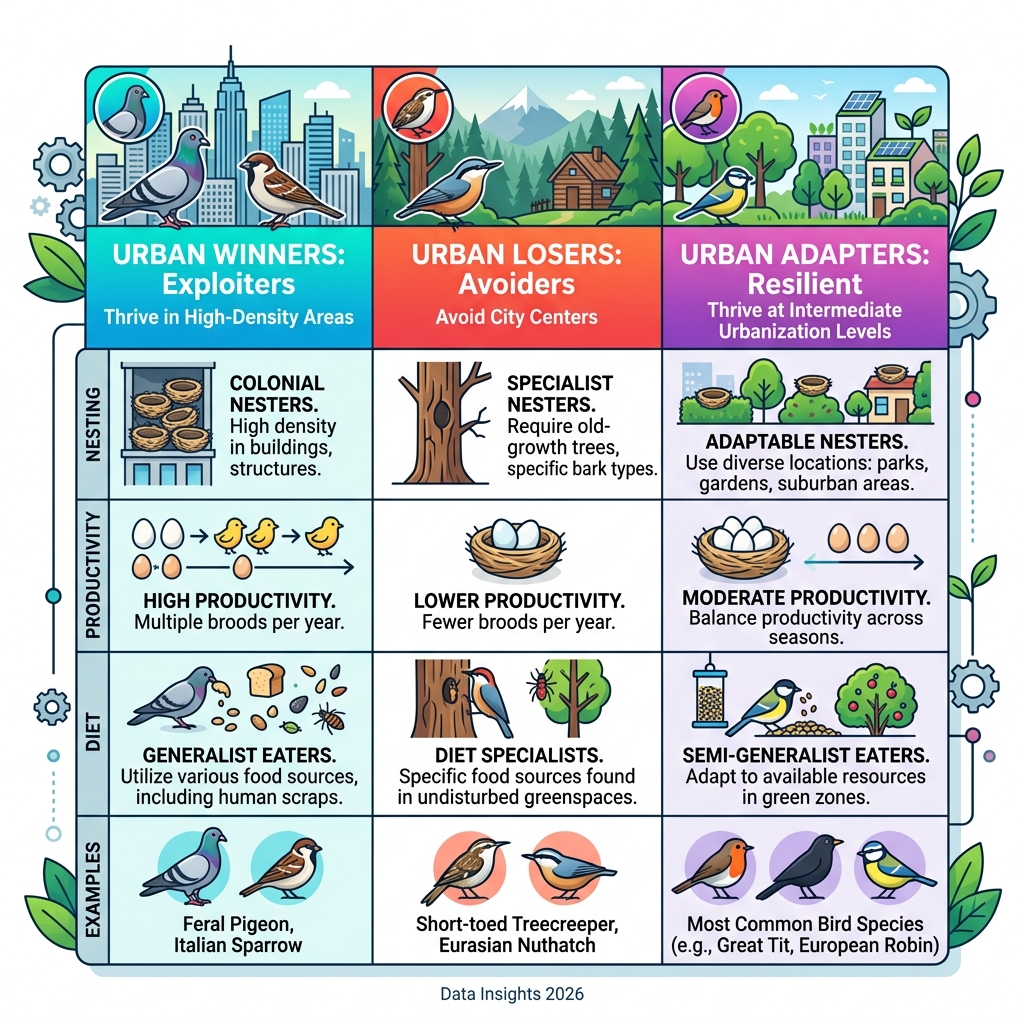
- Urban Winners: These are the “exploiters.” Think of the Feral Pigeon or the Italian Sparrow. They thrive in high-density areas. Their secrets? They often nest in colonies, have high productivity (multiple broods a year), and are generalist eaters.
- Urban Losers: These species avoid the city at all costs. The Short-toed Treecreeper or the Eurasian Nuthatch are classic examples. They are often “specialists” that require specific types of bark or old-growth trees found only in large, undisturbed green spaces.
- Urban Adapters: This is actually where most species fall! Adapters are resilient; they don’t necessarily love the city center, but they thrive at intermediate levels of urbanization, like leafy suburbs or large city parks.

The table below breaks down the specific traits that determine which category a bird falls into:
Data from the Covid-19 lockdowns provided a “natural experiment” to see how these groups react when humans retreat. A study in Tel Aviv showed that bird activity is highly habitat-specific. While “exploiters” like hooded crows actually decreased their activity when humans (and their food scraps) disappeared, “adapters” like the graceful prinia actually expanded their presence into areas they previously avoided.
Seasonal Shifts and Levels Editing Urban Birds in Winter
The “level” a bird chooses can change when the temperature drops. The Urban Heat Island (UHI) effect means city centers can be up to 3°C warmer than the surrounding countryside. For a small bird, that’s the difference between freezing and surviving the night.
In winter, we see a “seasonal shift.” Species that are “losers” during the breeding season—like the European Robin in Southern Europe—might move into urban areas during the winter to take advantage of the warmth and easier foraging. This is a great time for photographers to enhance colors in bird photography, as the winter light is softer, and the birds are often more approachable. If you’re struggling with the gray tones of a winter city, using specific lightroom presets for urban birds can help bring out the warmth in their feathers.
Intra-specific Variation and Levels Editing Urban Birds for Research
Sometimes, the same species acts differently in different cities. This is called intra-specific variation. For example, in Northern Europe, bird feeding is a massive industry that keeps many species in cities year-round. In Southern Europe (like Italy), supplementary feeding is rare. This means Italian urban birds rely more on natural foraging, making their survival a true testament to their adaptability.
When photographing these subtle differences, sharpening bird images in post becomes vital to show the texture of the feathers, which can indicate the bird’s health and condition. By improving clarity in bird shots, we can document how these urban populations evolve differently from their rural cousins.
Behavioral Adaptations: Song and Territory Quality
Living in the city requires more than just a change in diet; it requires a change in voice. Cities are noisy, and that noise is usually “low-frequency” (the rumble of traffic). To be heard, urban birds have to adapt.
Research on the European Blackbird shows they actually sing at higher pitches in the city to avoid being “masked” by traffic noise. However, there is a catch. A study on White-crowned Sparrows found that while they sing higher to be heard, they often compromise their vocal performance. By singing at a higher minimum frequency, they reduce their “bandwidth” (the range of notes they can hit), which makes them sound “less sexy” to potential mates and less intimidating to rivals.
Furthermore, territory quality in urban areas isn’t just about food; it’s about acoustics. High-performing males tend to snag territories with lower canopies and less dense vegetation—features that help their songs carry further despite the urban din.
Conservation Implications for Urban Planning
What does all this levels editing urban birds research mean for our cities? It tells us that if we want biodiversity, we can’t just have one big park; we need a “resolution” of green.
In boreal cities like Lahti, Finland, researchers found that gradient resolution matters. When they looked at the city in fine detail, they realized that even small gardens and communal yards between buildings significantly boosted species richness. Tree cover is the single most important factor—once tree cover drops below 28%, bird diversity plummets.
For urban planners, this means:
- Prioritizing Tree Canopies: Even in high-density areas, a few well-placed trees act as stepping stones.
- Managing Noise: Reducing traffic noise isn’t just good for humans; it restores the “vocal performance” of our feathered neighbors.
- Green Infrastructure: Modern green roofs and “living walls” can provide nesting sites for urban winners like the Black Redstart.
As photographers, we can help by removing distractions from bird photos—like litter or unsightly wires—to create images that inspire people to appreciate and protect these urban habitats.
Frequently Asked Questions about Urban Bird Levels
Why do some birds thrive in city centers while others avoid them?
It mostly comes down to their biological “toolkit.” Species that thrive in city centers (Winners) usually have traits like colonial nesting (they don’t mind neighbors), high productivity (they have lots of babies), and foraging generalism (they can eat anything from seeds to pizza crusts). Species that avoid cities (Losers) are usually specialists that need specific insects or nesting cavities only found in deep woods.
How does the absence of bird feeding in Southern Europe affect urban bird populations?
In places like Italy, where bird feeders are rare, bird communities are shaped more by the natural environment and the “urban heat island” effect than by human handouts. This leads to a more “natural” distribution of species based on available green space and insect populations, rather than a community dominated by a few species that hang out at feeders. This often requires correcting lighting in bird images more carefully, as you’ll be shooting birds in more varied, natural foraging spots.
Can urban birds adjust their behavior in real-time to human activity?
Yes! This is known as behavioral plasticity. Many birds exhibit the Lombard effect, where they immediately increase the volume of their song when a loud truck passes. During the Covid-19 lockdowns, we saw birds “reclaim” spaces within days, proving they are constantly monitoring human activity levels and “editing” their habitat use in real-time. If you’re interested in capturing these quick behavioral shifts, check out our photoshop tips for bird photos to help refine those “spur-of-the-moment” captures.
Conclusion
At Ciber Conexão, we believe that understanding the science behind your subject makes you a better creator. By understanding how levels editing urban birds works, you can predict where the best shots will be—whether it’s a pigeon in a high-contrast city square or a rare nuthatch in a quiet suburban park.
As Hugo Andrade often says, great photography is about more than just a fast shutter speed; it’s about composition and context. Whether you are mastering crop and composition editing tips or diving deep into the ecology of your local park, we are here to provide the expert advice you need.
Ready to take your urban bird images to the next level? Visit Ciber Conexão for more expert guides on digital photography education and professional editing techniques.
