
Why the Best Camera Settings for Birding Make or Break Your Shot
The best camera settings for birding can mean the difference between a sharp, stunning image and a blurry, wasted opportunity. Here’s a quick-reference summary to get you started right away:
| Setting | Recommended Value |
|---|---|
| Shutter Speed (perched bird) | 1/500s – 1/1000s |
| Shutter Speed (bird in flight) | 1/2000s – 1/4000s |
| Shutter Speed (small fast birds) | 1/2500s – 1/5000s |
| Aperture | f/5.6 – f/7.1 (most situations) |
| ISO | Auto ISO, max 3200–6400 |
| Camera Mode | Aperture Priority or Manual + Auto ISO |
| Autofocus Mode | Continuous AF (AI Servo / AF-C) |
| Drive Mode | High-speed continuous burst |
| File Format | RAW |
| Metering | Evaluative / Matrix |
Birds don’t wait. They dart, dive, and disappear — often in less than a second. That’s what makes bird photography so challenging for beginners.
Most blurry bird photos come down to one thing: the wrong shutter speed. But shutter speed is just one piece of the puzzle. Aperture, ISO, autofocus mode, and drive settings all work together to either freeze that perfect kingfisher dive — or miss it entirely.
The good news? You don’t need to be a pro to get this right. Modern cameras have powerful tools that do a lot of the heavy lifting. You just need to know which buttons to push and why.
This guide breaks it all down in plain language.
Mastering the Exposure Triangle for Bird Photography
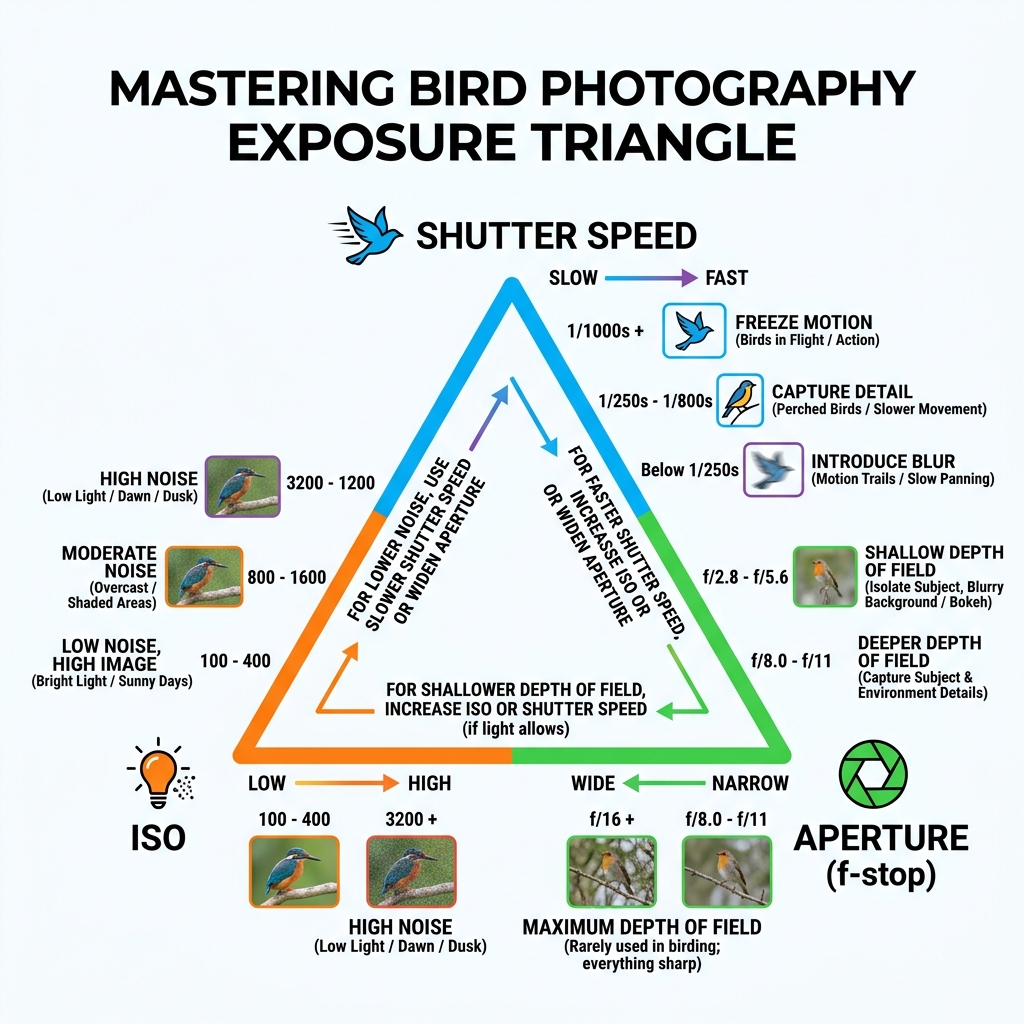
When we talk about the best camera settings for birding, we are really talking about balancing the “Exposure Triangle”: shutter speed, aperture, and ISO. In bird photography, this balance is skewed heavily toward speed. Because birds are incredibly fast and we are often using long telephoto lenses (which magnify every tiny shake of our hands), we have to prioritize shutter speed above almost everything else.
A good rule of thumb for beginners is the “reciprocal rule,” which suggests your shutter speed should be at least 1 divided by your focal length. If you are using a 500mm lens, you need at least 1/500s just to stop the blur from your own hands! However, for a bird that is actually moving, 1/500s is often the bare minimum.
Managing light is the biggest hurdle. Often, we are shooting in the “golden hour” or under a thick forest canopy where light is scarce. This is where your choice of gear and settings becomes critical. If you’re looking for inspiration on what others are achieving with various setups, checking out a Sigma Flickr Group can show you the real-world results of different lens and setting combinations.
Best Camera Settings for Birding: Shutter Speed and Motion
Shutter speed is the “make or break” setting. If your shutter is too slow, the bird will be a blurry mess, and no amount of editing can fix that. We generally categorize bird movement into four tiers:
- Perched Birds: Even a “still” bird is twitching its head. We recommend at least 1/1000s to ensure tack-sharp eyes. If the bird is truly motionless, you might drop to 1/500s, but stay alert!
- Slow Action (Walking/Swimming): For a heron wading or a duck swimming, 1/1250s to 1/1600s is a safe bet.
- Birds in Flight (BIF): This is the ultimate test. For large, slow-flapping birds like pelicans, 1/2000s might work. For most birds, we aim for 1/3200s or even 1/4000s to freeze the wingtips.
- Erratic Small Birds: For swifts, swallows, or hummingbirds, don’t be afraid to push to 1/5000s.
If you find yourself constantly coming home with “soft” images, you’re likely fighting motion blur. Understanding the nuances of avoiding-blurry-images-in-bird-photography is essential for moving from “lucky shots” to consistent keepers.
Best Camera Settings for Birding: ISO and Noise Management
In the past, photographers were terrified of high ISO settings because they caused “noise” (that grainy, crunchy look). In 2025, we have a new mantra: Sharp noise is better than clean blur. You can fix noise in post-processing, but you cannot fix a blurry bird.
Modern mirrorless cameras like the Canon R5 or Nikon Z8 can handle ISO 6400 or even 12,800 with surprising grace. When using the best camera settings for birding, we recommend using Auto ISO. This allows the camera to automatically jump to a higher ISO to maintain your fast shutter speed as the light changes.
We often set an “Auto ISO Ceiling” at 6400 or 12,800. If the sun goes behind a cloud, the camera bumps the ISO so your shutter speed stays at 1/3200s. Thanks to AI noise reduction tools like Lightroom’s AI Denoise or Topaz Photo AI, even an image shot at ISO 20,000 can look professional after a few clicks. For a deeper dive into managing these technical trade-offs, see our guide on mastering-camera-settings-for-bird-photography.
Choosing the Right Shooting Modes and Metering
Which dial setting should you use? While “Full Auto” is a recipe for disaster in birding, you don’t necessarily have to shoot in “Full Manual” either.
- Aperture Priority (Av or A): Many pros use this. You set the aperture (usually wide open, like f/5.6) and the ISO, and the camera chooses the shutter speed. The risk? If the light drops, the camera might choose a shutter speed that’s too slow.
- Shutter Priority (Tv or S): You lock in the speed (e.g., 1/2000s), and the camera adjusts the aperture. The risk? If it gets too dark, the lens can’t open wide enough, and your photo will be underexposed.
- Manual Mode + Auto ISO: This is our “secret weapon.” You set the Shutter Speed (to freeze motion) and the Aperture (to control depth of field), and let the camera’s Auto ISO handle the exposure. This gives you total control over the “look” of the photo while the camera handles the math.
Whatever mode you choose, you must understand how to read your light. Learning about adjusting-exposure-for-bird-photos will help you navigate those tricky moments when a bird flies from bright sunlight into deep shadow.
Metering Modes and Exposure Compensation
Metering is how your camera “sees” the light in the scene. For birding, we usually recommend Evaluative (Canon) or Matrix (Nikon/Sony) metering. These modes look at the whole scene and try to find a balanced exposure.
However, birds are rarely “average.” A white egret against dark water will trick your camera into overexposing, turning the bird into a featureless white blob. A black crow against a bright sky will result in a silhouette.
This is where Exposure Compensation comes in.
- For white birds: Use -1 or -2 EV to keep the feather detail.
- For dark birds: Use +1 EV to see the textures in the feathers.
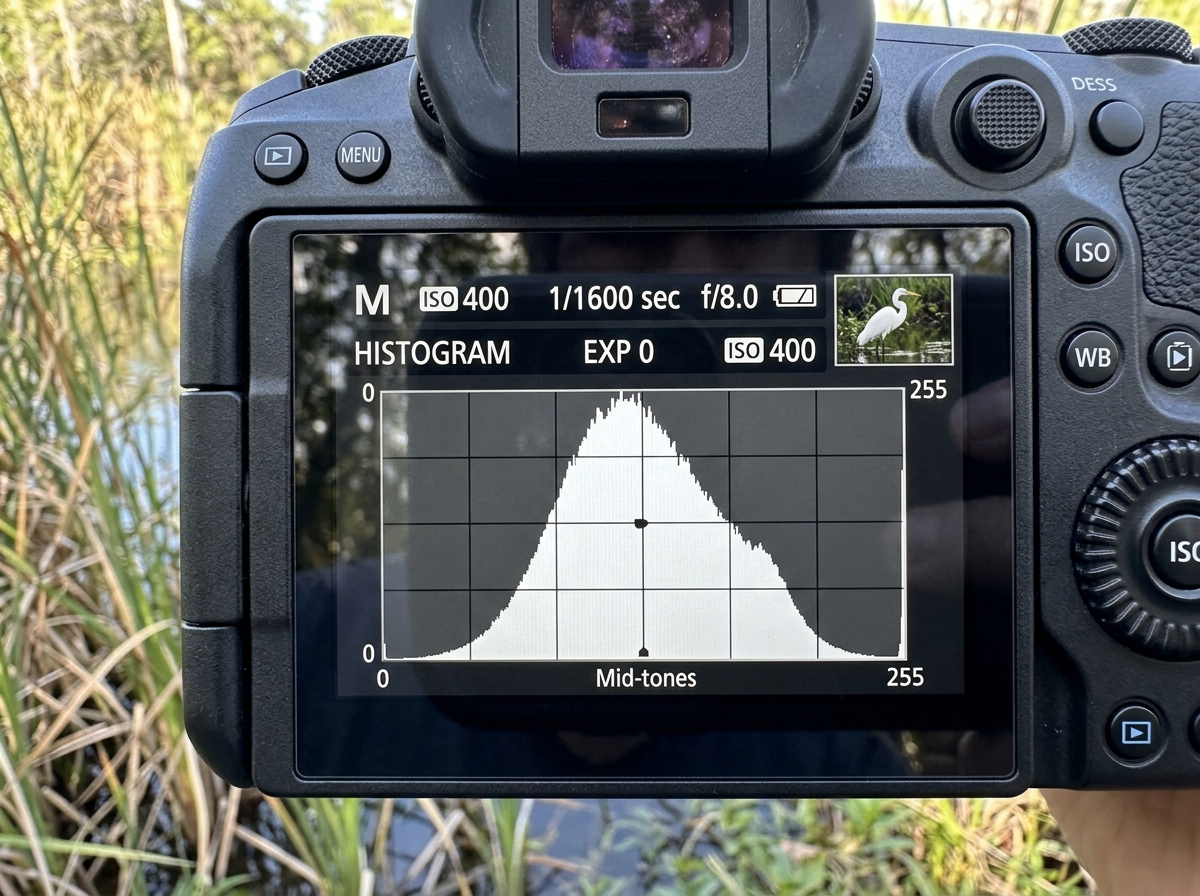
Always keep an eye on your Histogram. This little graph is your best friend. If the “mountains” on the graph are smashed against the right side, your highlights are “clipped” (lost forever). If they are smashed to the left, your shadows are “crushed.” Aim for a nice hump in the middle.
Advanced Autofocus and Drive Settings for Sharp Results
If shutter speed is the heart of bird photography, autofocus is the brain. If you are using “Single Shot” AF (where the camera focuses once and stops), you will miss almost every bird photo.
You must use Continuous AF (AI Servo on Canon, AF-C on Nikon/Sony). This tells the camera to keep refocusing as long as your finger is on the button. If a bird flies toward you, the camera will track it in real-time.
Modern mirrorless cameras have “Subject Detection” or “Animal Eye Tracking.” This is arguably the greatest advancement in wildlife photography history. The camera can actually find the bird’s eye and lock onto it, even if the bird is flapping behind branches. When you’re capturing-swift-movements-bird-in-flight-photography, these tracking modes are your most valuable asset.
Back-Button Focus and Burst Modes
Have you ever tried to take a photo, but the camera hunted for focus and missed the moment? Back-button focus solves this. By moving the focus function from the shutter button to a button on the back of the camera (usually labeled AF-ON), you separate the act of focusing from the act of taking the picture. You can hold the back button to track a moving bird, or let go to lock focus on a perched bird, all without changing settings.
Finally, set your Drive Mode to the highest possible speed. We aren’t just “spraying and praying”; we are looking for the perfect wing position.
- Nikon Z8: Up to 20 fps (or 120 fps in JPEG).
- Sony α1: Up to 30 fps.
- Canon R5: Up to 20 fps.
When a bird takes off, hold that shutter down! Out of a burst of 20 photos, only one might have the wings in the perfect “V” shape. For more on these essential setups, check out our beginners-guide-to-bird-photography-key-settings.
Post-Processing and Field Techniques for Better Bird Photos
The best camera settings for birding don’t end when you click the shutter. To get professional results, you must shoot in RAW format. RAW files capture all the data from the sensor, allowing you to recover shadows and highlights that would be lost in a JPEG. It also lets you change your White Balance after the fact—perfect for when the “Auto White Balance” gets confused by green leaves or blue water.
Even with the best settings, you’ll often deal with noise or slight softness. We recommend using specialized tools; for instance, you can get a discount on Topaz Labs software here to help clean up high-ISO images.
At Ciber Conexão, we believe that editing is half the battle. Our expert, Hugo Andrade, emphasizes that crop and composition are just as important as your initial settings. A bird that looks small in the frame can be transformed into a powerful portrait with the right crop. For a complete overview of the workflow, see mastering-bird-photography-essential-camera-settings.
Field Craft and Composition
Settings are just tools; you still need to be a good “birder.”
- Sun at your back: This ensures the bird’s eye is well-lit and has a “catchlight,” making it look alive.
- Get low: Shooting at the bird’s eye level creates a much more intimate connection than looking down on them.
- Know your subject: If you know a certain bird always poops before it takes off, you’ll be ready for the action!
- Etiquette: Never stress a bird for a photo. If they stop feeding or start looking at you nervously, you are too close.
Practice is key. If you’re in the UK, the London Wetland Centre is a fantastic place to practice your BIF (Birds in Flight) technique in a controlled environment.
Frequently Asked Questions about Best Camera Settings for Birding
What is the best shutter speed for birds in flight?
For most birds in flight, we recommend a shutter speed between 1/2000s and 1/4000s. If you are shooting a large, slow bird like a Heron, you might get away with 1/1600s. However, for smaller songbirds or raptors, 1/3200s is the “sweet spot” to ensure the wingtips are frozen and the head is tack-sharp.
Should I use Auto ISO for bird photography?
Yes! Most modern bird photographers use Manual Mode with Auto ISO. This allows you to set your shutter speed (to freeze motion) and your aperture (for depth of field), while the camera automatically adjusts the ISO to keep the exposure perfect as the bird moves between sun and shade. It’s the ultimate way to manage camera-settings-for-bird-lenses in dynamic environments.
How do I get a blurry background in bird photos?
To get that creamy, professional “bokeh,” use a wide aperture (the lowest f-number your lens allows, such as f/4 or f/5.6). Additionally, try to increase the distance between the bird and the background. The further the trees are behind the bird, the blurrier they will be. Using a long telephoto lens (400mm+) also naturally compresses the background, enhancing the blur.
Conclusion
Mastering the best camera settings for birding is a journey of trial and error, but by prioritizing shutter speed, embracing Auto ISO, and utilizing modern autofocus tracking, you’ll see your “keeper rate” skyrocket.
At Ciber Conexão, we are dedicated to helping you take your images to the next level. Beyond the camera, the way you edit your shots—specifically how you handle crop and composition—can turn a standard wildlife photo into a work of art. Our founder, Hugo Andrade, always says that the best settings get you the data, but the best editing creates the story.
Ready to improve your skills further? Explore More info about photography tips on our site to master the art of the perfect wildlife edit. Happy birding!
