
Why Getting the F-Stop for Bird Portraits Right Makes All the Difference
The f-stop for bird portraits is one of the most important settings you’ll ever dial in as a bird photographer. Get it wrong and you end up with soft feathers, a blurry tail, or a background that competes with your subject. Get it right and suddenly your photos look like they belong in a nature magazine.
Here’s the quick answer most bird photographers need:
| Scenario | Recommended F-Stop |
|---|---|
| Perched bird portrait (single subject) | f/5.6 – f/7.1 |
| General all-around bird photography | f/7.1 – f/8 |
| Multiple birds in frame | f/9 – f/11 |
| Birds in flight | f/5.6 – f/8 |
| Low light or distant subject | f/5 – f/5.6 |
The sweet spot for most telephoto lenses falls between f/5.6 and f/8. Many experienced bird photographers settle on f/7.1 for around 90% of their shots – it balances sharpness, depth of field, and background blur without constant adjustment.
Going wider than f/5.6 often softens the image and leaves parts of the bird – like the tail or wingtips – out of focus. Going narrower than f/11 introduces diffraction, which actually reduces overall sharpness.
It sounds technical, but it’s simpler than you think. This guide walks you through exactly how to choose the right f-stop for every bird portrait situation.

Similar topics to f-stop for bird portraits:
Understanding Aperture and Depth of Field in Bird Photography
To master the f-stop for bird portraits, we first need to understand what’s happening inside that expensive glass on the front of your camera. Aperture is simply the opening in your lens that allows light to hit the sensor. We measure this opening in “f-stops.”
The confusing part for many beginners is that a small f-number (like f/2.8 or f/4) means a large opening, while a large f-number (like f/11 or f/16) means a small opening.
In bird photography, aperture controls two critical elements:
- Light Gathering: A wider aperture (lower f-number) lets in more light, which is vital when we are using the ultra-fast shutter speeds required to freeze a bird’s movement.
- Depth of Field (DoF): This is the zone of “acceptable sharpness” in your image. A wide aperture creates a shallow depth of field, which is how we get that creamy, blurred background (bokeh) that makes a bird pop.
However, birds are three-dimensional subjects. If your depth of field is too shallow, you might have a tack-sharp eye but a blurry beak or tail. Finding the right balance is the secret to a professional-looking portrait. For a deeper dive into these mechanics, check out our aperture guide bird photography.
The Ideal f-stop for Bird Portraits: Finding the Sweet Spot
Every lens has a “sweet spot”—an aperture setting where it produces the sharpest possible results with the least amount of distortion or “fringing.” For the majority of telephoto lenses used in birding, this sweet spot typically falls between f/5.6 and f/8.
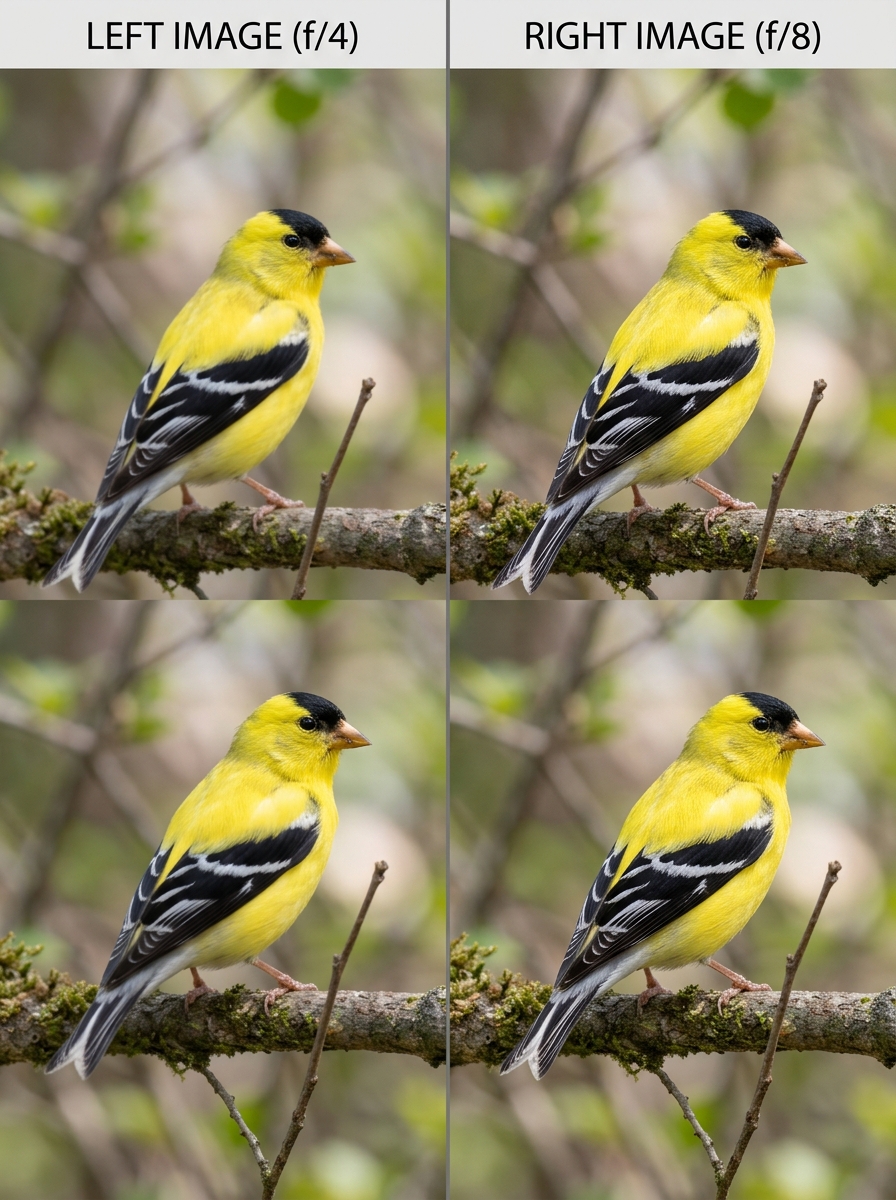
While it’s tempting to always shoot “wide open” (at the lowest f-number your lens allows) to get the most light, most lenses are actually a bit soft at their maximum aperture. By “stopping down” just a little bit—for example, moving from f/5.6 to f/7.1—you significantly increase the optical performance of your gear.
Statistics show that nearly 90% of professional bird photos are taken at f/7.1. It has earned a reputation as the “perfect all-rounder.” It provides enough depth of field to keep the entire bird sharp from beak to tail-tip, while still maintaining a beautiful, non-distracting background. If you want to learn more about why this specific range works so well, read about the ideal aperture for birds and how to use it.
Why Shooting Wide Open Can Ruin Your f-stop for Bird Portraits
We’ve all been there: you have a beautiful bird in your sights, and you want that buttery smooth background, so you dial your lens to its widest setting (like f/4 or f/5.6). While this helps in low light, it often leads to “soft” images.
The primary problem is insufficient depth of field. At close range, the difference between a bird’s eye and its wingtip might only be an inch or two, but at f/4, that distance is enough to move the wing out of the focus plane. You end up with a photo where the eye is sharp but the rest of the bird looks like a blurry mess.
Additionally, shooting wide open can highlight lens flaws like chromatic aberration (purple or green fringing around the edges of the bird). By stopping down slightly, you give yourself a “buffer” of sharpness that ensures the whole subject is crisp. For more on balancing these technical hurdles, see the best aperture and autofocus settings for birds.
Balancing f-stop for Bird Portraits with Shutter Speed and ISO
Photography is a game of trade-offs known as the Exposure Triangle. When you change your f-stop, you must adjust your shutter speed or ISO to keep the exposure balanced.
In bird photography, shutter speed is king. We generally need at least 1/2000s to freeze the twitchy movements of a songbird or the flapping wings of a raptor. If you stop down to f/8 to get more sharpness, your camera has to compensate for the lost light.
Modern mirrorless cameras are incredible at handling high ISO settings. Don’t be afraid to push your ISO to 3200 or even 6400 if it means you can maintain a sharp f-stop for bird portraits and a fast shutter speed. A noisy image can be fixed with modern software; a blurry image usually goes in the trash.
Choosing the Right F-Stop for Different Scenarios
Not every bird requires the same settings. A tiny Chickadee sitting on a branch requires a different approach than a Bald Eagle soaring overhead.
| Scenario | Recommended F-Stop | Why? |
|---|---|---|
| Perched Portrait | f/6.3 – f/7.1 | Maximizes bird sharpness while blurring the branch/leaves behind. |
| Action/Hunting | f/8 | Provides a larger “focus window” so you don’t miss the shot if the bird moves. |
| Birds in Flight | f/5.6 – f/8 | Balances the need for light with enough depth to keep wings sharp. |
| Multiple Birds | f/9 – f/11 | Ensures birds at slightly different distances are both in focus. |
Impact of Distance and Bird Size on Aperture
Distance is a huge factor that many photographers overlook. The closer you are to your subject, the “thinner” your depth of field becomes.
If you are lucky enough to be very close to a small bird for a tight portrait, you may actually need to stop down to f/8 or f/9 just to keep the whole head in focus. Conversely, if the bird is 50 feet away, the depth of field is much deeper, and you can safely shoot at f/5.6 without losing detail.
Size matters, too. A large heron has a very long body. If you shoot it from the side at f/5.6, its head might be sharp while its tail is blurred. For larger raptors and water birds, we often recommend sticking to f/8 to ensure the entire “canvas” of the bird is rendered clearly. For more tips on handling close encounters, check out our guide on up-close and personal camera settings for close-up bird shots.
Camera Modes for Controlling Aperture Effectively
Which mode should you use to control your f-stop for bird portraits? There is a healthy debate among pros, but here are the three most effective ways:
- Aperture Priority (Av or A): This is a favorite for portraits. You set the f-stop (e.g., f/7.1), and the camera automatically chooses the shutter speed. Just keep an eye on that shutter speed—if it drops too low in the shade, your photos will be blurry!
- Manual Mode with Auto ISO: This is arguably the most powerful “pro” setup. You manually set your shutter speed (to freeze motion) and your aperture (for sharpness), and let the camera’s ISO float to handle the exposure.
- Manual Mode: Best for consistent lighting conditions (like a sunny day at a lake). It gives you total control but is the hardest to master when birds are moving between sun and shadow.
Whichever mode you choose, we highly recommend using Exposure Compensation. This allows you to quickly brighten or darken your photo without changing your primary settings—essential for when a white egret flies in front of a dark forest. Learn more about these setups in mastering camera settings for bird photography.
Frequently Asked Questions about Bird Photography F-Stops
What is the sharpest f-stop for most telephoto lenses?
For most popular birding lenses (like the 150-600mm or 200-600mm zooms), the sharpest f-stop is usually f/8. While these lenses often start at f/5.6 or f/6.3, “stopping down” to f/8 reduces optical aberrations and ensures better edge-to-edge detail. We always suggest testing your specific lens on a tripod with a static object to find its unique “sweet spot.”
Should I use f/2.8 for bird portraits in low light?
If you own a “big prime” lens that opens to f/2.8, it’s a tempting tool for low light. However, at f/2.8, the depth of field is razor-thin. Unless the bird is quite far away, you risk having only the eyelashes in focus while the beak is soft. In low light, it is often better to use f/4 or f/5.6 and raise your ISO rather than risking a missed focus at f/2.8.
How do I get a blurry background while keeping the bird sharp?
The secret isn’t just the f-stop; it’s distance. To get that professional “bokeh”:
- Use a relatively wide aperture (f/5.6 to f/7.1).
- Get as close to the bird as safely possible.
- Ensure there is a large distance between the bird and the background (e.g., a bird on a branch with the forest 20 feet behind it).
- Use a long focal length (400mm or more).
Conclusion
Finding the perfect f-stop for bird portraits is a journey of practice and experimentation. While f/7.1 is a fantastic starting point for almost any situation, the “perfect” setting always depends on the light, your distance to the bird, and your creative vision.
At Ciber Conexão, we know that capturing the shot is only half the battle. Once you have that sharp RAW file, the real magic happens in the editing suite. Our expert, Hugo Andrade, specializes in helping photographers master the art of crop and composition to turn a good bird photo into a breathtaking portrait. By understanding how to balance your in-camera settings with post-processing techniques, you can truly master the art of wildlife photography.
Ready to take your images to the next level? Explore more of our photography tips and start capturing the beauty of the natural world with more confidence today!
