
Why a Basic Photography Techniques PDF Is the Fastest Way to Learn Your Camera
If you’re looking for a basic photography techniques pdf, here’s what you need to know right away:
Core topics covered in a basic photography techniques PDF:
- Exposure triangle – aperture, shutter speed, and ISO
- Composition rules – rule of thirds, leading lines, framing, symmetry
- Camera settings – metering modes, shooting modes, white balance
- Lenses and sensors – prime vs. zoom, crop vs. full-frame, RAW vs. JPEG
- Depth of field – how aperture and distance control background blur
- Light – hard, soft, natural, and ambient lighting
Cameras are complicated. Most beginners spend months making the same mistakes before a single photo finally clicks – and that frustration is completely normal.
The problem isn’t talent. It’s not having the right reference in your hands when you need it.
A good photography techniques guide puts everything in one place – exposure, composition, gear, and light. You stop guessing and start shooting with intention.
This guide covers all the fundamentals you’d find in a downloadable PDF, written in plain language so you can apply it today, whether you’re shooting portraits in your backyard or landscapes at sunset.
Mastering the Exposure Triangle: Aperture, Shutter Speed, and ISO
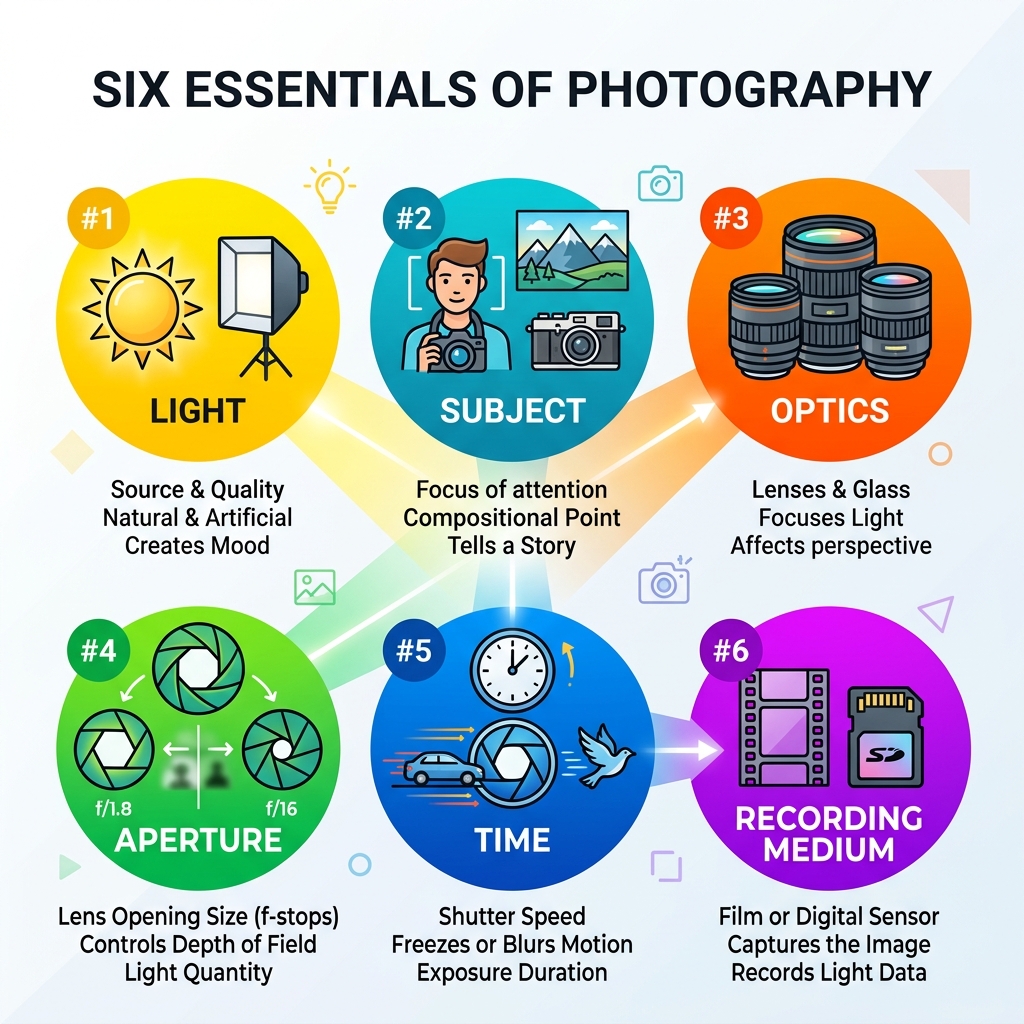
At the heart of every great photo is a balanced exposure. Think of exposure as a three-legged stool; if one leg is too short, the whole thing topples over. These “legs” are Aperture, Shutter Speed, and ISO. Together, they form the Exposure Triangle.
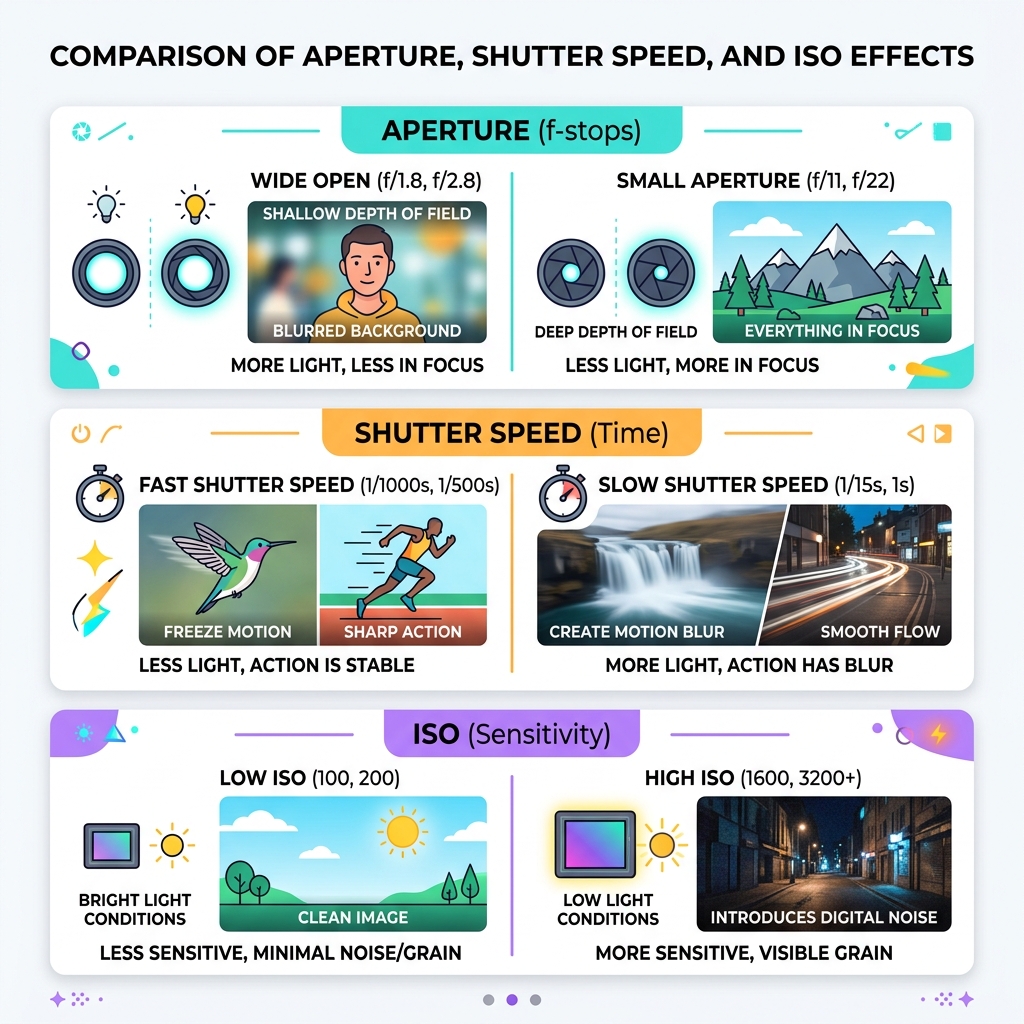
Aperture is the opening inside your lens. We like to compare it to the pupil of your eye. In the dark, your pupil gets larger to let in more light; in bright sun, it shrinks. In photography, we measure this in “f-stops.” A small number like f/1.8 means a wide opening (lots of light), while a large number like f/22 means a tiny opening (very little light).
Shutter Speed is the “time” element. It’s how long the camera’s sensor is exposed to light. A fast shutter speed, like 1/1000th of a second, freezes a hummingbird’s wings. A slow shutter speed, like 2 seconds, turns a waterfall into silky mist.
ISO is your sensor’s sensitivity to light. A low ISO (100 or 200) is best for bright days and produces the cleanest images. As it gets darker, you might need to raise your ISO to 1600 or 3200, but be careful—higher ISOs introduce “digital noise,” which looks like grain or sand over your photo.
Choosing the Right Settings for Every Scene
When you’re out in the field, you don’t always have time to fiddle with every dial. This is where shooting modes come in. While we encourage everyone to eventually master Manual Mode, many pros use semi-automatic modes to stay fast.
- Aperture Priority (A or Av): You choose the aperture (to control background blur), and the camera handles the shutter speed.
- Shutter Priority (S or Tv): You choose the shutter speed (to freeze or blur motion), and the camera handles the aperture.
- Manual Mode (M): You have total control over all three elements.
If you are just starting out, check out this Beginners Guide to Bird Photography: Key Settings to see how these settings apply to fast-moving subjects. One pro tip we always share: use Exposure Compensation. If your photo looks too dark even in an auto mode, you can “dial in” a stop of light to tell the camera to brighten things up.
| Feature | Low Setting (e.g., f/1.8, 1/15s, ISO 100) | High Setting (e.g., f/22, 1/4000s, ISO 6400) |
|---|---|---|
| Aperture | More light, blurry background | Less light, sharp background |
| Shutter Speed | More light, motion blur | Less light, frozen motion |
| ISO | Less sensitive, clean image | More sensitive, noisy/grainy image |
Essential Composition Rules for Stunning Photos
You can have the most expensive camera in the world, but if your composition is messy, the photo won’t resonate. Composition is simply how you arrange the elements within your frame.
The most famous rule is the Rule of Thirds. Imagine a tic-tac-toe grid over your image. Instead of putting your subject dead-center (which can feel static and boring), try placing them on one of the four intersections. This creates more “breathing room” and visual interest.
Beyond the grid, we look for Visual Weight. This is the idea that certain elements—like bright colors, sharp faces, or large objects—draw the eye more than others. You want to balance these elements so the photo doesn’t feel “heavy” on one side.
Other powerful tools include:
- Leading Lines: Using roads, fences, or shorelines to lead the viewer’s eye toward the subject.
- Framing: Using overhanging branches or windows to create a “frame within a frame.”
- Symmetry: Finding perfect reflections or architectural balance for a sense of calm.
For those interested in nature, Getting Started with Bird Photography: A Guide for Beginners offers great insights on how to compose shots when your subject won’t sit still!
Enhancing Visual Appeal Through Perspective
Perspective is the “secret sauce” of photography. Most people take photos from eye level. By simply crouching down or climbing higher, you change the Angle of View and make a common scene look extraordinary.
Focal Length also plays a huge role here. A wide-angle lens (like 24mm) makes a room look huge but can distort faces if you get too close. A telephoto lens (like 200mm) uses “lens compression” to bring the background closer to the subject, which is incredibly flattering for portraits. This is a key reason why many photographers love the “Nifty Fifty” (50mm lens)—it sees the world very similarly to the human eye. To learn more about how these optics interact with wildlife, see this guide on Captivating Bird Photography: A Guide to Camera Settings.
Understanding Your Gear: Lenses, Sensors, and File Formats
Lenses are the “optics” of your camera, and they come in two main flavors: Prime and Zoom.
- Prime Lenses: These have a fixed focal length (you can’t zoom in or out). Because they do one thing, they usually do it better, offering sharper images and wider apertures (like f/1.8).
- Zoom Lenses: These offer versatility, allowing you to go from wide-angle to telephoto with a twist of the wrist.
Then there is the sensor. Most beginner cameras use a Crop Sensor (APS-C), while professional models use a Full-Frame Sensor. Understanding how these components interact with light is fundamental to the craft; for more detail, see this Scientific research on the physics of light and optics. A crop sensor essentially “zooms in” on your lens. For example, a 50mm lens on a crop sensor camera actually looks like a 75mm or 80mm lens.
When it comes to saving your work, you’ll see RAW vs. JPEG. A JPEG is a finished product—the camera “cooks” the file for you. A RAW file is the “raw ingredients.” It looks flat and dull at first, but it contains massive amounts of data, allowing you to recover shadows and highlights in editing that would be lost in a JPEG. If you’re curious about the hardware side, you might want to read about Mirrorless Cameras for Beginners.
Maximizing Image Quality with Professional Tools
Beyond the camera and lens, a few accessories can transform your work. A Polarizing Filter is like sunglasses for your lens; it removes glare from water and leaves, making colors pop in a way that is impossible to recreate in Photoshop.
We also highly recommend mastering Back Button Focus. Usually, your camera focuses when you press the shutter halfway. By moving the focus function to a button on the back of the camera, you separate “focusing” from “taking the picture.” This is a game-changer for moving subjects. For more gear tips, check out Beginner-Friendly Camera Accessories.
Advanced Control with a Basic Photography Techniques PDF
Once you understand the basics, a basic photography techniques pdf serves as a bridge to more advanced concepts like Metering Modes. Your camera has a built-in light meter that tries to guess how bright a scene should be.
- Evaluative/Matrix Metering: Looks at the whole scene (good for general use).
- Spot Metering: Only measures light from a tiny point (perfect for a backlit subject).
To truly know if your exposure is correct, don’t trust the screen on the back of your camera—it can lie to you in bright sunlight. Instead, learn to read the Histogram. A histogram is a little graph showing the distribution of light. If the graph is all the way to the left, your photo is underexposed (too dark). If it’s touching the right edge, your highlights are “blown out” and lost forever.
Check out Mastering Camera Settings for Bird Photography for more on how to use these tools in high-pressure situations.
Using a Basic Photography Techniques PDF to Master Manual Mode
Manual mode is where the magic happens. Once you stop letting the camera make decisions, you can try creative techniques like:
- Light Painting: Using a long exposure (10-30 seconds) in the dark and “drawing” with a flashlight.
- Panning: Using a slower shutter speed (like 1/30th) and moving your camera at the same speed as a passing car to blur the background while keeping the car sharp.
- Long Exposure: Turning ocean waves into a smooth, misty floor.
For those focusing on specific niches, knowing The Best Aperture and Autofocus Settings for Birds can help you transition from “getting a shot” to “creating art.”
Why Every Beginner Needs a Basic Photography Techniques PDF
The biggest hurdle for beginners is the “forgotten setting.” You go out for a sunset shoot, but you forget to check your ISO from the night before, and all your beautiful photos come out grainy. A basic photography techniques pdf acts as a field reference and a pre-shoot checklist. It helps you troubleshoot issues on the fly, like why your images aren’t sharp or why the colors look “off” (usually a White Balance issue).
If you are struggling with blurry shots, we’ve put together a specific guide on Avoiding Blurry Images in Bird Photography that applies to almost any type of action photography.
Frequently Asked Questions about Photography Basics
What are the three core elements of exposure?
The three core elements are Aperture (the size of the lens opening), Shutter Speed (how long the sensor is exposed to light), and ISO (the sensor’s sensitivity). They work together to determine the total amount of light in your image.
How does aperture affect depth of field?
Aperture controls how much of your image is in focus. A wide aperture (small f-number like f/2.8) creates a “shallow” depth of field, where the subject is sharp and the background is blurry. A narrow aperture (large f-number like f/16) creates a “deep” depth of field, keeping everything from the foreground to the distant mountains sharp.
When should I use a fast shutter speed versus a slow one?
Use a fast shutter speed (1/500s or faster) to freeze motion, such as sports or wildlife. Use a slow shutter speed (1/30s or slower) to intentionally blur motion, like creating “cotton candy” water in a stream or capturing light trails from cars at night.
Conclusion
Photography is a journey of both technical skill and creative vision. At Ciber Conexão, we believe that mastering the basics—the exposure triangle, composition, and your gear—is the foundation that allows your unique style to shine through. Whether you are following the advice of Hugo Andrade on how to crop for maximum impact or learning the physics of light, every step you take brings you closer to the images you’ve always dreamed of capturing.
The best camera is the one you have with you, and the best technique is the one you’ve practiced until it becomes second nature. For more expert advice and deep dives into specific styles, be sure to explore our Photography Tips Category.
