
Why Basic Photography Techniques Are the Foundation of Great Photos
Basic photography techniques are the core skills every photographer needs to take sharper, more intentional, and better-composed images — no expensive gear required.
Here’s a quick overview of the most important ones:
| Technique | What It Does |
|---|---|
| Exposure Triangle | Controls brightness using aperture, shutter speed, and ISO |
| Rule of Thirds | Places subjects off-center for more dynamic compositions |
| Leading Lines | Guides the viewer’s eye through the frame |
| Golden Hour Lighting | Uses soft, warm natural light for flattering results |
| Autofocus Modes | Keeps subjects sharp whether still or moving |
| RAW Format | Captures more detail for better editing flexibility |
| Tripod Use | Eliminates camera shake for sharp, clean shots |
Most beginners assume great photos come from expensive cameras. They don’t.
As Henri Cartier-Bresson said, “Your first 10,000 photographs are your worst.” The good news? Every one of those photos is a lesson.
The gap between a blurry, flat snapshot and a photo that stops someone mid-scroll almost always comes down to a handful of fundamentals — things like understanding how light works, knowing where to place your subject, and making intentional choices with your camera settings instead of leaving everything on Auto.
This guide breaks down each of those fundamentals in plain language, so you can start applying them on your very next shoot.
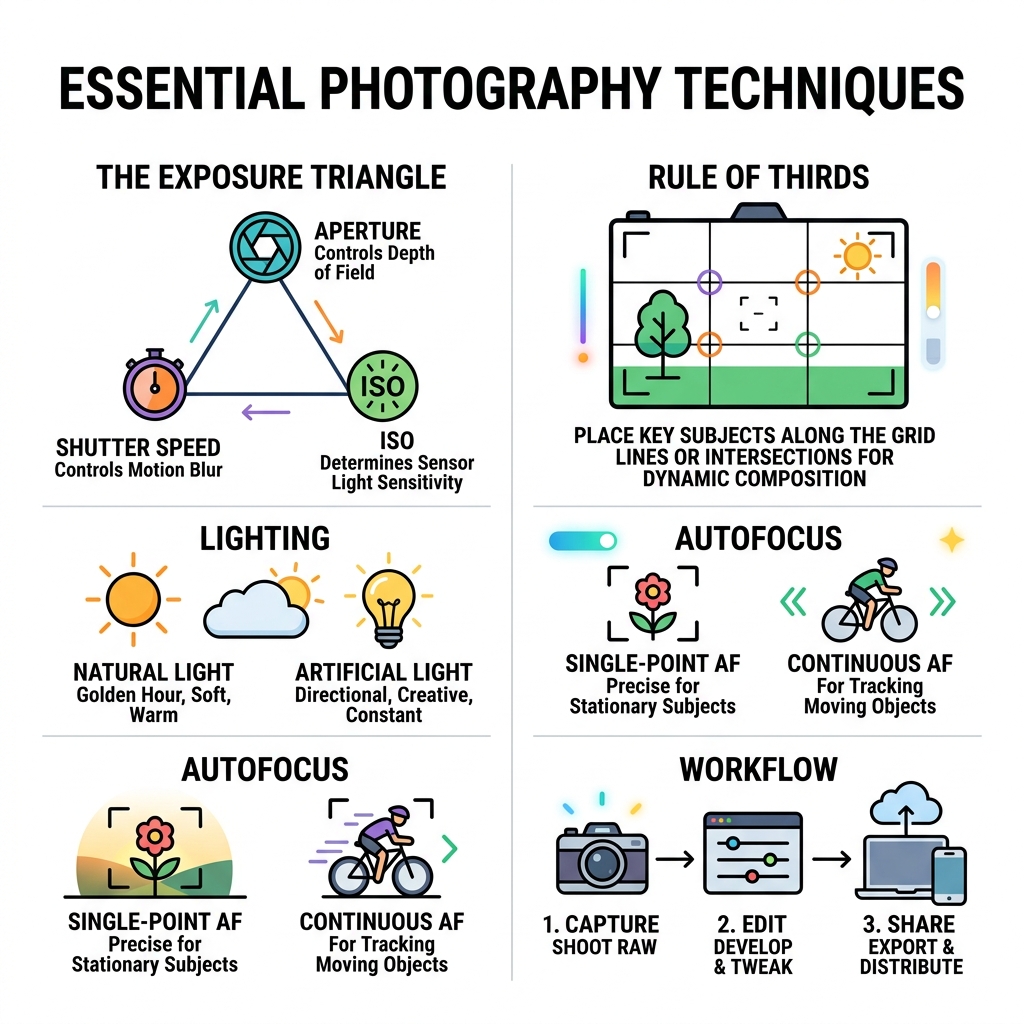
Mastering the Exposure Triangle: Aperture, Shutter Speed, and ISO
When we first pick up a camera, the “Auto” mode feels like a safety net. But to truly look like a pro, we need to understand the mechanics of light. The exposure triangle is the relationship between three elements: aperture, shutter speed, and ISO. Think of it like a three-legged stool; if you move one leg, you have to adjust the others to keep the stool level.
Aperture controls the size of the lens opening, shutter speed controls how long the “window” stays open, and ISO determines how sensitive the sensor is to the light hitting it. Balancing these is the secret to getting a perfectly exposed image—neither too bright (overexposed) nor too dark (underexposed).

Understanding Depth of Field
Aperture is measured in “f-stops.” This can be a bit counterintuitive for beginners: a small number (like f/1.8) means a wide opening, while a large number (like f/22) means a tiny opening.
The most exciting part of mastering aperture is controlling “depth of field.” When we use a wide aperture (low f-stop), we create a shallow depth of field. This is how pros get that creamy, blurred background (often called bokeh) that makes a subject pop. If you are interested in wildlife, we have a specific aperture guide for bird photography that explains how to isolate fast-moving subjects from distracting branches.
Conversely, for landscapes, we usually want a small aperture (high f-stop) to ensure everything from the pebbles at our feet to the distant mountains stays sharp.
Controlling Motion and Noise
Shutter speed is our tool for time travel. A fast shutter speed (like 1/1000s) freezes a bird in flight or a splashing wave. A slow shutter speed (like 1/2s) creates motion blur, which is beautiful for making waterfalls look like silk. However, slow speeds require a very steady hand or a tripod to avoid “camera shake.” If you find your images aren’t as crisp as you’d like, check out our tips on avoiding blurry images in bird photography.
Finally, there is ISO. In bright sunlight, we keep ISO low (100 or 200). In dark rooms, we raise it to make the sensor more sensitive. The trade-off? High ISO introduces “noise” or grain, which can make photos look muddy. Modern cameras are getting better at handling high ISO, but as a rule of thumb, we always try to keep it as low as possible for the cleanest image.
| Scenario | Aperture | Shutter Speed | ISO |
|---|---|---|---|
| Portrait | f/1.8 – f/2.8 | 1/200s | 100 |
| Landscape | f/8 – f/11 | 1/125s (on tripod) | 100 |
| Action/Sports | f/4 | 1/1000s+ | 400 – 800 |
| Night Sky | f/2.8 | 20s | 3200 |
Essential Basic Photography Techniques for Composition
If exposure is the “science” of photography, composition is the “art.” You can have a perfectly exposed photo of a trash can, but it’s still just a photo of a trash can. Composition is about arranging elements within the frame to tell a story.
One of the first things we teach beginners is to look at the edges of the frame. It’s a classic mistake to focus so hard on the subject that we don’t notice a tree “growing” out of someone’s head or a distracting bright orange cone in the corner. Before pressing the shutter, do a quick “border patrol.”
Mastering the Rule of Thirds and Basic Photography Techniques
The Rule of Thirds is perhaps the most famous of all basic photography techniques. Imagine your frame is divided into a 3×3 grid (most cameras have a setting to show this on the screen). Instead of putting your subject dead-center—which can feel static and boring—place them along the lines or at the four intersection points.
This creates balance and gives the subject “room to breathe.” If you’re shooting a person looking to the left, place them on the right-side grid line so they are looking into the empty space of the frame. This simple shift creates a sense of movement and curiosity. When deciding how to orientation your camera, you might find our vertical or horizontal framing tips for bird photography helpful for understanding which layout fits your subject best.
Guiding the Viewer’s Eye
We can guide our viewers through a photo using “leading lines.” These are literal or implied lines—like a road, a fence, or even a row of trees—that point toward the main subject.
Symmetry and patterns also provide powerful visual hooks. A perfectly symmetrical reflection in a lake feels peaceful and “pro.” However, don’t be afraid to break the rules. Sometimes, getting low to the ground or shooting from a high balcony provides a perspective the average person never sees. We love exploring angles and perspectives in bird photography because it transforms a standard nature shot into a piece of art.
Optimizing Camera Settings and Lighting
Even with great composition, poor lighting can ruin a shot. Photography is, quite literally, “drawing with light.” Understanding how your camera interprets that light is key to consistent results.
One of the biggest hurdles is the camera’s “brain.” Most cameras try to make every scene look like 18% gray. This is why photos of bright white snow often look gray and dull. By using exposure compensation (the +/- button), we can tell the camera, “Hey, this is supposed to be bright, let in more light!”
Using Basic Photography Techniques to Control Natural Light
The “Golden Hour”—the hour just after sunrise and just before sunset—is a photographer’s best friend. The light is soft, warm, and creates long, flattering shadows. Avoid shooting at high noon if possible; the overhead sun creates harsh “raccoon eyes” and blown-out highlights.
If you must shoot in the middle of the day, look for “open shade” (like under a porch or a large tree) to get that even, soft light on your subject’s face. For those just starting out, our beginners guide to bird photography key settings covers how to handle tricky natural lighting in the wild.
Essential Gear and Accessories
While gear isn’t everything, a few basics go a long way.
- A Tripod: Essential for landscapes and low-light shots. It forces you to slow down and think about your composition.
- Lens Cleaning Kit: A fingerprint on your lens will make even a $5,000 camera produce blurry images. Clean your glass!
- Extra Batteries: Nothing kills a “pro” vibe faster than a dead camera ten minutes into a sunset.
Mastering these physical tools is just as important as the software. For a deeper dive into the hardware side, check out mastering bird photography essential camera settings and our guide to camera settings for captivating bird photography.
Post-Processing and Workflow Management
A “pro” look rarely ends at the camera. In the days of film, photographers spent hours in the darkroom. Today, our darkroom is software like Adobe Lightroom or Photoshop.
The first rule of post-processing: Shoot in RAW. Unlike JPEGs, which are compressed and “baked” by the camera, RAW files contain all the data the sensor captured. This allows us to recover details in shadows or fix a “white balance” mistake that made everyone look like they had a bad tan.
Organizing and Protecting Your Work
As you start taking more photos, organization becomes vital. We recommend the 3-2-1 backup rule:
- 3 copies of your data.
- 2 different media types (e.g., your computer and an external hard drive).
- 1 copy off-site (cloud storage).
Don’t let your memories disappear because of a spilled coffee or a hard drive failure. Use descriptive file names and metadata tags so you can actually find that one great shot from three years ago. If you’re overwhelmed by where to start, our guide on getting started with bird photography for beginners includes workflow tips that apply to all genres.
Developing a Selective Eye
One of the biggest differences between a beginner and a pro is how many photos they don’t show. We might take 500 photos in a day but only share five. Being selective improves the perceived quality of your work.
Go back and review your old photos. You’ll likely find “weak points”—maybe you always tilt your horizons or over-saturate the blues. Identifying these patterns is how you grow. For those focusing on specific niches, learning the best aperture and autofocus settings for birds can help you narrow down your “keepers” more effectively.
Frequently Asked Questions about Basic Photography Techniques
How do I stop my photos from being blurry?
Blur usually comes from three things: missed focus, camera shake, or subject movement. To fix it, ensure your shutter speed is fast enough (at least 1/focal length), use a tripod, or switch to continuous autofocus (AF-C) to track moving subjects. Also, make sure your lens is clean!
Should I always shoot in Manual mode?
Not necessarily. Many pros use Aperture Priority (A or Av) because it allows them to control the depth of field while the camera handles the shutter speed. Manual is great when the lighting is consistent and you want total control, but don’t feel like a “fake” for using semi-auto modes.
What is the best lens for a beginner?
Most cameras come with a “kit lens” (usually an 18-55mm). It’s a great tool to learn with. However, if you want that “pro” look, we highly recommend a “Nifty Fifty”—a 50mm f/1.8 prime lens. It’s affordable, great in low light, and produces beautiful background blur.
Conclusion
At Ciber Conexão, we believe that everyone has the potential to capture world-class images. You don’t need the latest flagship camera to stand out; you need a solid grasp of the basic photography techniques we’ve discussed today.
Our expert, Hugo Andrade, always emphasizes that the most important part of photography happens behind the viewfinder, not inside the circuit board. By mastering the exposure triangle, being intentional with your composition, and learning the basics of post-processing—especially how to crop for maximum impact—you’ll see your work transform.
The most important tip? Practice. Don’t just read about aperture—go outside and shoot a flower at f/1.8 and then at f/11 to see the difference for yourself. Make mistakes, review them, and most importantly, have fun.
For more deep dives into specific skills, check out our more photography tips and editing guides. Happy shooting!
