
Mastering the Fundamentals of Visual Balance
In bird photography, we are often working with long telephoto lenses that compress the scene. This makes every compositional choice feel magnified. To create a photo that feels balanced rather than cluttered, we must master the core principles of visual arrangement.
The most famous of these is the rule of thirds. Imagine your frame is divided by two horizontal and two vertical lines, creating a grid. The points where these lines intersect are called “power points.” By placing the bird—or more specifically, the bird’s eye—on one of these intersections, you create a more dynamic and engaging image than if you simply centered the subject.
However, we don’t always have to stick to the grid. Some of the most harmonious images in nature follow the golden ratio (approximately 1:1.618). This mathematical proportion appears everywhere, from the spiral of a shell to the arrangement of feathers. When we compose the perfect bird photo, we are essentially trying to replicate this natural harmony.
Another vital concept is the rule of space. If a bird is looking or flying toward the right, we should place the bird on the left side of the frame. This gives the bird “room to breathe” and space to move into. Without this negative space, the bird looks like it is about to crash into the edge of the photo, creating a sense of “visual claustrophobia.” For a deeper dive into these concepts, check out the ultimate guide to better photo composition.
Applying the Rule of Thirds: Essential Composition Tips for Bird Photos
When applying composition tips bird photos enthusiasts often ask: “Where exactly does the bird go?”
- Off-Center Placement: Avoid the “bullseye” effect. Placing the bird slightly to the side makes the viewer’s eye travel across the frame, which is more satisfying.
- Eye Alignment: The eye is the emotional anchor of the photo. Aligning the eye with a top-third power point ensures the viewer connects with the subject immediately.
- Subject Gaze: If the bird is looking directly at the camera (common with owls), a centered composition can actually work to emphasize symmetry. But for profile shots, always leave more space in the direction of the gaze.
- Dynamic Tension: Using the rule of thirds creates a sense of “unbalanced balance” that feels more like a moment captured in time rather than a static museum display.
Utilizing Negative Space for Breathing Room
We like to use the “Mozart analogy” when discussing negative space: music isn’t just the notes; it’s the silence between them. In photography, negative space is the “silence” that allows the “note” (your bird) to sing.
Negative space defines the boundaries of the positive space. It helps isolate the subject and removes distractions. If you have a colorful bird like a Painted Bunting, a large area of out-of-focus green leaves around it makes the bird’s colors pop. We should always ensure the subject’s direction dictates where that space goes. A bird flying into a vast, empty sky creates a sense of freedom, while a bird positioned at the very edge of the frame looking out feels like it’s leaving the story—a technique sometimes used to convey a sense of “goodbye” or “saudade.”
Advanced Composition Tips for Bird Photos in Action
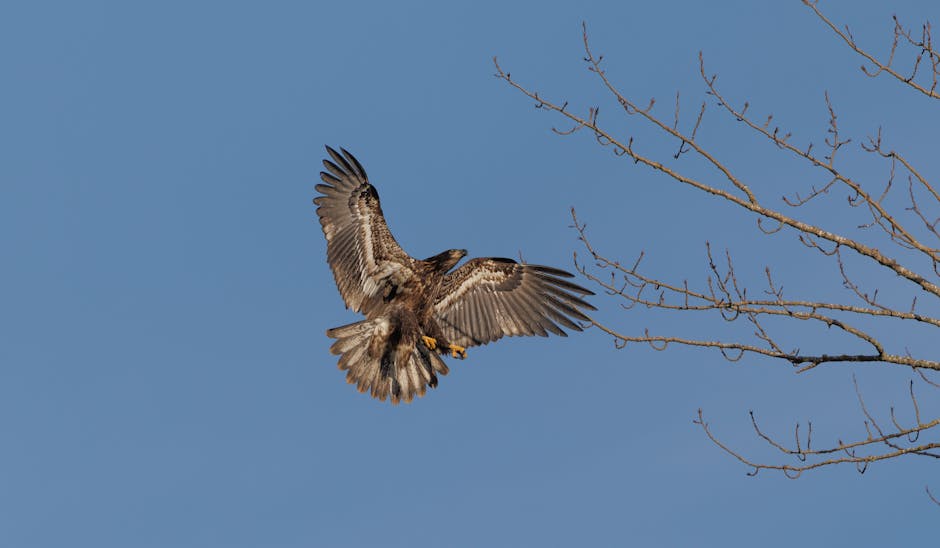
Capturing a bird perched on a branch is one thing; capturing it in motion is a completely different challenge. When birds take flight, our compositional needs change instantly. We need to account for wing spans, speed, and the direction of travel.
For birds in flight (BIF), the most desirable wing positions are usually at the full upstroke or full downstroke. There is also a specific “TIE fighter” posture (named after the Star Wars ships) during the upstroke where the wings are bent, which can look quite graphic and powerful. To compose the perfect bird photo in motion, we recommend using high frame rates (at least 10–20 frames per second) and fast shutter speeds (1/1600s to 1/3200s).
Capturing Takeoffs and Landings
Anticipation is the secret to great action shots. Many birds give “behavioral cues” before they move. For example, many large birds will defecate right before taking off to lighten their load. If you see this happen, get ready to fire the shutter!
During landings, birds use their wings as flaps to slow down, often creating spectacular, fan-like shapes. We should aim to keep the entire wingspan within the frame. A common mistake is “clipping” the wingtips. We find it’s better to shoot slightly wider and crop later in post-processing than to lose a primary feather to the edge of the sensor.
Composing Flocks and Multiple Birds
When photographing groups, we follow the odd-number principle. Groups of three, five, or seven birds tend to look more balanced and “natural” than even numbers.
When dealing with a chaotic flock, look for graphic patterns. Is there a leading edge of the flock that creates a diagonal line? Try to ensure there is “separation” between the birds so they don’t look like a single, multi-headed blob. If they do overlap, ensure it’s a “clean” overlap that adds depth rather than confusion. Establishing a compositional hierarchy—where one bird is clearly the “star” (perhaps by being sharper or more isolated)—helps the viewer’s eye find a place to rest.
Creating Depth with Backgrounds and Environmental Storytelling
One of the biggest differences between an amateur and a pro is how much time they spend looking at the background instead of the bird. A beautiful bird in front of a messy, “twiggy” background is a wasted opportunity.
| Feature | Tight Portrait | Environmental Birdscape |
|---|---|---|
| Focus | Details of feathers and eyes | Relationship between bird and habitat |
| Lens Choice | 500mm – 800mm | 70mm – 400mm |
| Story | “This is what the bird looks like” | “This is how the bird lives” |
| Background | Creamy bokeh (blurred) | Identifiable elements (trees, water) |
To achieve that creamy background separation (bokeh), we should use a wide aperture (like f/4 or f/5.6) and try to put as much distance as possible between the bird and the background. If you’re looking for more specific advice on composing bird photos with urban backgrounds, man-made structures can provide excellent leading lines.
Beyond the Portrait: Environmental Composition Tips for Bird Photos
While full-frame portraits are popular, they can sometimes be “compositional dead-ends.” To truly go beyond the portrait, we need to embrace the “birdscape.”
An environmental portrait includes enough of the habitat to tell a story. If we’re photographing a Pileated Woodpecker, including the decaying tree, the fungus, and the wood chips flying through the air tells an ecological story about forest health. Use leading lines—like a curved shoreline or a diagonal branch—to guide the viewer’s eye toward the bird. Foreground anchors, like an out-of-focus flower or leaf near the lens, can also add a sense of “peeking in” on the bird’s private world.
Managing Cluttered Backgrounds
If you find yourself in a “busy” environment, like a thick forest, don’t panic. You can manage the clutter by:
- Changing your position: Even moving six inches to the left can hide a distracting branch behind the bird’s body.
- Getting low: Shooting from the bird’s eye level often puts the distracting ground further away from the subject, creating better blur.
- Color Contrast: Look for a background color that contrasts with the bird. A yellow bird against a dark green shadow will always stand out, even if the background isn’t perfectly smooth.
Technical Precision: Eye Focus, Lighting, and Angles
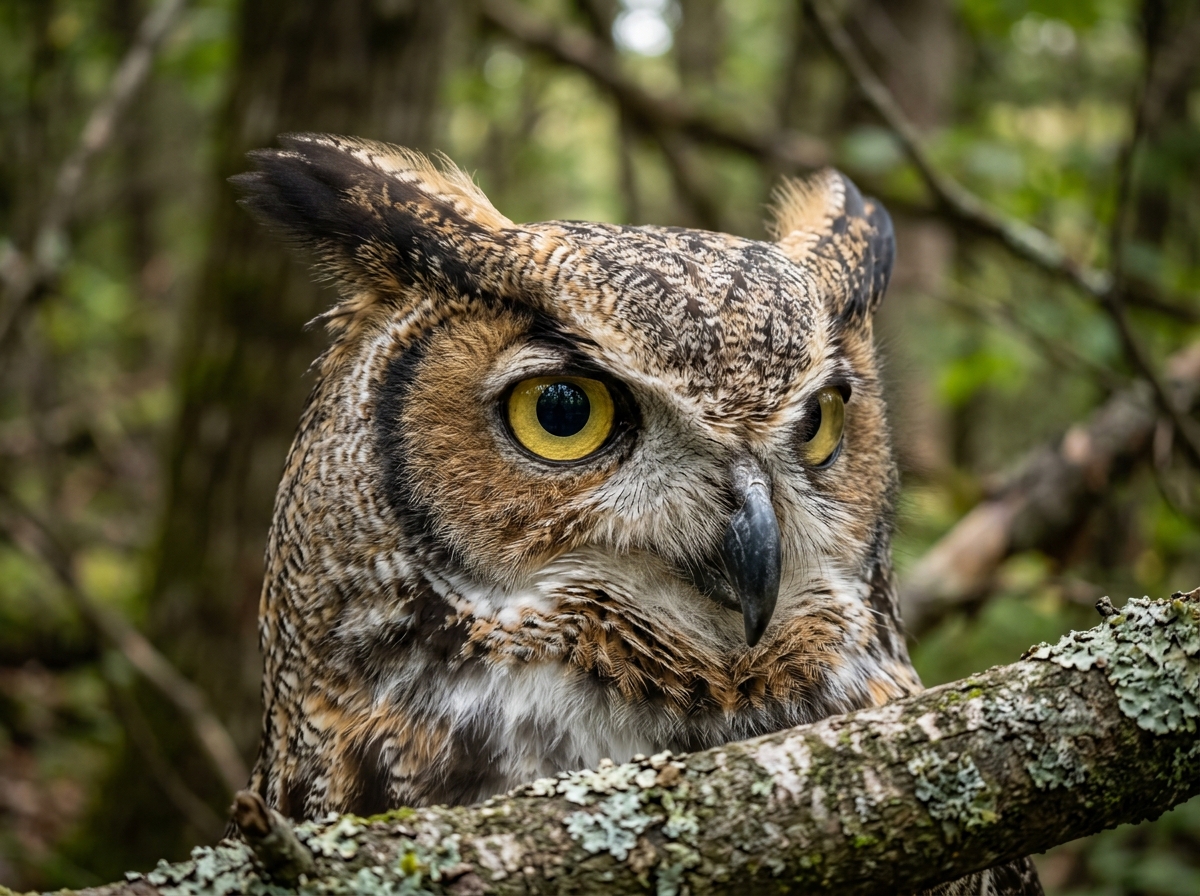
Technical errors can ruin even the best composition. The most critical rule in bird photography is this: The eye must be sharp. If the eye is blurry, the entire photo is usually a “delete.”
We always look for catchlights—the tiny reflection of the sun or sky in the bird’s eye. This “spark” makes the bird look alive. Without it, the eye looks dull and “dead.”
Lighting plays a massive role in how we perceive the bird’s form:
- Side Light: Reveals texture in the feathers.
- Backlighting/Rim Light: Creates a “halo” effect around the bird, which is stunning for subjects with fluffy feathers or “down.”
- Front Light: Great for showing off vibrant colors but can sometimes look “flat.”
We should also be aware of heat distortion. On hot days, the air density changes can make a distant bird look “wavy” or soft, even with perfect focus. The best way to avoid this is to shoot early in the morning when the air is stable. Finally, watch out for tangents—unwanted intersections where a branch seems to grow out of a bird’s head or a wingtip just barely touches the edge of the frame. For more on this, read about exploring angles and perspectives in bird photography.
Refining the Shot: Post-Processing and Cropping
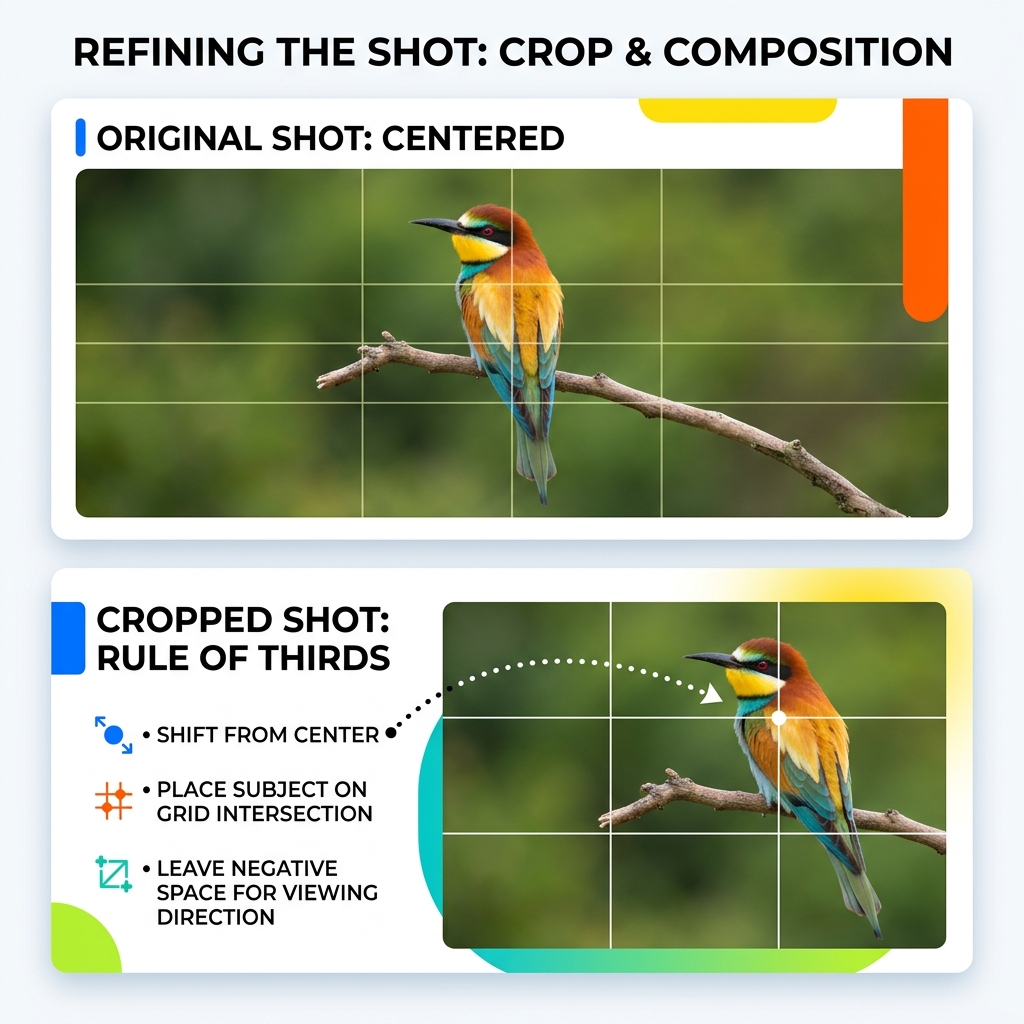
Even the best photographers crop their images. Sometimes the bird didn’t land exactly where you wanted, or you had to shoot wide to ensure you didn’t clip a wing.
When editing, we always recommend shooting in RAW format. This preserves the most data, allowing us to recover details in the shadows of a bird’s wing or the highlights of a white egret. When it comes to color, we prefer increasing vibrance over saturation. Vibrance is “smarter”—it boosts the less-saturated colors without making the already-bright colors look “neon” or fake.
Ethics matter in editing, too. While we can remove a tiny distracting “sensor dust” spot, we should avoid “cloning out” major branches or adding elements that weren’t there. The goal is an “honest depiction” of nature.
Choosing between vertical or horizontal framing depends on the bird’s shape and action. A tall heron usually calls for a vertical (portrait) crop, while a duck swimming across a pond fits a horizontal (landscape) crop. For professional results, we suggest following these expert crop and composition editing tips and checking out these vertical or horizontal framing tips for bird photography.
Frequently Asked Questions about Bird Composition
How do I avoid “centering” my bird photos?
The easiest way is to turn on the “grid” overlay in your viewfinder or on your LCD screen. Practice placing the bird’s head on one of the vertical lines. If you’ve already taken the shot, use the “Crop” tool in your editing software to reposition the bird according to the rule of thirds.
What is the best way to handle birds on long branches?
A long branch can be a great “leading line.” Try to position yourself so the branch creates a diagonal across the frame. This adds a sense of movement and directs the viewer’s eye straight to the bird. Be careful not to “cut off” the branch too abruptly at the edge of the frame; let it lead the eye in or out.
When should I break the rule of thirds for creative effect?
Rules are made to be broken! A centered composition is powerful for birds looking directly at you (like owls or hawks) because it emphasizes symmetry and intensity. You might also break the rule if the bird is part of a larger, repeating pattern in a flock, where the overall “texture” of the group is more important than any single individual.
Conclusion
Mastering composition tips bird photos is a journey of artistic evolution. It starts with learning the rules, like the rule of thirds and eye-level shooting, and ends with developing the intuition to know when to break them.
At Ciber Conexão, we believe that the best camera is the one you know how to use creatively. Whether you are using a high-end DSLR or a mobile phone, applying these principles will help you move past simple “documentation” and toward true wildlife art. The goal isn’t just to show people what a bird looks like—it’s to show them how that bird lives.
Practice is the only way to get faster at framing these fleeting moments. So, grab your gear, head to the nearest park, and start looking for those power points! For more help refining your final images, check out our professional photo editing category for more guides. Happy shooting!
