
Why Your Wildlife Photos Are Blurry (And What Shutter Speed Has to Do With It)
Shutter speed for wildlife photography is the single most important camera setting for getting sharp images of moving animals. Here’s a quick reference before we dive in:
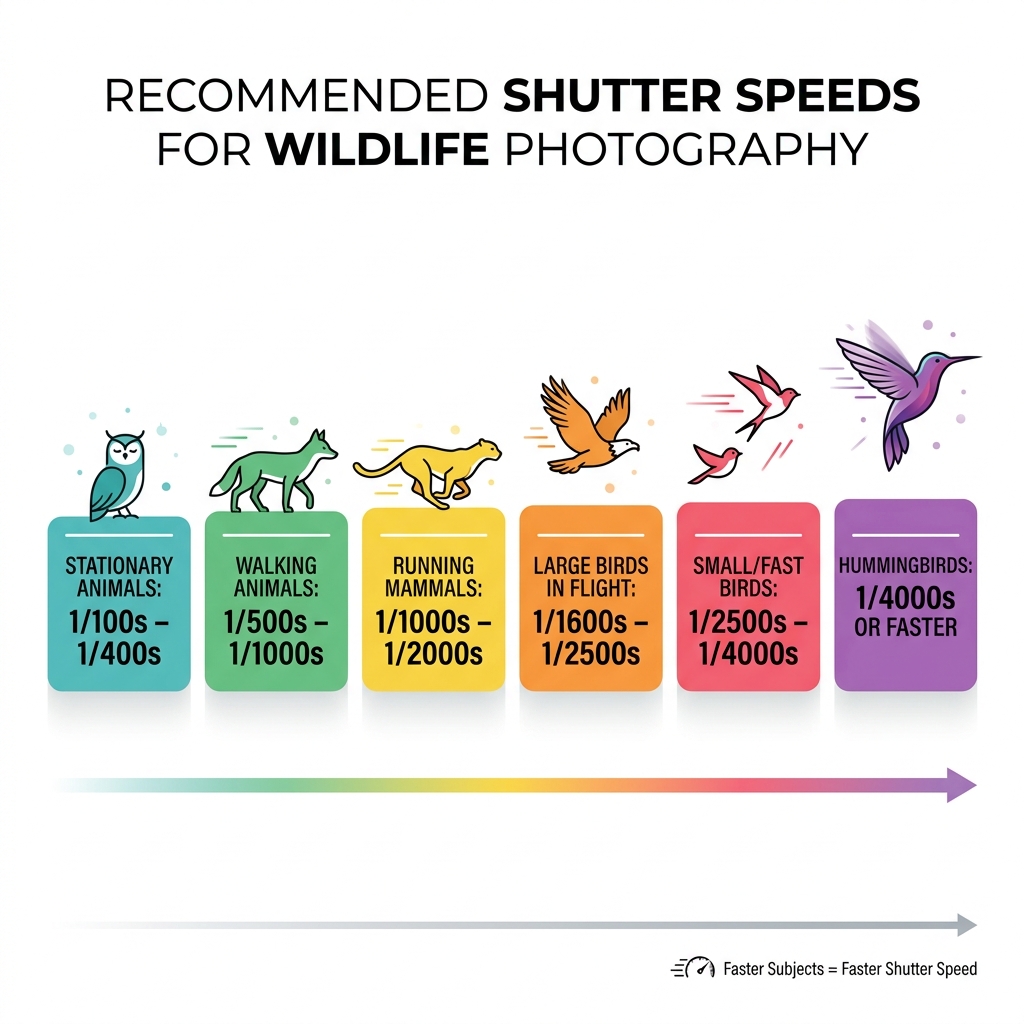
Quick Answer: Recommended Shutter Speeds by Subject
| Subject | Minimum Shutter Speed |
|---|---|
| Stationary animals | 1/100s – 1/400s |
| Walking animals | 1/500s – 1/1000s |
| Running mammals | 1/1000s – 1/2000s |
| Large birds in flight | 1/1600s – 1/2500s |
| Small/fast birds | 1/2500s – 1/4000s |
| Hummingbirds | 1/4000s or faster |
You raise the camera. A deer steps into perfect light. You press the shutter.
And the photo is blurry.
It happens to almost every beginner. Sometimes it’s the animal moving. Sometimes it’s your hands. Often it’s both at once. The frustrating part? A blurry photo can’t be fixed in post-processing. Unlike noise or color problems, motion blur is permanent.
That’s what makes shutter speed so critical. It’s the one setting that directly controls whether your subject is frozen sharp or smeared into a soft mess.
Most beginners set their shutter speed too slow — often because they’re trying to keep ISO low. But as you’ll see in this guide, a slightly noisy sharp photo is always better than a clean blurry one.
Modern cameras and image stabilization have changed the rules a lot. But the core principle is the same: fast subjects need fast shutter speeds, and knowing the right numbers for each scenario is what separates keepers from the delete pile.
The Critical Role of Shutter Speed for Wildlife Photography
When we talk about sharpness, we are really talking about two things: freezing the subject’s motion and eliminating camera shake. In wildlife, where subjects can go from 0 to 60 in a heartbeat, shutter speed for wildlife photography becomes the gatekeeper of quality.
Think of your camera sensor as a bucket and light as water. Shutter speed is simply how long you leave the lid off that bucket. If the lid is off too long (a slow shutter speed), and the “water” (the animal) moves, the image smears across the sensor. To get that tack-sharp “frozen” look—where you can see every individual droplet in a water splash or every barb on a feather—you need a very fast shutter speed to “stop” time.
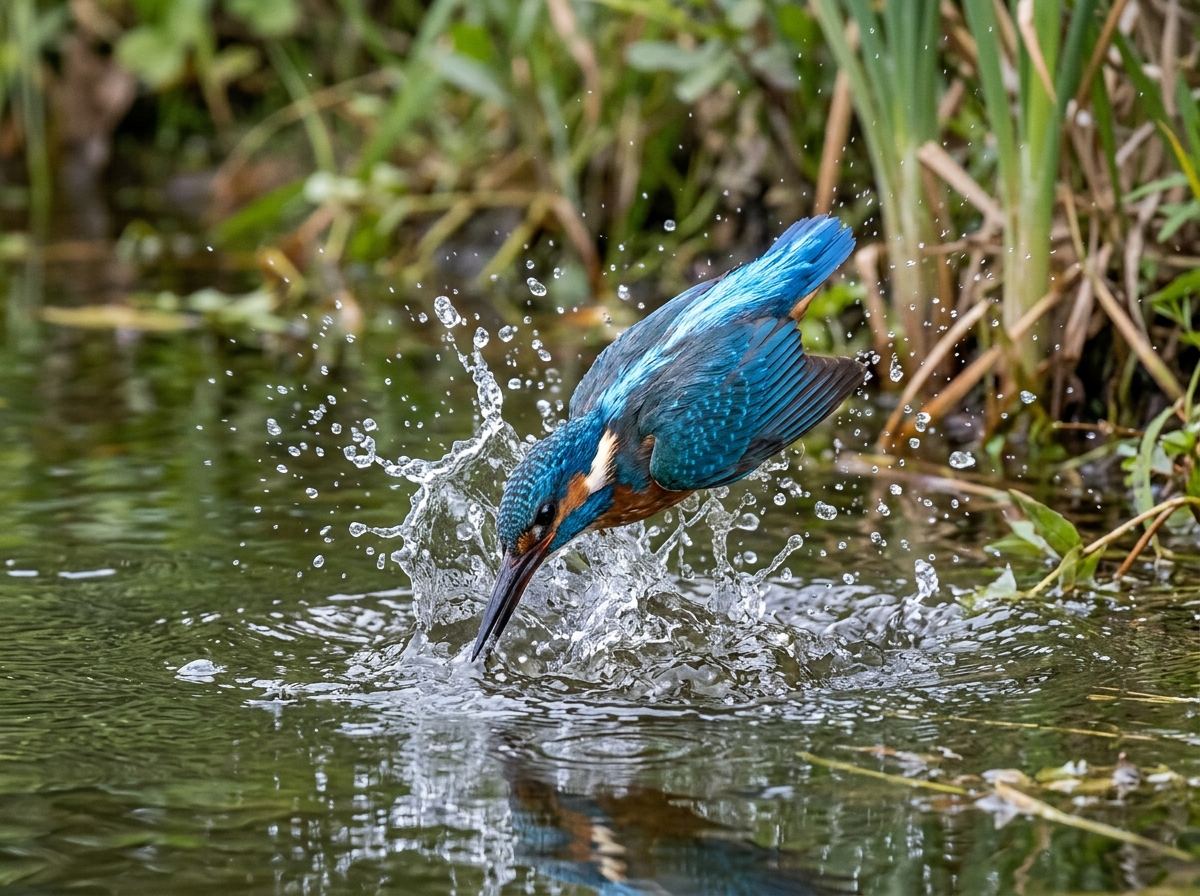
In the exposure triangle (shutter speed, aperture, and ISO), shutter speed is the non-negotiable setting for wildlife. While we can often fix a bit of noise from a high ISO or live with a slightly deeper depth of field from a narrower aperture, we cannot fix a bird whose wings are a blurry smudge because the shutter wasn’t fast enough.
The goal is always “sharp eyes.” In wildlife photography, if the eye isn’t sharp, the photo is usually a fail. Because animals move their heads and blink incredibly fast, even a “stationary” animal often requires a faster shutter speed than you might think to ensure the eye remains tack-sharp.
Modern Stabilization and the New Reciprocal Rule
For decades, photographers lived by the “Reciprocal Rule.” It was a simple piece of advice: your shutter speed should be at least 1 divided by your focal length. If you were shooting with a 500mm lens, you needed at least 1/500s to avoid the blur caused by your own shaky hands.
However, two things have changed this rule: high-megapixel sensors and modern image stabilization.
High-resolution sensors (45MP and up) are amazing for detail, but they are also incredibly “picky.” Because the pixels are so small, even the tiniest vibration is magnified. If you are using a modern high-res mirrorless camera, we recommend doubling that old rule. For a 500mm lens, aim for 1/1000s as your handheld baseline to ensure you aren’t the reason the photo is soft.
The 1/Focal Length Rule vs. Modern Gear
On the flip side, we have incredible technology like In-Body Image Stabilization (IBIS) and Lens Vibration Reduction (VR). Some modern systems claim up to 6 or even 8 stops of stabilization. This means that, theoretically, you could handhold a 600mm lens at 1/160s and still get a sharp shot of a stationary owl.
While this technology is a lifesaver in low light, it only stops your movement, not the animal’s movement. This is a common trap for beginners. You might have the steadiest hands in the world thanks to IBIS, but if that bird twitches its head at 1/160s, the photo will still be blurry.
To dive deeper into why your shots might be missing the mark, check out our guide on avoiding-blurry-images-in-bird-photography.
When to Turn Off Image Stabilization
It sounds counterintuitive, but there are times when you should actually turn stabilization off.
- On a Tripod: If you are using a sturdy tripod with a gimbal head, some older stabilization systems can actually “hunt” for movement that isn’t there, creating a tiny bit of blur. Check your lens manual; many modern “Sport” or “Vibration Reduction” modes are smart enough to stay on, but when in doubt, turn it off for long exposures on a tripod.
- Very Fast Shutter Speeds: Once you are shooting at 1/2000s or faster, the shutter is opening and closing so quickly that camera shake isn’t really an issue anymore. Some photographers find that leaving VR on at these speeds can actually slightly degrade image quality or cause “shutter shock.”
- Battery Conservation: Stabilization uses power. If you’re in the field and your battery is at 5%, turning off VR can buy you a few extra minutes of shooting time.
For more technical nuances on gear setup, see our article on mastering-camera-settings-for-bird-photography.
Recommended Settings for Different Wildlife Scenarios
Choosing the right shutter speed for wildlife photography depends entirely on the “velocity” of the moment. A sleeping lion requires a very different setting than a diving falcon.
One factor often overlooked is “frame-filling.” The closer you are to an animal, or the more it fills your frame, the faster your shutter speed needs to be. This is because a small movement from a close subject covers more pixels on your sensor than the same movement from an animal far away.
| Scenario | Recommended Shutter Speed | Why? |
|---|---|---|
| Large Mammals (Resting) | 1/100s – 1/400s | To account for breathing or slight head tilts. |
| Mammals (Walking) | 1/500s – 1/1000s | Freezes leg movement and prevents “ghosting.” |
| Mammals (Sprinting/Hunting) | 1/1600s – 1/2500s | Necessary for fast predators like cheetahs or wolves. |
| Large Birds (Perched) | 1/250s – 1/640s | Safe baseline for eagles, herons, or owls. |
| Large Birds (In Flight) | 1/1600s – 1/2500s | Freezes wings but might allow slight “tip blur.” |
| Small Birds (Flight/Action) | 1/3200s – 1/4000s | Needed for erratic movements and fast wingbeats. |
Minimum Shutter Speed for Wildlife Photography: Mammals and Stationary Subjects
For mammals, the “Big Cat Rule” is a great starting point. If a lion or leopard is just lounging, 1/400s is usually plenty. If they start a slow, regal walk, we bump it up to 1/800s. If they decide it’s dinner time and start a full-speed hunt, you’ll need at least 1/1600s or 1/2000s to freeze that explosive power.
For stationary subjects like a grazing bison or a perched hawk, you can often drop your shutter speed to save ISO. However, never go so low that you risk camera shake. We’ve found that even for “still” animals, 1/400s is a “comfort zone” that ensures sharpness even if the animal makes a sudden subtle movement.
Learn more about capturing these moments in our guide on captivating-bird-photography-a-guide-to-camera-settings.
High-Speed Settings for Birds in Flight
Birds in flight (BIF) are the ultimate test of a photographer’s skill. The smaller the bird, the faster the shutter speed required.
For a large bird with slow wingbeats, like a Great Blue Heron, 1/1600s might be enough to get a sharp body, though the wingtips might still have a beautiful, artistic blur. But if you are chasing songbirds or ducks, 1/3200s is your “golden” setting.
And then there are hummingbirds. Their wings beat up to 80 times per second. To truly freeze those wings, you’re looking at 1/4000s or even 1/8000s. At these speeds, you’ll need a lot of light, which brings us to the next challenge: balancing the exposure triangle.
For specific BIF techniques, read capturing-swift-movements-bird-in-flight-photography.
Balancing the Exposure Triangle in Challenging Conditions
Wildlife doesn’t always hang out in bright, midday sun. In fact, the best action often happens during the “golden hours” of dawn and dusk when light is low.
This is where many photographers panic. They see their ISO climbing to 3200, 6400, or higher, and they instinctively slow down their shutter speed to “save” the image from noise. Don’t do this.
A noisy image can be saved by modern AI denoise tools or clever editing. A blurry image is trash. We always recommend what we call “ISO Insurance”: use the shutter speed you need for the action, and let the ISO land where it must.
Managing Shutter Speed for Wildlife Photography in Low Light
When shooting in the dim light of dawn, we suggest using Manual Mode with Auto ISO. This allows you to set your shutter speed (say, 1/1000s for a walking bear) and your aperture (usually wide open like f/4 or f/5.6), while the camera handles the ISO.
To help your camera out, use Exposure Compensation. If you’re shooting a dark animal against a dark background, you might need to dial in -0.3 or -0.7 to prevent the camera from over-brightening the scene and unnecessarily spiking the ISO. Conversely, for a white bird against a dark background, Highlight-Weighted Metering is a lifesaver—it ensures the whites aren’t “blown out,” preserving that precious feather detail.
For beginners, our beginners-guide-to-bird-photography-key-settings covers these basics in detail.
Creative Motion and Panning Techniques
Sometimes, “tack-sharp” isn’t the goal. If you want to convey the sheer speed of a running antelope or the grace of a flying swan, you can use panning.
Panning involves using a slower shutter speed (like 1/10s for large mammals or 1/60s for birds) and moving your camera at the exact same speed as the animal. If done correctly, the animal’s head and body stay relatively sharp, while the legs, wings, and background blur into beautiful, impressionistic streaks.
It takes practice—lots of it. We recommend starting with a “burst” of shots. Usually, out of a sequence of ten, only one will be perfectly panned, but that one shot will have more “soul” than a thousand frozen frames.
Explore this artistic side in our article on how-to-freeze-motion-with-the-best-shutter-speed-for-flying-birds.
Overcoming Environmental Obstacles to Sharpness
Even with the perfect shutter speed for wildlife photography, the environment can sometimes conspire against you.
- Wind: High winds can vibrate even the sturdiest long lenses. If it’s windy, bump your shutter speed up by one or two stops higher than usual. If you’re using a tripod, remove the lens hood (it acts like a sail) and keep the tripod legs as low as possible.
- Heat Waves: On hot days, “heat shimmer” or atmospheric distortion can make distant subjects look soft or “wavy.” No shutter speed can fix this. The only solution is to get closer to your subject to minimize the amount of air between you and the animal.
- Vehicle Vibration: If you are shooting from a safari vehicle or your car, turn the engine off. The subtle vibration of an idling engine is a sharpness killer. Use a bean bag on the window sill for maximum stability.
- Burst Mode: Always shoot in “Continuous High” mode. The act of pressing the shutter button creates a tiny vibration. By shooting a burst of 3-5 frames, the second and third frames are often sharper because the initial vibration has settled.
Finally, we cannot overstate the value of “backyard practice.” Don’t wait for a once-in-a-lifetime trip to Africa to figure out your personal minimum shutter speed. Practice on squirrels or local pigeons. Figure out how low you can go handheld before the “blur” creeps in.
Frequently Asked Questions about Shutter Speed
What is the best shutter speed for a handheld 600mm lens?
Given the high-megapixel sensors in modern cameras, we recommend a minimum of 1/1200s or 1/1600s for handheld 600mm shots. While IBIS might allow you to go lower for stationary subjects, these faster speeds protect you from both camera shake and unexpected subject movement.
Should I prioritize low ISO or a fast shutter speed?
Always prioritize shutter speed. Digital noise from a high ISO is a “fixable” problem in modern editing. Motion blur is a permanent defect. We would much rather have a sharp, grainy photo of a rare leopard than a clean, blurry one.
Why are my photos still blurry at 1/2000s?
If your shutter speed is high but the image is still soft, check for these three culprits:
- Missed Focus: The camera might have locked onto a branch or the animal’s shoulder instead of the eye.
- Atmospheric Distortion: Heat waves can ruin sharpness even at 1/8000s.
- Lens Quality/Filters: A cheap UV filter on a high-end telephoto lens can significantly degrade sharpness. Try taking the filter off!
Conclusion
Mastering shutter speed for wildlife photography is a journey of balancing physics with artistic intent. It’s about knowing when to be “safe” with a fast 1/3200s and when to be “brave” with a 1/10s panning shot.
At Ciber Conexão, we believe that the shot doesn’t end when you click the shutter. Hugo Andrade and our team specialize in helping you take those sharp RAW files and turning them into masterpieces through expert photo editing. Often, a great wildlife photo is hidden inside a larger frame—knowing how to crop for impact and use composition to lead the eye is just as important as the settings you used in the field.
Once you’ve mastered your shutter speeds and brought home those sharp files, the right crop can turn a “good” photo into a “breathtaking” one. For more tips on getting the most out of your camera, check out our guide on mastering-bird-photography-essential-camera-settings.
Keep practicing, don’t fear the high ISO, and we’ll see you in the field!
