
Why Good Composition Transforms Your Photos
Composition tips for beginners are the fastest way to turn flat, forgettable snapshots into images that actually stop people scrolling.
Here are the core composition tips every beginner should know:
- Rule of Thirds – Place your subject off-center, at one of the grid’s four intersection points
- Leading Lines – Use roads, fences, or rivers to guide the viewer’s eye into the scene
- Negative Space – Leave empty space around your subject to create breathing room
- Symmetry and Patterns – Use reflections or repeating shapes to add visual rhythm
- Simplify the Frame – Remove distractions so the viewer knows exactly where to look
- Odd Numbers – Group subjects in threes or fives, not twos or fours
- Check Your Edges – Scan the frame borders before you shoot to cut out unwanted clutter
So what is composition, exactly?
The Tate defines it simply as “the arrangement of elements within a work of art.” In photography, that means deciding what goes where inside your frame — and why.
Think of it like furniture in a room. A messy room feels chaotic. A well-arranged room feels calm and inviting. Your photo works the same way. Every element either adds to the story or gets in the way of it.
The secret most beginners miss? Composition isn’t about following strict rules. It’s about making intentional choices. Nothing in your frame should happen by accident.
When composition works, the viewer doesn’t notice it. Their eye just flows naturally through the image, landing on what matters most — and staying there.
The good news: you don’t need expensive gear or advanced editing skills to get this right. You just need to know where to look.

Essential Composition Tips for Beginners: The Building Blocks
When we start our journey in photography, we often get distracted by camera settings like ISO or shutter speed. While those are important, they are just the “ink” on the page. Composition is the “story” you are telling. To build a great story, you need reliable building blocks.
In art, whether you are understanding composition for artists or framing a shot of a sparrow, the principles remain the same. We want to create a visual structure that feels intentional. If you are just getting started with bird photography, you’ll quickly find that where you place that bird in the frame matters just as much as how sharp the feathers are.
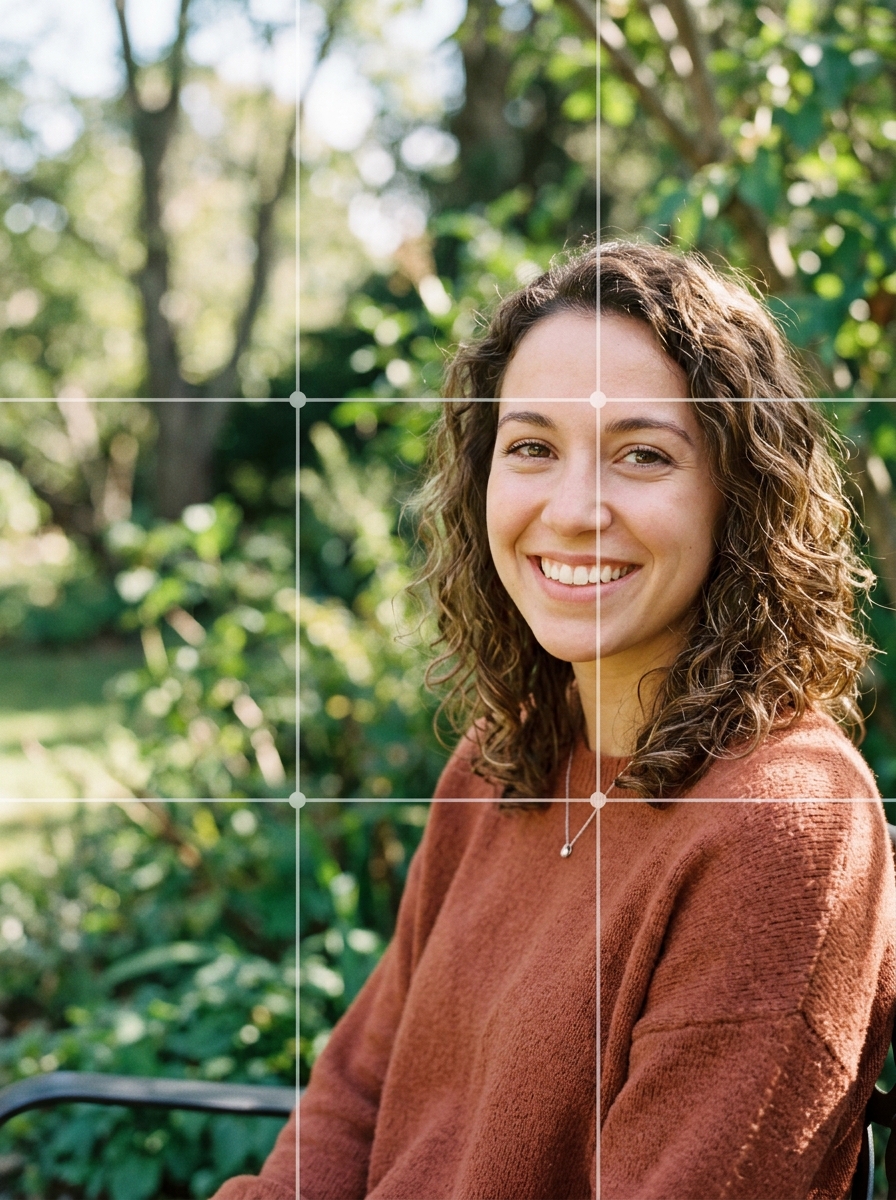
Using the Rule of Thirds as a Composition Tip for Beginners
The Rule of Thirds is perhaps the most famous of all composition tips for beginners. Imagine your frame is divided into nine equal rectangles by two vertical and two horizontal lines—much like a tic-tac-toe board. Most smartphones and digital cameras have a setting to display this grid on your screen.
The theory is simple: our eyes don’t naturally gravitate toward the dead center of an image. Instead, they linger on the “power points” where those grid lines intersect. By placing your subject—be it a person’s eye, a lone tree, or a bird—on one of these intersections, you create a more balanced and professional look.
When shooting landscapes, try placing the horizon on the top third line to emphasize the foreground, or the bottom third line to highlight a dramatic sky. This avoids the “split-in-half” look that can make a photo feel static and boring.
Leading Lines: A Pro Composition Tip for Beginners
Have you ever looked at a photo and felt like your eyes were being pulled into the distance? That is the magic of leading lines. These are literal or implied lines that guide the viewer’s eye toward the focal point of the image.
Common leading lines include:
- Roads and Paths: These naturally pull the eye toward the horizon or a subject at the end of the trail.
- Fences and Walls: These create a sense of depth and perspective.
- Rivers and Shorelines: Curving lines (often called S-curves) create a rhythmic, graceful flow.
Leading lines don’t just point; they create a sense of three-dimensional depth in a two-dimensional photograph. If you find a great subject, look around for a line you can use to “point” at it.
The Power of Symmetry and Patterns
While the Rule of Thirds encourages off-center placement, symmetry is the exception that proves the rule. Symmetry creates a sense of formal balance, calm, and order. Think of a perfectly reflected mountain in a still lake or the repetitive arches of a cathedral.
Patterns and repetition also add a rhythmic quality to your work. Our brains love finding order in chaos. However, one of the best ways to use a pattern is to break it. A row of identical red apples with one green apple creates instant emphasis. This “break” in the rhythm acts as a magnet for the viewer’s attention.
Advanced Techniques: Compositional Stacking and Visual Weight
Once you have mastered the basics, you can start “stacking” techniques. Compositional stacking is a method where you layer multiple rules on top of each other. For example, you might place your subject using the Rule of Thirds, use a fence as a leading line, and then use a shallow depth of field to blur the background.
Just as a musician learns how to compose music by layering melody over harmony and rhythm, a photographer layers visual elements to create a complex “chord” of interest.
Achieving Balance and Unity
Balance isn’t just about symmetry; it’s about “visual weight.” Every object in your photo has a weight based on its size, color, and contrast. A large, dark object on the left side of the frame feels “heavy.” To balance the photo, you might need a smaller, very bright object on the right side.
Think of it like a seesaw. A heavy subject close to the center (the fulcrum) can be balanced by a lighter subject further out toward the edge.
| Feature | Symmetrical Composition | Asymmetrical Composition |
|---|---|---|
| Feeling | Formal, calm, stable, organized | Dynamic, energetic, modern, tense |
| Focal Point | Usually centered | Usually off-center (Rule of Thirds) |
| Best For | Architecture, reflections, portraits | Landscapes, street photography, action |
| Visual Weight | Evenly distributed | Balanced through counterweights |
The Role of Negative Space and Breathing Space
One of the most common mistakes we see beginners make is trying to cram too much into the frame. Simplicity is often the mark of a master. Negative space—the “empty” area around your subject—is vital. It gives your subject “breathing space.”
If you are photographing a bird in flight, leave more space in front of the bird than behind it. This gives the bird “room to fly” into. If the bird’s beak is right against the edge of the frame, the photo will feel cramped and uncomfortable. Negative space helps isolate the subject and emphasizes the emotional impact of the scene.
Mastering Perspective and Depth in Your Shots
Perspective is how we represent three-dimensional objects on a flat surface. By changing your physical position, you can completely change the story of the photo.
Changing Your Point of View
Most people take photos from eye level. This is the “default” setting of the human experience, and as a result, it can feel a bit ordinary. To make your photos stand out, we recommend exploring angles and perspectives that people don’t see every day.
- Low Angle: Squat down or lay on the ground. This makes subjects look powerful, heroic, or looming. It also helps to simplify the background by using the sky as a backdrop.
- Bird’s Eye View: Shoot from high above looking down. This flattens the world into a map-like pattern and is great for capturing shapes and shadows.
- Eye-Level Intimacy: When photographing animals or children, getting down to their eye level creates a sense of connection and intimacy.
The orientation of your camera also matters. We have some great vertical or horizontal framing tips that can help you decide which way to hold your camera based on the lines of your subject.
Using Depth of Field as a Compositional Tool
Depth of field refers to how much of your image is in focus. A “shallow” depth of field (achieved with a wide aperture like f/1.8 or f/2.8) creates a blurry background, often called bokeh.
This is a powerful compositional tool because it physically separates the subject from the background. If you are shooting in a messy urban environment, a shallow depth of field can turn a distracting pile of trash into a soft, colorful blur, keeping the focus entirely on your subject.
Refining Your Eye: Border Patrol and Common Mistakes
Even the best composition can be ruined by a small distraction at the edge of the frame. This is where “Border Patrol” comes in.
How to Conduct a Border Patrol
Before you press the shutter button, we want you to run your eyes around the very edges of your frame. Look for:
- Stray Branches: A random twig poking in from the side.
- Bright Spots: A white car or a bright light at the edge that pulls the eye away from the subject.
- Cut-offs: Ensure you aren’t accidentally cutting off someone’s toes, fingertips, or a bird’s tail feathers.
If you spot these issues, you can often fix them by moving slightly to the left or right, or by zooming in. If you missed it in the field, don’t worry—you can often use crop and composition editing tips to clean up the edges later.
Avoiding Common Beginner Pitfalls
We all start somewhere, and certain mistakes are universal. Here is how to avoid them:
- Bullseyeing: Placing everything dead center. Use the Rule of Thirds instead!
- Busy Backgrounds: When composing bird photos with urban backgrounds, look for “clean” patches of color to place your subject against. Avoid “mergers,” where a tree branch looks like it’s growing out of your subject’s head.
- Tilted Horizons: A slanted ocean looks like the water is leaking out of the frame. Use your camera’s built-in level or grid to keep things straight.
When to Break the Rules for Creative Results
Once you understand why the rules exist, you have our permission to break them! Intentional rule-breaking is what leads to a unique artistic style.
- The Rule of Odds: This rule suggests that an odd number of subjects (3, 5, 7) is more visually appealing than an even number. Even numbers create “pairs” that our brains find easy to dismiss, while odd numbers keep the eye moving.
- The Golden Ratio: Also known as the Fibonacci Spiral, this is a more complex version of the Rule of Thirds based on a mathematical ratio (1:1.618) found throughout nature. It creates a very organic, flowing eye movement.
- Central Placement: Sometimes, a subject is so powerful and symmetrical that placing it dead center is the only way to do it justice. This creates a sense of “confrontation” or intense focus.
The key is intent. If you center your subject because you didn’t think about it, it’s a mistake. If you center it because you want to evoke a specific feeling of stability, it’s art.
Frequently Asked Questions about Composition Tips for Beginners
What is the most important rule of composition?
While the Rule of Thirds is the most famous, the most important “rule” is actually simplicity. If an element in your photo doesn’t help tell the story or support the subject, it shouldn’t be in the frame. Learning to subtract is more important than learning to add.
Can I fix bad composition during photo editing?
To an extent, yes. You can use cropping to improve the Rule of Thirds placement or to remove edge distractions. However, you cannot change your perspective (the angle you shot from) or the relationship between objects once the photo is taken. It is always better to get it right in the camera!
Why does the “Rule of Odds” work in photography?
Our brains are wired to look for patterns and “pairs.” When we see two objects, we pair them up and move on. When we see three, our eyes have to bounce between them, which keeps us looking at the image longer. It creates a sense of natural, “messy” beauty that feels more authentic than perfect pairs.
Conclusion
Mastering composition tips for beginners is a lifelong journey. It is about training your brain to see the world not as “things,” but as shapes, lines, and light.
At Ciber Conexão, we believe that anyone can take world-class photos if they learn to look at the frame with intention. Whether you are following the advice of Hugo Andrade on how to crop your shots or you are out in the field practicing your leading lines, the most important thing is to keep shooting.
Visual literacy—the ability to “read” an image—comes with practice. Start by picking one technique, like the Rule of Thirds, and spend an entire weekend only shooting with that in mind. Then, move on to leading lines. Before you know it, these “rules” will become second nature, and you’ll be stacking them like a pro.
Ready to take the next step in your photography journey? Improve your skills with our photo editing guides and learn how to polish your compositions to perfection!
