
Why Getting Aperture Right Can Make or Break Your Bird Photos
The ideal aperture for birds is generally f/5.6 to f/8, with f/7.1 being the best all-around starting point for most situations.
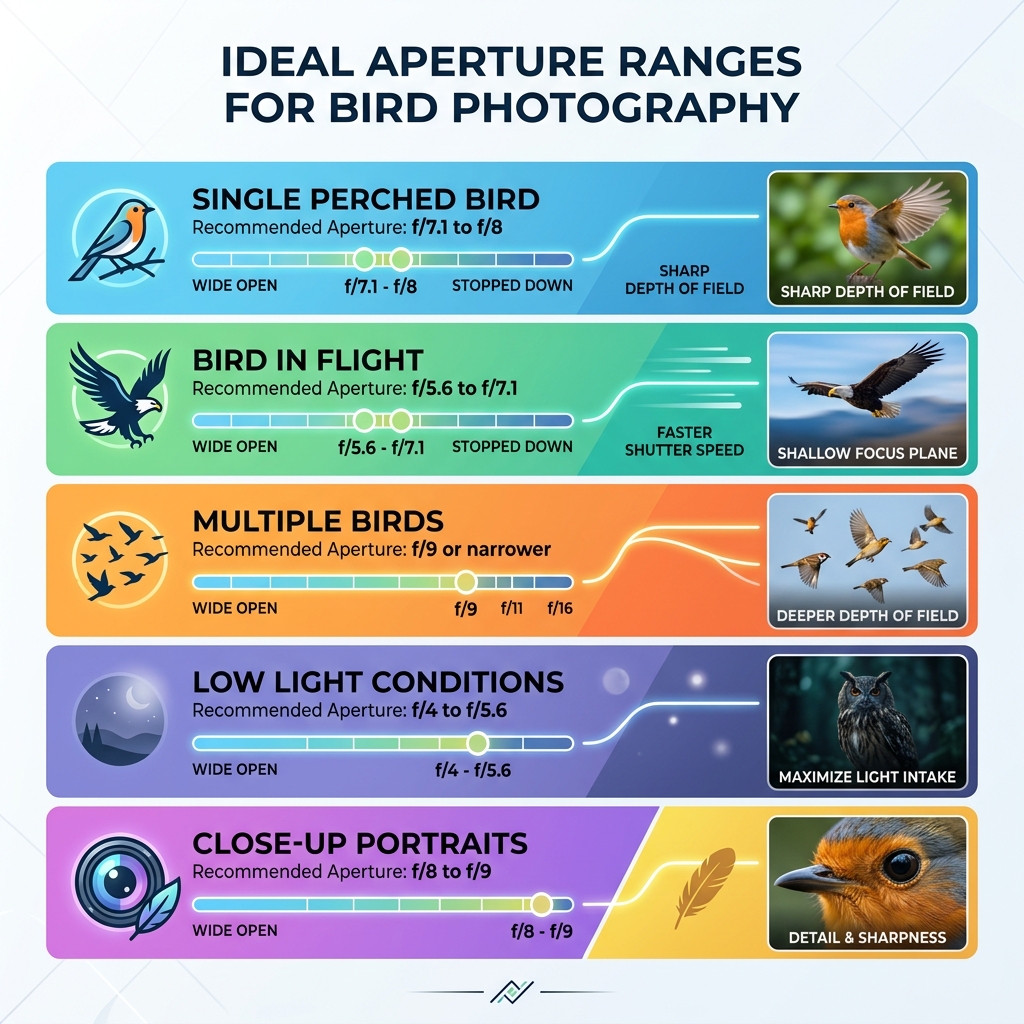
Here’s a quick reference:
| Situation | Recommended Aperture |
|---|---|
| Single perched bird | f/7.1 to f/8 |
| Bird in flight | f/5.6 to f/7.1 |
| Multiple birds | f/9 or narrower |
| Low light conditions | f/4 to f/5.6 |
| Close-up portraits | f/8 to f/9 |
Bird photography is unforgiving. You have a split second to get the shot — and aperture is one of the settings that can quietly ruin it.
Many beginners shoot with their lens wide open, thinking more light means better photos. But wide apertures like f/2.8 or f/4 often give you a razor-thin focus plane. You might nail the eye, but the tail, wings, or feet go soft.
That’s a frustrating pattern to discover after a long morning in the field.
The good news? A small adjustment — stopping down just one or two clicks to f/7.1 or f/8 — can dramatically improve how much of the bird lands in sharp focus, without ruining your background blur.
In this guide, you’ll learn exactly how to choose the right aperture for every bird photography scenario, from distant raptors to fast-moving songbirds.
Why f/5.6 to f/8 is the Ideal Aperture for Birds
When we talk about the ideal aperture for birds, we are looking for a “Goldilocks” zone. We want enough light to keep our shutter speeds fast, but we also need enough depth of field to ensure the entire bird is sharp. In our experience, shooting between f/5.6 and f/8 provides the most consistent results for several technical reasons.

The Lens “Sweet Spot”
Most telephoto lenses—whether they are high-end primes or versatile zooms—are not at their sharpest when used at their maximum aperture (wide open). If you have a lens that opens to f/5.6, it will almost certainly produce a crisper image if you stop it down to f/7.1 or f/8. This middle range is known as the “sweet spot.” By moving slightly away from the widest setting, you reduce optical aberrations like vignetting (dark corners) and chromatic aberration (color fringing), leading to much better image clarity.
The f/7.1 All-Rounder
If we had to pick one setting to leave our cameras on all day, it would be f/7.1. Many expert bird photographers find that 90% of their best shots are taken at this specific f-stop. It strikes a perfect balance: it provides enough depth of field to keep a medium-sized bird sharp from beak to tail, yet it is wide enough to maintain a pleasingly blurred background (bokeh).
For those just starting out, we recommend checking out our guide on Mastering Bird Photography Essential Camera Settings to see how aperture fits into the larger exposure picture.
Comparing Depth of Field
To understand why f/5.6 isn’t always enough, look at the math. If you are using an 840mm setup (a 600mm lens with a 1.4x teleconverter) and your subject is 50 feet away, your depth of field at f/5.6 is only about 4 inches. That is barely enough to cover a small bird’s head and body. If you stop down to f/10, that depth of field doubles to about 8 inches, giving you a much higher “keeper rate” for sharp photos.
| Aperture | DOF at 50ft (840mm) | DOF at 80ft (840mm) |
|---|---|---|
| f/5.6 | ~4 inches | 1.00 foot |
| f/8.0 | ~6 inches | 1.42 feet |
| f/10.0 | ~8 inches | 1.78 feet |
Avoiding the Pitfalls of Shooting Wide Open
It is incredibly tempting to shoot at f/4 or f/2.8 if your lens allows it. After all, those lenses cost a fortune! However, shooting wide open often leads to “soft” images. In bird photography, the focus plane is incredibly thin at long focal lengths. If you focus on the eye at f/4, the bird’s wingtips or tail feathers might fall out of the focus zone and appear blurry.
By stopping down slightly, you increase the “keeper rate”—the number of photos that are actually sharp enough to keep. We’ve found that even high-end lenses benefit from being stopped down just a bit to ensure the focus plane covers the entire subject. To learn more about getting the cleanest possible images, see our tips on Improving Clarity In Bird Shots.
Finding Your Lens’s Sharpness Sweet Spot
Every lens is a little different. To find the ideal aperture for birds on your specific gear, we suggest a simple tripod test:
- Set up your camera on a sturdy tripod.
- Place a detailed subject (like a bird feeder or a test chart) at a typical shooting distance.
- Take a series of photos starting from the widest aperture and stopping down in 1/3 stop increments (e.g., f/5.6, f/6.3, f/7.1, f/8, f/9).
- View the images on a computer at 100% magnification.
- Look for the point where the center and edges of the frame look the sharpest. Usually, this will be about 1 to 2 stops away from wide open.
Balancing Depth of Field for Perched Birds vs. Birds in Flight
The way you use aperture changes depending on whether your subject is sitting still or zooming through the sky.
Finding the Ideal Aperture for Birds in Flight (BIF)
Birds in flight are the ultimate challenge. Because they move so fast, your primary concern is usually shutter speed—you need at least 1/2000s or 1/2500s to freeze the action. Historically, photographers shot BIF wide open (f/4 or f/5.6) just to get enough light for those fast speeds.
However, modern cameras have incredible high-ISO performance. This means we can afford to stop down to f/7.1 or f/8 even for flying birds. This extra depth of field is a lifesaver; if your autofocus misses the eye by just an inch and hits the wing instead, a narrower aperture might still keep the head sharp. For more on tracking fast subjects, check out Capturing Swift Movements Bird In Flight Photography.
The Impact of Subject Distance on Focus
Distance is a huge factor in choosing the ideal aperture for birds. The closer you are to the bird, the shallower your depth of field becomes.
- Close-up Portraits: If you are lucky enough to be very close to a bird, even f/7.1 might be too wide. You may need f/9 or f/11 to ensure the beak and the eyes are both in focus.
- Distant Raptors: When a hawk is 100 feet away, your depth of field is naturally much deeper. In these cases, you can safely shoot at f/5.6 or f/6.3 without worrying about the bird going soft, which also helps keep your ISO lower.
For specialized advice on close-range work, read our guide on Up Close And Personal Camera Settings For Close Up Bird Shots.
When to Break the Rules: Low Light and Close-Ups
Sometimes, the standard f/5.6 to f/8 range won’t cut it. You have to be flexible based on the environment.
Adjusting the Ideal Aperture for Birds at Close Range
When photographing small birds like hummingbirds or warblers at very close distances, the “macro effect” takes over. The depth of field becomes so thin that at f/5.6, only a tiny sliver of the bird is sharp. In these scenarios, we often stop down to f/9 or even f/11. Yes, this requires a higher ISO, but a slightly noisy sharp photo is always better than a clean blurry one. You can find more beginner-friendly tips in our Beginners Guide To Bird Photography Key Settings.
Managing Multiple Subjects and Flocks
What happens when you have two or three birds in the frame? It’s hard enough to get one bird sharp! If the birds are not on the same plane (meaning one is slightly behind the other), a wide aperture will blur the ones in the back. To get a sharp “family portrait” of ducks or a flock of shorebirds, we recommend a rule-of-thumb minimum of f/8 on full-frame cameras. If light allows, f/11 or f/13 will ensure the entire group is rendered clearly.
For deeper insights into handling complex scenes, visit Mastering Camera Settings For Bird Photography.
Mastering Aperture Priority and Auto ISO
To consistently hit the ideal aperture for birds, we recommend using Aperture Priority mode (Av or A) combined with Auto ISO.
This setup allows us to:
- Set the Aperture: We choose f/7.1 or f/8 for the desired depth of field.
- Set a Minimum Shutter Speed: Most modern cameras allow you to tell the Auto ISO system to keep the shutter speed above a certain limit (like 1/2000s).
- Let the Camera Handle ISO: The camera will automatically raise or lower the ISO to maintain your chosen aperture and shutter speed.
This “secret sauce” configuration lets you focus on the bird’s behavior and composition rather than fumbling with dials. For a deeper dive into exposure management, see Adjusting Exposure For Bird Photos.
Maintaining the Ideal Aperture for Birds in Changing Light
Wildlife lighting changes in an instant. A bird might fly from bright sunlight into deep shade. By using Aperture Priority and Auto ISO, your camera adapts instantly. If you find your images are coming out too dark or too bright (common with white birds or dark backgrounds), use the Exposure Compensation dial to tweak the brightness without changing your core aperture setting.
Remember to keep your autofocus set to AI-Servo (Canon) or AF-C (Nikon/Sony) to track the bird’s movement. For more lens-specific tips, check out Camera Settings For Bird Lenses.
Frequently Asked Questions about Bird Aperture
Why shouldn’t I always shoot at my lens’s widest aperture?
While it lets in the most light, the widest aperture (like f/4) often results in a depth of field that is too shallow to keep the whole bird sharp. Additionally, most lenses are slightly softer at their maximum aperture compared to when they are stopped down.
Does stopping down to f/8 affect my camera’s autofocus speed?
Generally, no. Most modern DSLR and mirrorless cameras perform autofocus with the lens wide open, only closing the aperture to your selected f-stop the moment the shutter is pressed. Your AF system still gets all the light it needs to track the bird.
What is the best aperture for capturing a bird with its wings spread?
Because wings spread wide increase the “depth” of the subject, we recommend at least f/7.1 or f/8. This ensures that if you focus on the head, the wingtips—which might be angled toward or away from you—stay within the sharp zone of focus.
Conclusion
Finding the ideal aperture for birds is a journey of trial and error, but starting in the f/5.6 to f/8 range will put you ahead of the curve. At Ciber Conexão, Hugo Andrade and our team believe that mastering these technical details is what allows your creativity to truly shine.
Don’t be afraid to experiment! Spend a morning at f/7.1, then try another at f/9, and compare your results. The more you practice, the more intuitive these settings will become. For more expert advice on refining your images through editing and composition, explore our full library of Photography Tips and Tutorials. Happy shooting!
