
The Composition Secret Behind Every Great Shot
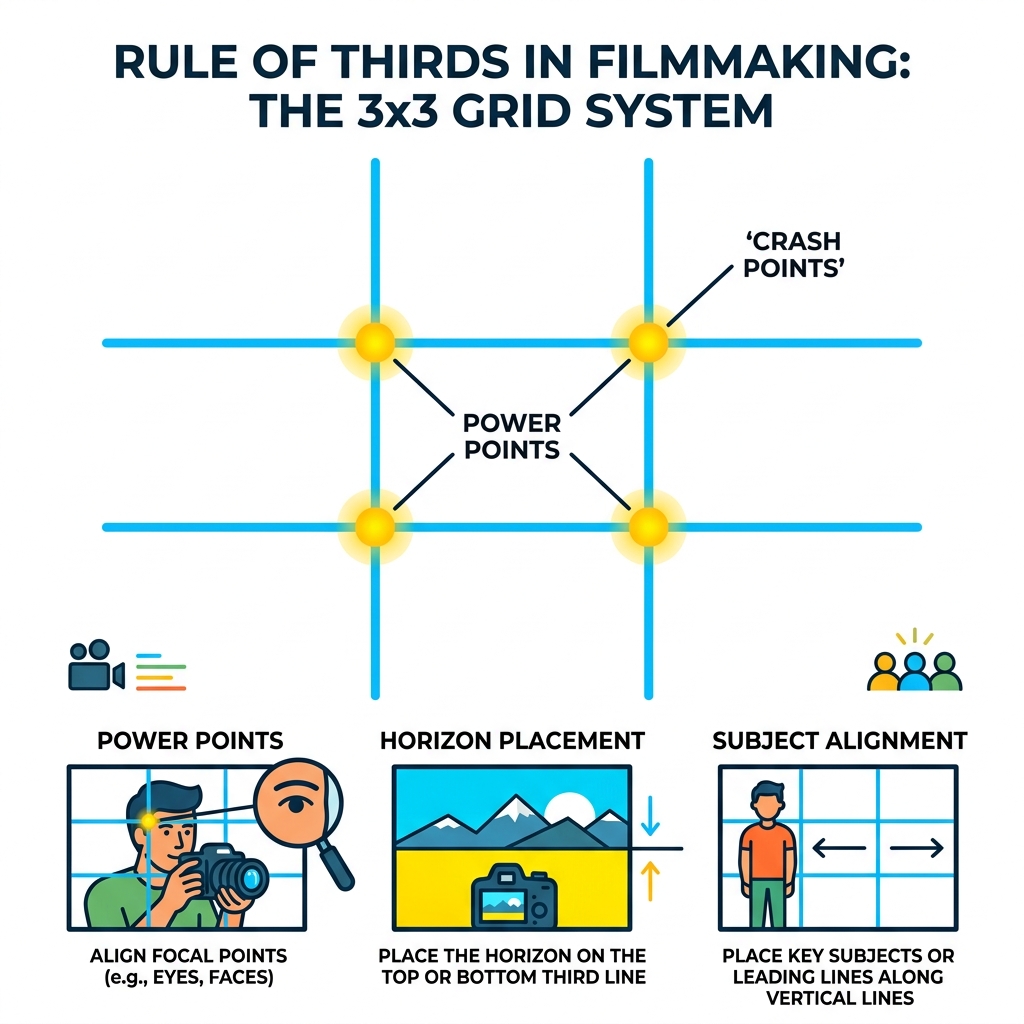
The rule of thirds in filmmaking is a composition guideline that divides your frame into a 3×3 grid using two horizontal and two vertical lines, creating nine equal sections and four intersection points — called power points — where you place your most important subjects or elements.
Quick answer:
- Draw (or imagine) two horizontal lines and two vertical lines across your frame
- This creates a grid with four intersection points
- Place your subject, horizon, or key focal point on these lines or intersections — not dead center
- The result is a more dynamic, engaging, and visually natural shot
It sounds almost too simple. But this one shift — moving your subject off-center — is the difference between a flat, forgettable frame and a shot that pulls the viewer in.
Almost every cinematographer you admire uses it. From the moody corridors of The Shining to the sun-drenched landscapes of Skyfall, the rule of thirds quietly shapes how we experience film.
And the good news? You don’t need a film school degree to use it. Once you see the grid, you can’t unsee it.
What is the Rule of Thirds in Filmmaking?
At its core, the rule of thirds in filmmaking is about structure. Imagine your camera screen divided into nine equal rectangles by two vertical lines and two horizontal lines. This creates a tic-tac-toe style overlay that serves as your roadmap for Rule of thirds composition.
The magic happens at the four points where these lines cross. These are often referred to as “power points” or “crash points.” In cinematography, placing a character’s eyes or a vital prop on one of these intersections creates a sense of visual balance that feels inherently “right” to the human eye.
Unlike a centered shot, which can often feel static or like a mugshot, off-center framing creates cinematic energy. It allows the subject to interact with their environment, providing room for the background to tell its own part of the story. This creates a natural tension and flow, guiding the viewer’s gaze exactly where the director wants it to go.
The History and Origin of the Rule
While we use it today on high-tech 8K cameras, the rule of thirds has surprisingly humble beginnings. The term was first coined by John Thomas Smith in 1797 in his book, Remarks on Rural Scenery. Smith wasn’t talking about movies—he was a painter and engraver discussing how to balance light and dark in landscape paintings.
Smith was influenced by the legendary Sir Joshua Reynolds, who spoke about the proportions of warm and cold colors. Smith took these ideas further, suggesting that a 2:1 ratio (two-thirds to one-third) was much more harmonizing than a precise 50/50 split.
This concept is a simplified cousin of the “Golden Section” or Golden Ratio used by Renaissance artists like Da Vinci. While the Golden Ratio is a complex mathematical formula found in nature, the rule of thirds became the “pragmatic” version—a quick, reliable way for artists and eventually cinematographers to ensure their work looked professional and balanced.
Why the Rule of Thirds in Filmmaking Works Psychologically
Why does a grid make us feel more “connected” to a movie? It all comes down to visual perception and how our brains process information. Our eyes don’t naturally settle in the dead center of a frame; instead, they tend to wander toward the edges and intersections.
When we use the rule of thirds in filmmaking, we are aligning the image with the viewer’s natural eye-tracking patterns. This reduces “eye fatigue” because the brain doesn’t have to work as hard to find the focal point. Furthermore, using peripheral vision to process off-center stimuli can actually invoke a stronger emotional response.
| Feature | Centered Composition | Rule of Thirds Composition |
|---|---|---|
| Visual Feel | Static, Formal, Direct | Dynamic, Natural, Fluid |
| Viewer Focus | Fixed on the middle | Moves across the frame |
| Storytelling | Focuses only on the subject | Subject interacts with environment |
| Emotional Tone | Confrontational or Symmetrical | Realistic or Narrative-driven |
By avoiding the middle, we create a “visual conversation” between the subject and the negative space around them. This aesthetic harmony keeps the audience immersed in the story rather than just looking at a picture.
Applying the Rule of Thirds Grid in Filmmaking
Applying this rule on set is easier than ever. Most modern cameras—from the smartphone in your pocket to high-end DSLRs and mirrorless systems—have a built-in grid overlay function. We always recommend turning this on in your viewfinder or LCD screen settings. It acts as a constant “sanity check” for your framing.
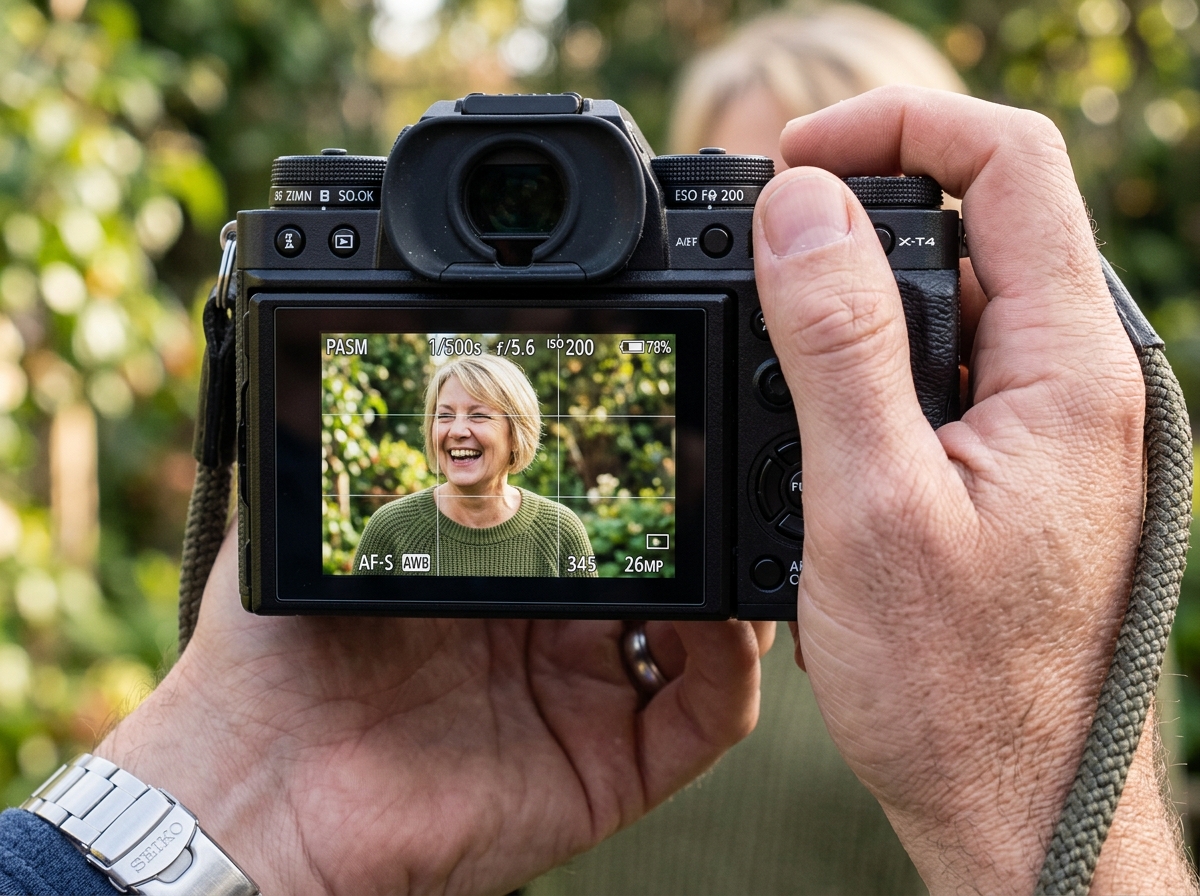
When setting up your shot, look at your horizontal lines. If you are shooting a landscape, avoid putting the horizon in the middle. Instead, place it on the bottom horizontal line to emphasize a dramatic sky, or the top line to focus on the terrain. For vertical lines, align your main subject—be it a person, a tree, or a building—along one of the two vertical pillars. The Rule of Thirds: A Must-Know Composition Rule for Filmmakers reminds us that this distribution of visual weight is what makes a frame look intentionally designed rather than accidental.
Using the Rule of Thirds in Filmmaking for Eye Lines and Leading Room
In filmmaking, the eyes are the most important element of any performance. Humans are biologically wired to look at eyes to gather emotional data. When framing a close-up, we should aim to place the character’s eyes on the top horizontal grid line.
But where on that line? This is where “leading room” (or “look room”) comes in. If your character is looking toward the left side of the frame, you should place them on the right vertical line. This creates negative space in the direction of their gaze, which builds psychological anticipation. The audience wants to see what the character sees.
If you place a character on the left line while they are looking left, they appear “boxed in” or trapped against the edge of the frame. Unless you are trying to convey claustrophobia, this usually feels uncomfortable. For more on how to choose between different orientations, check out our vertical or horizontal framing tips which, while focused on photography, share the same core principles of gaze and space.
Mastering Rack Focus and Movement
The rule of thirds in filmmaking gets more exciting (and a bit trickier) once things start moving. Unlike a static photo, a film frame is dynamic. If a character walks across the room, you have to pan the camera to keep them on those grid lines.
This is especially vital for a “rack focus” (or focus pull). Imagine a scene where a foreground subject is on the bottom-left power point and a background subject is on the top-right power point. By shifting the focus from one to the other, you are literally “leading” the viewer’s eye across the diagonal of the grid. This creates a powerful sense of depth and visual weight.
When tracking movement, always try to keep “lead room” in front of the subject. If a person is running, they should have two-thirds of the frame open in front of them to run into. If they are too close to the edge they are moving toward, the shot feels “choked.” Mastering these angles and perspectives allows you to maintain a cinematic feel even in high-action sequences.
Breaking the Rule: When Symmetry and Center Framing Win
As we often say at Ciber Conexão, you have to learn the rules before you can break them. The rule of thirds is a “golden guideline,” but it isn’t a law. Sometimes, the most powerful thing a filmmaker can do is put the subject dead center.
Think of directors like Stanley Kubrick or Wes Anderson. Wes Anderson has made a career out of “center framing” and perfect symmetry. His films feel like quirky, meticulously detailed dollhouses. By breaking the rule of thirds and putting everything in the middle, he creates a stylistic trademark that feels surreal and intentional.
Centering a subject can also be used to create:
- Dramatic Tension: A character staring directly into the lens from the center can feel confrontational or intense.
- Discomfort: In horror films, centering a character in a wide, empty hallway (like in The Shining) can make them look small and vulnerable.
- Psychological Descent: In Joker, the framing often shifts from the rule of thirds to claustrophobic, centered close-ups to show the character losing his grip on reality.
When you are composing photos with urban backgrounds, you might find that the geometry of a city—like a narrow alleyway—naturally pulls you toward symmetry. Embrace it! Breaking the rule is just as much a storytelling tool as following it.
Frequently Asked Questions about Cinematic Composition
How does the rule of thirds differ between photography and filmmaking?
The biggest difference is motion and time. In photography, you are capturing a single, frozen moment. You have all the time in the world to ensure that the bird or the mountain is perfectly on the intersection.
In filmmaking, the composition is a living thing. You have to consider the “shot-to-shot flow.” If character A is on the left third in one shot, and character B is on the right third in the next, the “conversation” between those two frames needs to feel continuous. Filmmaking is about transitions; you aren’t just composing a frame, you’re composing a sequence.
Can I fix composition in post-production?
Yes, but it comes with a cost. If you’ve shot a scene and realized your subject is awkwardly close to the center, you can use your editing software (like Premiere Pro or Camtasia) to crop and reframe the shot.
By using canvas rulers and digital guides, you can shift the image until the subject hits the power points. However, “digital zoom” results in a loss of resolution. If you crop too much, your image might become grainy. We always recommend getting it right on set, but for quick fixes, our crop and composition editing tips can help you save a shot without losing too much quality.
What are some famous examples of the rule of thirds in film?
Cinematography is a visual language, and the rule of thirds is its most common “word.”
- The Godfather: Many of the intense conversations between Don Corleone and his “supplicants” use the rule of thirds to show power dynamics, placing the Don in a dominant third of the frame.
- Skyfall: Cinematographer Roger Deakins is a master of this. Look at the scene where James Bond stands in a skyscraper in Shanghai; the horizon and the vertical lines of the buildings perfectly align with the grid.
- Mission: Impossible – Fallout: During the famous rooftop chase, the camera often follows Ethan Hunt while keeping him on a vertical line, allowing the audience to see the massive scale of London behind him.
- Mad Max: Fury Road: This film uses “cross-hair framing” (centering) for action, but uses the rule of thirds for its vast, epic desert landscapes to give a sense of scale and emptiness.
Conclusion
Mastering the rule of thirds in filmmaking is one of the fastest ways to elevate your work from “home movie” to “cinematic.” It’s a tool that helps you organize the chaos of a 3D world into a balanced 2D frame. By using the grid to place your subjects, align your horizons, and create leading room for your actors, you are speaking the same visual language as the greatest directors in history.
But remember, the grid is a guide, not a cage. Use it to build a solid foundation, and when the story calls for something jarring, symmetrical, or intense, don’t be afraid to throw the grid away. Composition is about intent. Whether you are following the lines or breaking them, the goal is always the same: to tell a better story.
At Ciber Conexão, we believe that great editing starts with great composition. Whether you are a budding filmmaker or a photographer looking to sharpen your eye, we invite you to explore more photography tips and tutorials on our site. Keep practicing, keep shooting, and most importantly, keep your eyes on the grid!
