
Why the Best Aperture for Bird Photography Makes or Breaks Your Shot
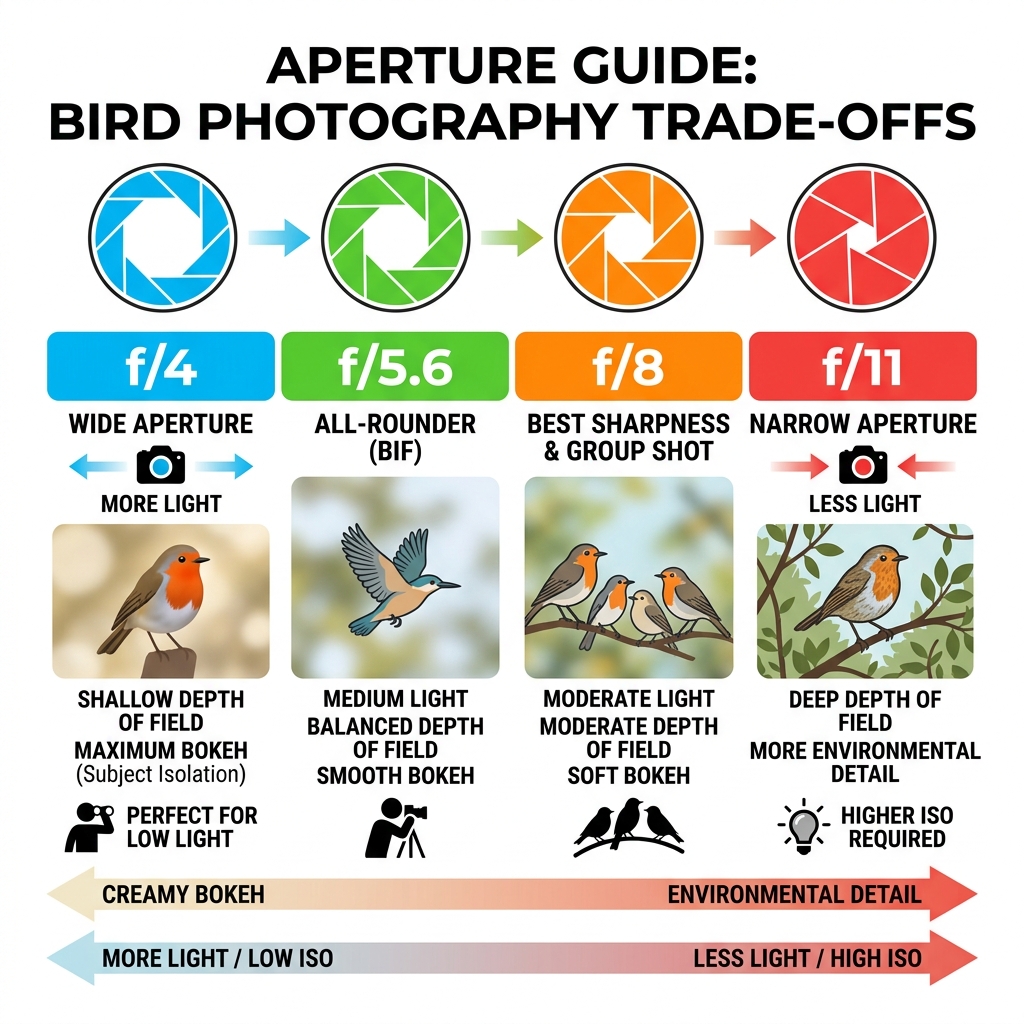
The best aperture for bird photography is generally f/5.6 to f/8 — wide enough to let in plenty of light and blur the background, but narrow enough to keep the whole bird sharp.
Here’s a quick reference to get you started:
| Scenario | Recommended Aperture |
|---|---|
| Birds in flight (BIF) | f/5.6 |
| Perched birds (single) | f/7.1 |
| Perched birds (close-up) | f/8 |
| Groups of birds | f/9 to f/11 |
| Low light conditions | f/4 to f/5.6 |
Getting this one setting wrong is one of the most common reasons bird photos come out soft, blurry, or with a distractingly sharp background.
Shoot too wide open — say, f/2.8 or f/4 — and you risk only the bird’s eye being sharp while the wings or tail go blurry. Stop down too far to f/16 or f/22, and you’ll need a much higher ISO to compensate, adding unwanted noise to your image.
The sweet spot sits right in the middle. Most experienced bird photographers land on f/7.1 as their go-to all-rounder, covering roughly 90% of situations without needing to constantly adjust.
The rest of this guide breaks down exactly why that range works, when to deviate from it, and which camera settings pair best with it for consistently sharp bird photos.
Understanding the Role of Aperture in Bird Photography
When we talk about aperture, we are essentially talking about the “pupil” of your lens. Just like your own eye, the aperture opens and closes to control how much light hits the sensor. However, in feathers and flight, aperture does much more than just manage brightness. It is our primary tool for creative storytelling and technical precision.
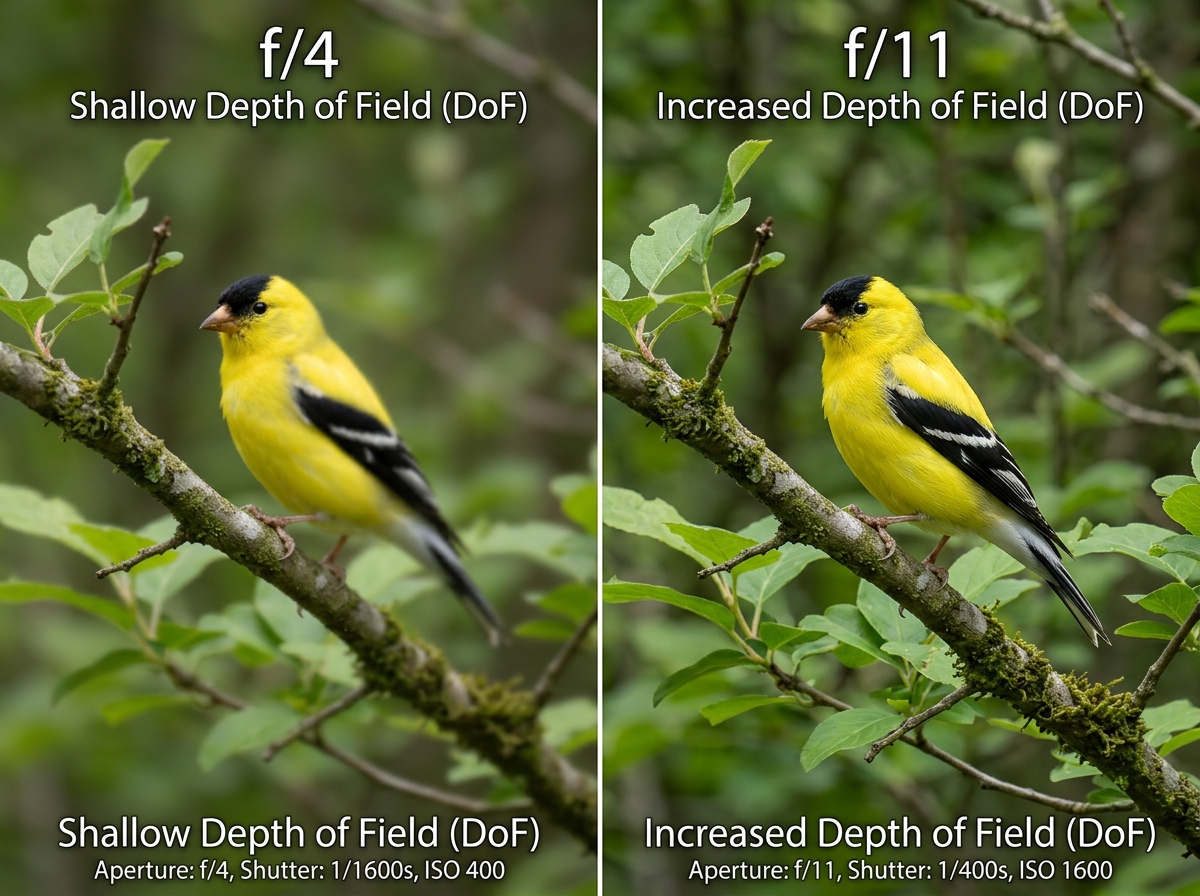
The most immediate impact of aperture is on the depth of field. This refers to the zone of “acceptable sharpness” in your image. In bird photography, we usually want a shallow depth of field to create that creamy, out-of-focus background (often called bokeh) that makes the bird “pop” from its surroundings. This subject isolation is what separates a professional-looking wildlife portrait from a cluttered snapshot.
However, there is a catch. If we use an aperture that is too wide (like f/2.8 or f/4), that zone of sharpness becomes razor-thin. We might get a perfectly sharp eye, but the bird’s beak, feet, or tail feathers might fall into a blur. This is why mastering camera settings for bird photography is so vital; you need to understand the trade-off between a beautiful background and a fully sharp subject.
Furthermore, every lens has a physical limit known as lens diffraction. When you close the aperture too much (think f/16 or f/22), the light waves begin to interfere with each other as they pass through the tiny opening, actually making the image less sharp. Finding the best aperture for bird photography means navigating the narrow path between “too blurry” and “diffraction soft.”
Finding the Best Aperture for Bird Photography Scenarios
Not all bird encounters are created equal. A tiny warbler flitting through dark branches requires a different approach than a Great Blue Heron standing stoically in a sunlit marsh.
For perched birds, we often have a bit more time to think. If the bird is close, we usually stop down to f/7.1 or f/8. Why? Because at close range, the depth of field is naturally shallower. To ensure the entire body of the bird is in focus, we need that extra bit of depth. If the bird is further away, we can often open up to f/5.6 because the distance itself increases the depth of field.
When it comes to birds in flight (BIF), the game changes. Speed is everything. We need fast shutter speeds (often 1/2000s or higher) to freeze the action. To achieve this without sending our ISO into orbit, we typically lean toward wider apertures like f/5.6. This lets in more light and helps isolate the bird from potentially busy backgrounds like trees or distant hills.
For group shots, such as a flock of ducks or a pair of nesting raptors, we must stop down further. An aperture of f/9 to f/11 is often necessary to ensure that birds at slightly different distances from the camera all remain sharp.
| Bird Size | Recommended Aperture | Reasoning |
|---|---|---|
| Small (Warblers, Finches) | f/5.6 – f/6.3 | Provides enough DOF for small bodies while keeping shutter speeds high. |
| Medium (Hawks, Owls) | f/7.1 – f/8 | Balances sharpness across larger wingspans. |
| Large (Eagles, Pelicans) | f/8 – f/10 | Necessary to keep the entire bird sharp from beak to tail tip. |
Learning how to balance these factors is a key part of adjusting exposure for bird photos effectively.
Why f/5.6 to f/8 is the best aperture for bird photography
You will often hear professionals refer to the “lens sweet spot.” Most lenses are not at their sharpest when used “wide open” (at their lowest f-number). Instead, they usually perform best when stopped down one or two clicks. For many popular telephoto zooms, this lands right in the f/7.1 to f/8 range.
By staying in this range, we achieve three things:
- Maximum Sharpness: We avoid the slight softness that can occur at f/4 or f/5.6 on some lenses.
- Forgiving Depth of Field: If our focus is off by just a fraction of an inch, f/8 might save the shot, whereas f/4 would result in a “miss.”
- Background Quality: We still get enough blur to isolate the subject without losing the “sense of place.”
In fact, research among experts shows that many shoot optimal aperture for birds in flight wide open only when light is scarce. When the sun is out, f/7.1 becomes the “90% rule” because it provides the safest margin for error while maintaining high image quality.
Choosing the best aperture for bird photography in low light
What happens when the sun goes down or you’re deep in a forest canopy? This is where those expensive f/4 prime lenses earn their keep. In low light, we often have no choice but to shoot wide open.
When shooting at f/4 or f/5.6 in the shade, your ISO will inevitably climb. While high ISO used to be the enemy of bird photographers, modern cameras are incredibly capable. We no longer fear ISO 3200 or even 6400 as much as we used to. Furthermore, tools like Topaz Photo AI for high-ISO recovery can work wonders in post-processing, removing noise while retaining the fine detail of feathers. It is always better to have a sharp, noisy photo than a clean, blurry one!
How Distance and Sensor Size Influence Your Settings
One of the most overlooked factors in choosing the best aperture for bird photography is the distance between you and the bird.
Physics tells us that the closer you are to your subject, the shallower the depth of field becomes. For example, if we use a 600mm lens with a 1.4x teleconverter (giving us 840mm) at f/5.6, and the bird is 50 feet away, our depth of field is a tiny 4 inches. If we stop down to f/10, that zone doubles to about 8 inches.
Now, imagine that same bird is 80 feet away. At f/5.6, our depth of field increases to 1 foot. If we stop down to f/8, it grows to 1.42 feet—a 42% increase. This is why distance is the “hidden variable” in your exposure triangle. You can check these specifics for your own gear using a DOF Master Calculator.
Sensor size also plays a role. Jim Neiger, a renowned bird photographer, suggests a “rule of thumb” for full bird sharpness when the bird fills about 50% of the frame:
- Full-frame cameras: Use at least f/8.
- Crop-sensor (1.3x) cameras: Use f/7.1.
This is because crop sensors provide a bit more effective depth of field at the same aperture compared to full-frame sensors. When deciding on your gear, it’s worth comparing DSLR vs Mirrorless for bird photography to see which sensor format fits your style of shooting.
Essential Autofocus and Camera Settings for Sharp Birds
Even the perfect aperture won’t save a photo if the focus is on the tail instead of the eye. To get those “tack-sharp” shots, we recommend a few specific settings.
First, use Back-Button Focus. By moving the focus function from the shutter button to a button on the back of the camera (usually labeled AF-ON), we separate the act of focusing from the act of taking the picture. This allows us to track a bird continuously without accidentally losing focus when we press the shutter.
Second, always use Continuous Autofocus (AF-C on Nikon/Sony or AI Servo on Canon). Birds are rarely perfectly still. Even a perched bird is swaying slightly in the wind. Continuous AF ensures the camera is constantly micro-adjusting. Modern mirrorless cameras also offer animal eye tracking, which is a total game-changer for birders. It locks onto the eye and stays there, even as the bird moves its head.
Pair these with a high-speed continuous shooting mode (burst mode) to capture the exact moment of a wing beat or a catch. For more detail, check out our beginners guide to bird photography key settings.
Does aperture affect autofocus performance?
This is a common point of confusion. Many photographers believe that if they set their aperture to f/11, the camera will have a harder time focusing because less light is reaching the sensor.
The truth? On most modern cameras, the lens stays wide open while you are focusing. The aperture only “stops down” (closes) to your selected setting the exact millisecond you press the shutter to take the photo. This means that whether you choose f/4 or f/11, your camera is using the maximum light transmission of the lens to find focus.
However, there is an exception: if you use teleconverters, your maximum aperture might drop to f/8 or f/11 (for example, putting a 2x converter on an f/5.6 lens). In these cases, the AF might slow down or stop working on older DSLR bodies. It’s important to understand the specific camera settings for bird lenses you are using.
Frequently Asked Questions about Bird Aperture
Should I always shoot wide open for maximum bokeh?
While we all love a “melted” background, shooting wide open (f/2.8 or f/4) is risky. As we mentioned, the depth of field can be so shallow that the eye is sharp but the beak is blurry. This is especially true for larger birds or close-up portraits.
We find that f/7.1 is the perfect versatility setting. It provides enough depth to keep the bird’s features sharp while still delivering a beautiful, non-distracting background. If you want to dive deeper into the aesthetics, our captivating bird photography guide offers more tips on composition and light.
What is the sharpest aperture for telephoto lenses?
Most telephoto lenses have a “sweet spot” about 1 to 2 stops down from their widest setting. For an f/5.6 lens, this is usually f/8. For an f/4 lens, it’s often f/5.6 or f/7.1.
Testing your own gear is easy: set your camera on a tripod, photograph a static object (like a cereal box with fine text) at every aperture, and compare them at 100% zoom on your computer. You’ll likely see that f/8 is noticeably crisper than f/5.6. To understand the hardware better, read our comparison of telephoto lens vs zoom lens for birds.
How do I handle multiple birds in one frame?
If you have two birds on a branch and one is slightly behind the other, f/5.6 will almost certainly leave one of them blurry. In these scenarios, we recommend stopping down to f/11 or even f/16 if the light allows.
This increases the depth of field enough to bring both subjects into the “zone of sharpness.” Just remember that as you stop down, you’ll need to increase your ISO or slow your shutter speed to maintain a good exposure. We cover these advanced maneuvers in our guide on mastering bird photography essential camera settings.
Conclusion
At Ciber Conexão, we believe that technical settings are the foundation upon which creative vision is built. Finding the best aperture for bird photography isn’t just about following a chart—it’s about understanding the environment, the bird’s behavior, and the limits of your gear.
Hugo Andrade often reminds our students that the shot doesn’t end in the camera. Even if you didn’t get the perfect background blur in the field, expert photo editing and cropping for composition can help emphasize your subject and remove distractions. Sometimes, a slightly wider shot taken at f/8 (for sharpness) can be cropped down to create the perfect intimate portrait.
To summarize our expert roundup:
- Start at f/7.1 for almost everything.
- Open to f/5.6 for birds in flight or very low light.
- Stop down to f/11 for groups or extreme close-ups.
- Always prioritize the eye and use back-button focus.
By mastering these settings, you’ll spend less time worrying about your dials and more time enjoying the incredible beauty of the birds in your viewfinder. For more deep dives into digital photography, explore our more photography tips and editing guides. Happy shooting!
