
Why the Different Types of Composition in Photography Transform Ordinary Shots
The different types of composition in photography determine whether your photo stops someone mid-scroll — or gets ignored completely.
Here’s a quick overview of the most common types:
| Composition Type | What It Does |
|---|---|
| Rule of Thirds | Places subjects off-center for natural balance |
| Symmetry & Centered | Creates formal, mirror-like balance |
| Leading Lines | Guides the viewer’s eye toward the subject |
| Negative Space | Uses empty areas to make the subject stand out |
| Frame Within a Frame | Uses elements like arches or windows to isolate the subject |
| Golden Ratio | Applies a natural, mathematical spiral for organic balance |
| Foreground/Layers | Adds depth with elements at multiple distances |
| Patterns & Repetition | Creates rhythm and visual interest |
| Diagonals & Triangles | Adds energy and dynamic tension |
| Fill the Frame | Removes distractions by zooming in tight on the subject |
You’ve probably been there: you come home after a shoot, excited to review your photos, only to find they look flat and forgettable. The lighting was fine. The subject was interesting. But something feels off.
Most of the time, that “something” is composition.
Think of composition as the foundation of your photo. You can edit brightness, fix colors, and sharpen details — but no amount of post-processing can fix a weak foundation. A poorly composed shot stays a poorly composed shot.
The good news? Composition isn’t a talent. It’s a set of learnable techniques. And once you understand them, you’ll start seeing better photos before you even press the shutter.
This guide breaks down every major composition type in plain language — so you can go from snapshots that lack impact to images that tell a story.

Understanding the Different Types of Composition in Photography
When we talk about composition, we aren’t just talking about where you put the person or the tree in your frame. We are talking about the “architecture” of your image. Imagine building a house; you wouldn’t start by picking out the curtains and the paint colors (the editing) before you’ve poured a solid concrete foundation and raised the walls.
The different types of composition in photography are that foundation.
The Foundation of a House Analogy
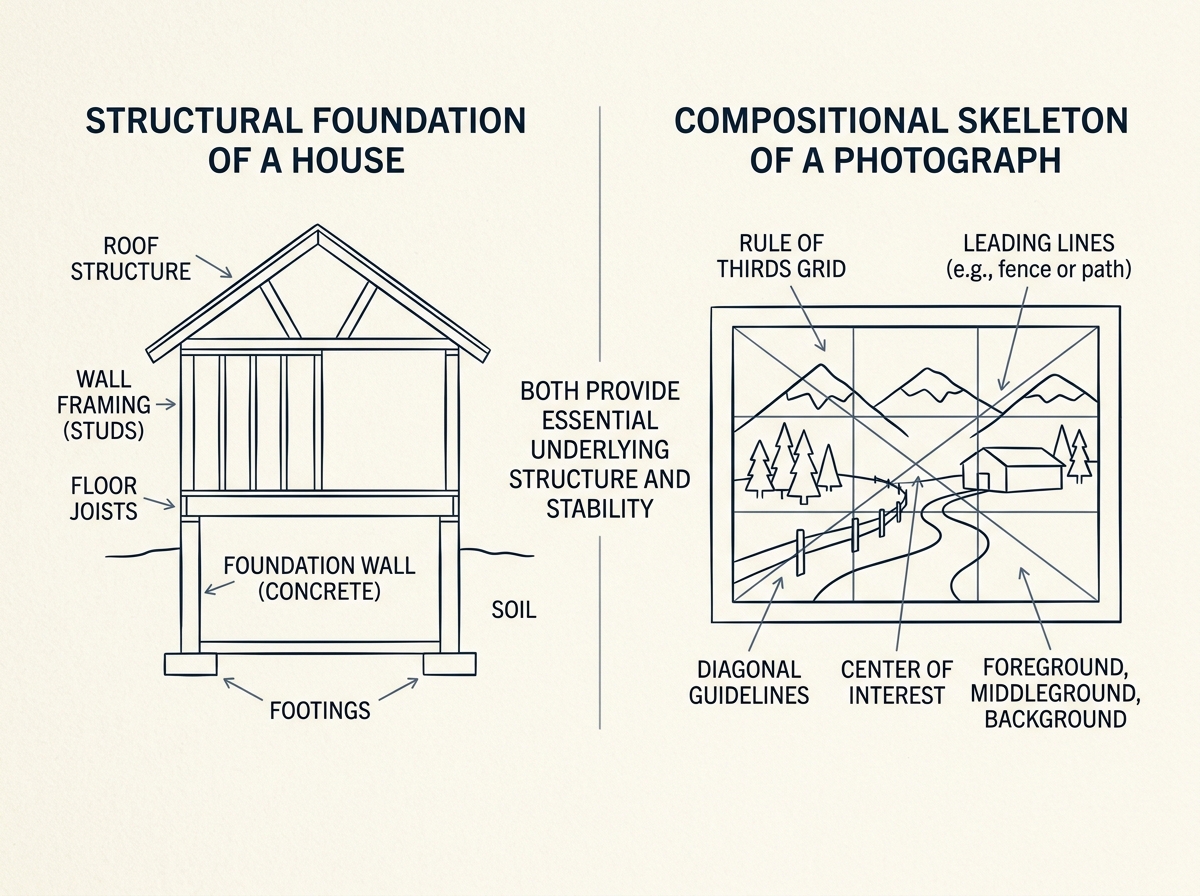
When we look at a scene, our eyes naturally seek order. If a photo is cluttered, our brains get tired and move on. If it’s well-composed, our eyes are “guided” through the image in a specific path. This is achieved through visual weight. Elements like high contrast, bright colors, or sharp focus carry more weight and pull the eye first.
By understanding how to place these weights, we can choose between balance (which feels stable and calm) or tension (which feels energetic and slightly “unstable” in a good way). We dive deeper into these core concepts in the-ultimate-guide-to-better-photo-composition, but for now, every element in your frame should have an intention. If an element doesn’t add to the story, it’s likely taking away from it. This is often called the “art of subtraction.”
Essential Rules for Visual Balance and Harmony
Before we get fancy with spirals and triangles, we need to understand how to make an image feel “right.” This usually comes down to how we balance the elements within the frame geometry.
| Feature | Symmetrical Balance | Asymmetrical Balance |
|---|---|---|
| Feeling | Formal, orderly, stable, calm | Dynamic, modern, energetic |
| Subject Placement | Dead center or mirrored | Off-center, balanced by another object |
| Best For | Architecture, reflections, portraits | Landscapes, street photography, action |
| Difficulty | Easy to spot, hard to perfect | Requires “feeling” the visual weight |
One of the best ways to achieve harmony is through simplicity. New photographers often try to cram too much into one shot. We recommend decluttering your scene until only the essential point of interest remains. Whether you are choosing between vertical-or-horizontal-framing-tips-for-bird-photography or shooting a vast landscape, the goal is the same: clarity.
The Rule of Thirds: The Most Popular Type of Composition in Photography
If there is one “rule” that every photographer learns first, it’s the Rule of Thirds. Most cameras and smartphones even have a setting to display this grid on your screen.
The concept is simple: divide your frame into a 3×3 grid (like a tic-tac-toe board). Instead of putting your subject right in the middle, you place them along one of the vertical or horizontal lines, or—even better—at the points where those lines intersect. These intersections are often called “power points.”
Why does this work? It creates a more “natural” flow. When a subject is centered, the eye has nowhere else to go. When it’s off-center, the viewer’s eye travels across the frame to find the subject, making the experience more engaging. For landscapes, try placing your horizon line on the top third (to emphasize the ground) or the bottom third (to emphasize a dramatic sky).
Symmetry and Centered Composition
Wait, didn’t we just say centering is boring? Not always! While the Rule of Thirds is great for movement, symmetry is the king of stability and power.
Symmetry works best when you have a clear vertical or horizontal axis. Think of a perfectly still lake reflecting a mountain, or a long hallway in an old cathedral. Centered composition works here because the “formal balance” is the point of the photo. It conveys a sense of architectural precision and minimalist impact that off-center shots can’t match.
Advanced Techniques to Guide the Viewer’s Eye
Once you’ve mastered balance, you can start playing with “eye flow.” This is how you lead a viewer on a journey through your photo.
Leading lines are one of the most powerful tools in your kit. These are literal or implied lines—like a road, a fence, or even a row of trees—that point directly toward your subject. Diagonals and zigzags add a sense of action and “dynamic tension.” If a horizontal line feels like a person lying down (stable), a diagonal line feels like a person running (unstable and fast).
When we are exploring-angles-and-perspectives-in-bird-photography, we often look for these lines in nature to guide the viewer toward a small subject. S-curves, often found in rivers or winding paths, are particularly beautiful because they slow the viewer down, making their eye “wander” gracefully through the frame.
The Golden Ratio and Mathematical Perfection
If the Rule of Thirds is the “beginner” version of balance, the Golden Ratio (or Phi Grid) is the “pro” version. Based on a mathematical constant of approximately 1.618, this ratio has been used by artists and architects for thousands of years. You can find extensive scientific research on the Golden Ratio in nature and art that explains why this specific proportion is so pleasing to the human eye.
The most famous application is the Fibonacci Spiral. This spiral mimics the growth patterns found in nautilus shells, sunflowers, and even galaxies. In photography, placing your subject at the smallest part of the spiral creates a composition that feels incredibly “organic” and “right” to the human brain.
While the Rule of Thirds is a 1:1:1 ratio, the Golden Ratio is roughly 1:0.618:1. It places the subject slightly closer to the center than the Rule of Thirds does. Is it practical? Absolutely. While you might not calculate math in the field, many modern cameras allow you to toggle a “Golden Spiral” overlay in the viewfinder.
Mastering Depth with Different Types of Composition in Photography
A photograph is a two-dimensional representation of a three-dimensional world. To keep your photos from looking “flat,” you need to create the illusion of depth.
We do this by thinking in layers:
- Foreground: Something close to the lens (a rock, flowers, a branch).
- Middle-ground: Where the main action usually happens.
- Background: The setting or horizon.
Using foreground interest gives the viewer an “entry point” into the photo. Linear perspective (where parallel lines appear to converge in the distance) and atmospheric perspective (where distant objects look lighter and bluer) also help create that sense of three-dimensionality.
Creative Elements: Space, Framing, and Patterns
Sometimes, what you don’t include is just as important as what you do.
Negative space refers to the empty areas around your subject. By giving your subject “breathing room,” you emphasize their importance and create a sense of calm or isolation. This is particularly effective when composing-bird-photos-with-urban-backgrounds, where a busy city can be simplified by finding a patch of clear sky or a solid-colored wall.
Frame Within a Frame
This is a classic technique for adding depth and isolating your subject. Instead of just the edge of your photo being the “frame,” you find something inside the scene to act as a second border.
Common frames include:
- Architectural arches or doorways.
- Overhanging tree branches.
- Windows or mirrors.
- Even holes in a fence!
This technique forces the viewer’s eye straight to the subject and adds a layer of mystery or context to the image.
Patterns, Repetition, and Rhythm
The human brain loves patterns. Repetition creates a visual “rhythm” that can be very soothing. Think of a row of identical beach chairs or the windows on a skyscraper.
However, the most interesting photos often break the pattern. If you have ten green apples and one red apple, the red one becomes an instant focal point. We also like to use the Rule of Odds, which suggests that an odd number of subjects (like three birds instead of two) feels more natural and less “staged” to the eye.
Frequently Asked Questions about Photo Composition
Why is composition more important than camera settings?
You can have the most expensive camera in the world, but if the “bones” of your photo are messy, the image will still be boring. Composition is about how you see and what you say with your camera. Settings like ISO and shutter speed are technical tools, but composition is the soul of the image. A well-composed smartphone photo will almost always beat a poorly composed “pro” photo.
When is it appropriate to intentionally break the rules of composition?
The old saying goes: “Learn the rules like a pro so you can break them like an artist.” You should break the rules when doing so helps you tell a specific story. For example, if you want a subject to feel trapped or uncomfortable, you might “awkwardly” crop them or place them right against the edge of the frame. Breaking the rules should be a choice, not an accident.
How does focal length affect the way I compose a shot?
Wide-angle lenses (like 16mm or 24mm) exaggerate the distance between objects, making foreground elements look huge—perfect for “leading lines.” Telephoto lenses (like 200mm) “compress” the scene, making the background look closer to the subject. This is called lens compression, and it’s a great way to simplify a busy background.
Conclusion
Mastering the different types of composition in photography is a lifelong journey, but it starts with a single step: being intentional. Before you click that shutter, take a second to look at the corners of your frame. Is there a distracting branch? Is your subject too centered? Could you get lower to the ground to add foreground interest?
At Ciber Conexão, we believe that great photos are made in the mind before they are captured by the sensor. Our expert, Hugo Andrade, always emphasizes that post-processing refinement is the final touch to a great composition. If you didn’t get it perfect in-camera, don’t worry—you can often fix minor issues with smart cropping. Check out our crop-and-composition-editing-tips to see how to save a “near-miss” shot.
The best way to improve is to practice. Pick one technique from this guide—like Leading Lines or the Rule of Thirds—and spend an entire weekend shooting nothing but that. You’ll be amazed at how quickly your “photographic eye” develops. For more deep dives, explore our More expert photography tips and tutorials. Happy shooting!
