
Why Good Composition Transforms Your Photos Instantly
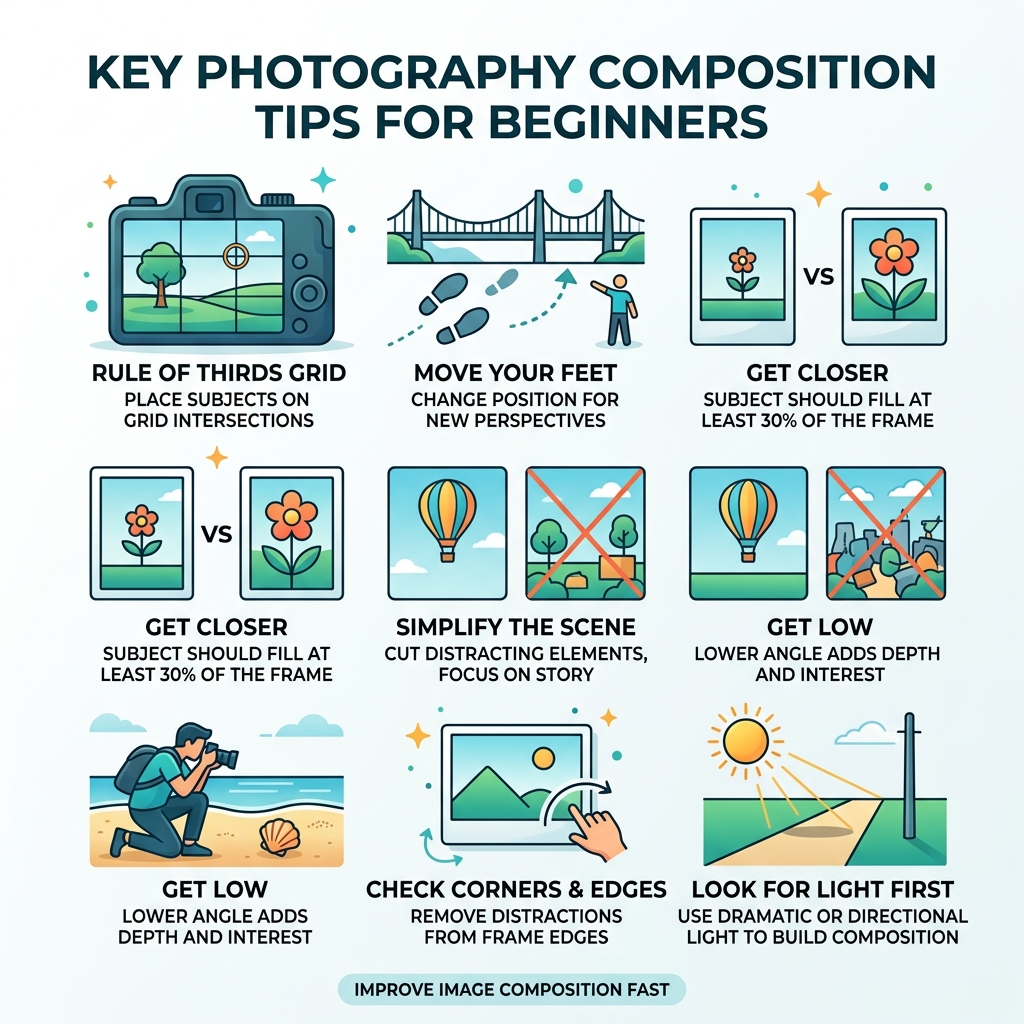
Improve image composition fast with these quick techniques:
- Turn on your Rule of Thirds grid — place your subject on a gridline intersection, not dead center
- Move your feet — change your physical position instead of relying on zoom
- Get closer — your subject should fill at least 30% of the frame
- Simplify the scene — include only what adds to the story, cut the rest
- Get low — a lower angle adds depth, texture, and foreground interest
- Check your corners and edges — remove distracting elements before you shoot
- Look for light first — dramatic or directional light does half the composition work for you
Most people think better photos come from better cameras. They don’t.
As Henri Cartier-Bresson said: “It is an illusion that photos are made with the camera — they are made with the eye, heart and head.”
Composition is how you arrange what’s inside your frame. It controls where the viewer’s eye goes, what they feel, and whether they keep looking. A well-composed photo pulls people in. A poorly composed one loses them in seconds.
The good news? Composition is a skill, not a talent. You can learn it fast. And most of the fixes are free — no expensive gear or software required.
This guide gives you practical, immediately usable techniques to go from flat, forgettable shots to images that actually connect.
The Fundamentals: Essential Rules to Improve Image Composition Fast
If photography is a language, composition is the grammar. Without it, your message gets lost in the noise. To improve image composition fast, we need to look at the “tried-and-true” frameworks that have guided artists for centuries.
The Rule of Thirds
This is the “bread and butter” of photography. Most cameras and smartphones have a grid feature that divides the screen into nine equal rectangles. Instead of placing your subject dead center—which can often feel static and boring—place them along one of the vertical or horizontal lines, or better yet, at the four intersection points. These “power points” are where the human eye naturally gravitates first.
Leading Lines and Diagonals
Leading lines act as a visual roadmap for your viewer. They can be anything: a road, a fence, a shoreline, or even a row of trees. When these lines lead toward your main subject, they create a powerful sense of direction.
Diagonals, on the other hand, introduce “dynamic tension.” While horizontal and vertical lines suggest stability (think of a horizon or a building), diagonals suggest movement and energy. An ascending diagonal (bottom left to top right) often feels like a challenge or progress, while a descending one can feel more relaxed or stable.
Visual Weight and Balance
Every element in your photo has “visual weight.” Bright colors, high contrast, and sharp details pull the eye more than muted, blurry areas. Balance doesn’t always mean symmetry. You can achieve “dynamic balance” by placing a large subject on one side and balancing it with a smaller, high-contrast element or significant negative space on the other.
| Feature | Rule of Thirds | Golden Ratio (Fibonacci) |
|---|---|---|
| Complexity | Simple; easy to apply instantly. | More complex; based on mathematical spirals. |
| Visual Feel | Clean, organized, and modern. | Natural, organic, and harmonious. |
| Best For | Quick shots, street, and action. | Fine art, landscapes, and portraits. |
| Grid Layout | 1:1:1 equal segments. | 1:0.618:1 segments (approx). |
Symmetry and Centered Composition
While we often warn against “bullseye” shots, symmetry is the exception. When you have a perfectly reflective lake or a grand architectural hallway, centering the subject creates a sense of awe and formal beauty. The key is intentionality—if you’re going to center it, make it perfect.
Change Your Perspective: Move Your Feet, Not Your Zoom
One of the biggest culprits of “lazy” photography is the zoom lens. When we stand in one spot and just twist the glass, we miss out on thousands of potential angles. To improve image composition fast, we must embrace physical movement.
The “Get Low” Revolution
Getting low is perhaps the single most effective piece of advice for landscape and street photographers. By dropping your camera closer to the ground, you instantly exaggerate the foreground. This makes textures like sand, grass, or cobblestones feel tactile. It also helps separate the layers of your image, preventing the foreground, midground, and background from “pancaking” into a flat mess.
In bird photography, this is crucial. As we discuss in our guide on exploring angles and perspectives in bird photography, getting down to the bird’s eye level creates an intimate connection that looking down from a standing height simply can’t match.
Subject Intimacy and Focal Points
Robert Capa said, “If your pictures aren’t good enough, you’re not close enough.” Moving your feet to get physically closer to a subject creates intimacy. It forces you to exclude the “extra” stuff that doesn’t matter.
When you’re deciding how to frame, consider your orientation. We offer specific vertical or horizontal framing tips for bird photography that apply to almost any subject: vertical frames emphasize height and power, while horizontal frames emphasize breadth and environment.
Wide-Angle vs. Telephoto Perspective
A wide-angle lens (anything below 35mm) is great for “vastness,” but it can also distort subjects if you’re too close. A telephoto lens (60mm and above) compresses the scene, making distant objects appear closer to the foreground. Understanding this allows you to “build” your photo layer by layer rather than just capturing a random slice of the world.
Simplify the Scene: The Power of Threes and Negative Space
A common beginner mistake is trying to fit too much into the frame. Great composition is often about subtraction, not addition.
The Rule of Odds
Humans have a strange psychological quirk: we find odd numbers of objects more attractive than even ones. Three birds on a wire look more “composed” than two or four. Thinking in “threes”—one main subject and two supporting elements—creates a natural triangle that keeps the eye moving within the frame.
Breathing Space and Negative Space
Negative space is the “empty” area around your subject. It’s not “wasted” space; it’s “breathing space.” It allows the viewer’s eye to rest and ensures the subject remains the undisputed hero of the shot. This is especially useful when making urban birds stand out in photos, where the background can often be a cluttered mess of wires and signs.
Check Your Corners and Edges
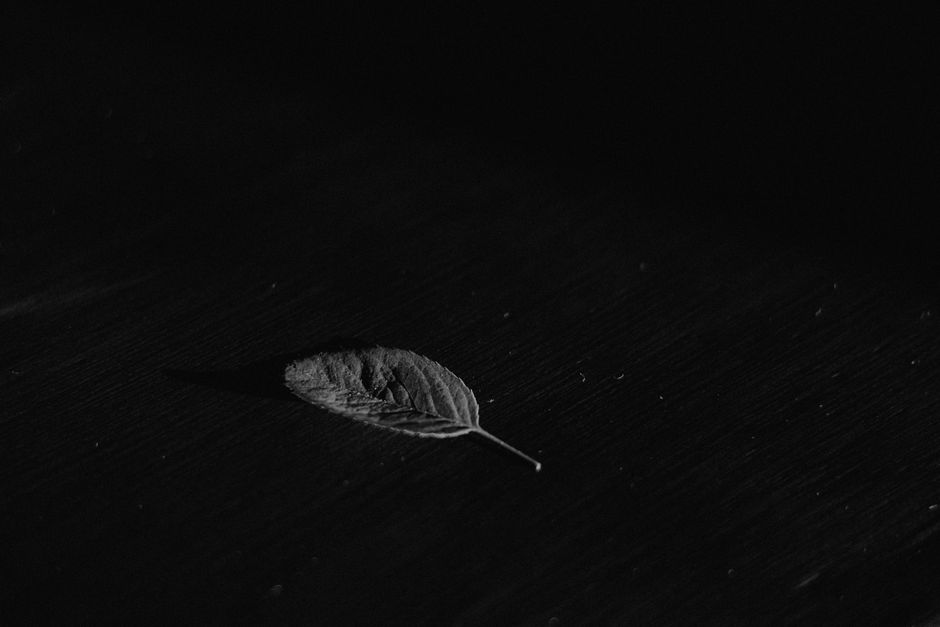
Before you press the shutter, do a “perimeter check.” Are there any stray branches, trash cans, or bright spots cutting into the edges of your frame? These small distractions pull the eye away from your subject. If you see them, move your feet or shift your angle slightly to “clean” the edges.
Use Light and Layers to Create Depth Instantly
Photography is the art of capturing 3D life on a 2D surface. To make a photo feel “real,” you need to create the illusion of depth.
Building Layers: Foreground, Midground, Background
A flat photo usually only has one layer. A compelling photo has three.
- Foreground: An object close to the lens (a rock, a flower, a dock cleat) that anchors the viewer.
- Midground: Where the main action or subject usually lives.
- Background: The context (mountains, the sky, a city skyline).
When you are composing bird photos with urban backgrounds, using these layers helps the subject pop against the busy environment.
Side Lighting and Texture
Front lighting (light coming from directly behind the photographer) is often the “death” of composition because it flattens everything. Side lighting, however, casts shadows that reveal texture and volume. Whether it’s the ripples in a sand dune or the feathers on a wing, light from the side makes objects look three-dimensional.
Chiaroscuro and Atmospheric Perspective
Chiaroscuro is the use of strong contrasts between light and dark. By placing your subject in a pool of light against a dark background, you create instant drama. Similarly, “atmospheric perspective”—where distant objects look lighter and bluer due to haze—naturally tells the brain that the scene has immense scale.
Refine Your Vision: Post-Processing and Digital Adjustments
Sometimes, the perfect composition happens after the shot. While we always advocate for getting it right in the camera, post-processing is a powerful tool for refinement.
Pre-visualization
Ansel Adams championed the idea of “pre-visualization”—seeing the finished print in your mind before you even take the photo. This mental discipline helps you choose the right crop and tonal balance later.
Quick Cropping Techniques to Improve Image Composition Fast
Cropping is the fastest way to fix a “near-miss” composition. If your subject is a bit too centered or there’s a distracting element at the edge, a quick crop can save the day.
At Ciber Conexão, we emphasize crop and composition editing tips that go beyond just “cutting the edges.” We look at:
- Frame Rotation: Leveling that slightly tilted horizon (a huge distraction!).
- Digital Zooming: Tightening the frame to ensure the subject fills at least 30% of the space.
- Aspect Ratios: Switching from a standard 3:2 to a panoramic 16:9 or a cinematic 2.35:1 to change the mood of the story.
Using AI and Grids to Improve Image Composition Fast
Modern technology has given us “smart” assistants. Many editing suites now offer AI-driven composition suggestions that can automatically identify the most pleasing crop based on the Rule of Thirds or the Golden Ratio.
For those working in the digital art space, there are systematic ways to refine images. As noted in the practical checklist for refining AI art, you can use iterative passes to establish color hierarchy and shape rhythm, ensuring the final result feels “composed” by a human eye rather than just an algorithm.
Frequently Asked Questions about Image Composition
What is the fastest way to fix a boring photo?
The fastest way is to simplify. Look at the photo and ask, “What is the one thing I want people to see?” Crop out everything else. Often, a boring photo is just a “busy” photo where the subject is lost in the clutter.
Should I always follow the Rule of Thirds?
No! Think of it as a “default setting” rather than a law. Once you understand why it works (balance and eye flow), you’ll know when to break it. Use centered symmetry for impact or “extreme” framing (putting the subject way off to one corner) to create a sense of isolation or vastness.
How does getting low change a landscape photo?
Getting low exaggerates the “near-to-far” relationship. It makes the foreground elements appear larger and more detailed, which pulls the viewer into the scene. It also helps separate the horizon from the foreground, creating a clearer sense of space.
Conclusion
To improve image composition fast, you don’t need to memorize a textbook. You just need to slow down and be intentional. Before you click the shutter, ask yourself: Where is the light? Is the background clean? Can I get closer?
Composition is a journey of training your eye. Start by picking just one of these techniques—like the Rule of Odds or getting low—and spend an entire day practicing only that. You’ll be amazed at how quickly your “vision” develops.
At Ciber Conexão, we believe that everyone can take professional-quality photos with the right guidance. For more in-depth advice on refining your shots, check out our more photography editing tips and tutorials. Happy shooting!
