
What Urban Street Photography Really Is (And Why It’s Worth Mastering)
Urban street photography is the art of capturing candid, unposed moments in city environments — from bustling crowds and dramatic architecture to quiet alleys and unexpected details.
Here’s a quick breakdown of what it involves:
- Subject: People, places, objects, or abstract scenes found in urban spaces
- Style: Candid and unplanned — you react to what the city gives you
- Goal: Reveal something beneath the surface — emotion, irony, beauty, or story
- Equipment: Any camera works; lightweight mirrorless cameras are popular for city shooting
- Key skills: Composition, timing, light awareness, and observation
It’s different from general photography because the city itself becomes your studio — unpredictable, layered, and always changing.
Whether you’re drawn to documenting human stories, hunting for geometric patterns in architecture, or chasing the perfect shaft of light between buildings — urban street photography rewards those who learn to see before they shoot.
The challenge most amateur photographers face isn’t the camera. It’s knowing what to look for and how to frame it once you find it. A technically sharp photo can still feel flat. And a slightly imperfect shot can be unforgettable — if the composition and timing are right.
This guide walks you through everything: styles, techniques, gear, ethics, and how to develop your own visual voice in the city.
Mastering Urban Street Photography: An Introduction
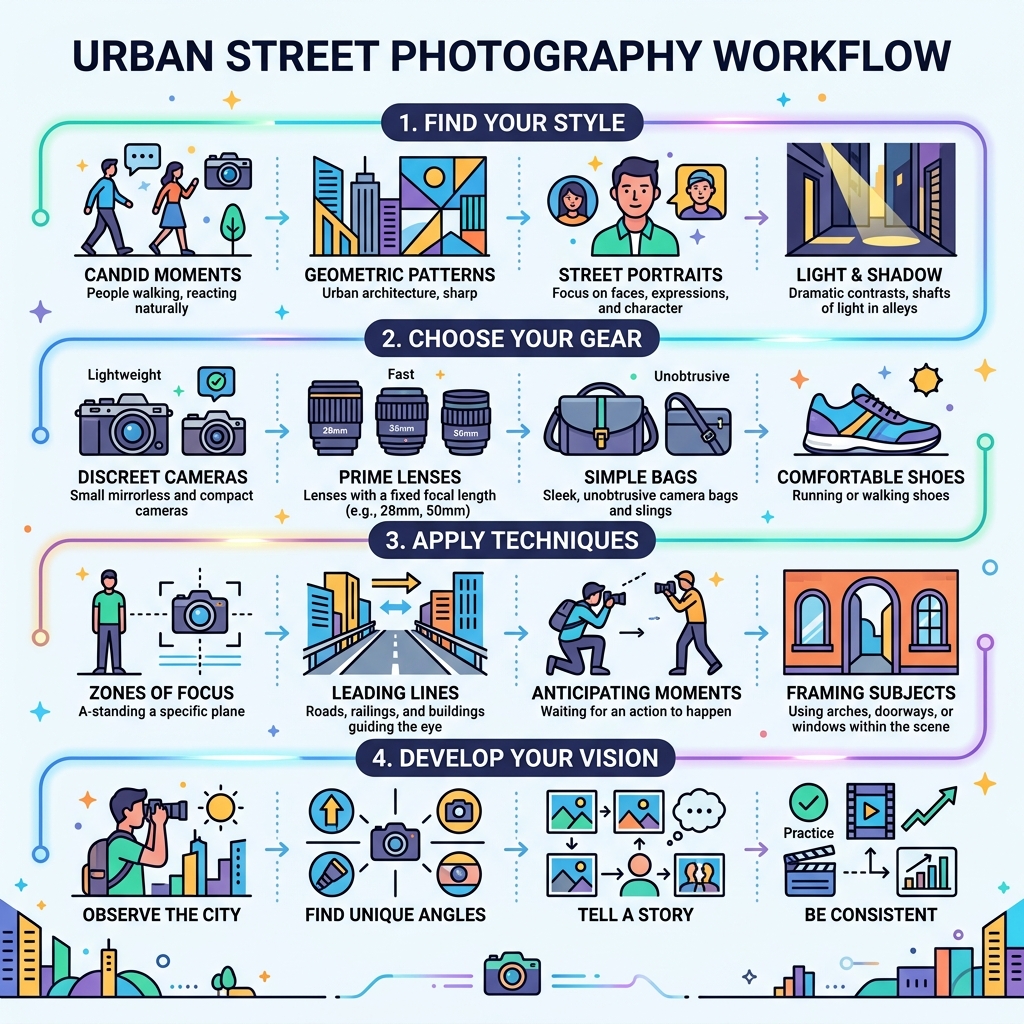
When we step out into the “concrete canyon,” we aren’t just taking pictures; we are engaging in urban street photography. This genre is a dance between instinct and observation. Unlike studio photography, where every light is placed with intention, the city offers a raw, unfiltered stream of data. Our job is to filter that noise into a visual story.
Mastering this craft requires what some call “instinctual seeing”—the ability to stop solving technical puzzles and start reacting to the world. It’s about the “vibe” of the city, the history etched into its walls, and the fleeting expressions of its inhabitants. Whether you are exploring a famous landmark or a quiet suburban municipality, the goal remains the same: to find the extraordinary within the ordinary.
Defining Urban Street Photography and Its Core Styles
One of the most common misconceptions is that urban street photography is just “taking pictures of people on the street.” In reality, it is a broad buffet of styles. Some photographers focus on the “social documentary” aspect, capturing the human condition and social issues like homelessness or gentrification. Others lean toward “urban fine art,” where the focus shifts to aesthetics—how light hits a building or how shadows create a graphic shape.

To help us navigate these styles, we can categorize them based on their intent:
| Style | Primary Focus | Key Elements |
|---|---|---|
| Social Documentary | Human Story | Emotion, social issues, historical context |
| Urban Fine Art | Aesthetics | Shapes, textures, light, and shadow |
| Poetic Style | Atmosphere | Haze, reflections, soft light, painterly feel |
| Geometric | Structure | Lines, symmetry, architectural patterns |
| Light Aesthetic | Contrast | Hard shadows, “Instagram-friendly” high contrast |
The “Clever” style is another popular one—think of it as the “Marmite” of photography. You either love it or hate it. It involves juxtapositions, like a person walking past a billboard that makes it look like they have wings. While fun, the most enduring images often come from “Complex” street photography, where multiple layers of action happen within a single frame.
The Evolution of the Genre
The genre has evolved significantly from the days of Henri Cartier-Bresson and his “decisive moment.” Masters like William Klein brought a raw, gritty energy to the streets, while Harry Gruyaert revolutionized the use of color, showing that the palette of the city is just as important as the subject.
Today, urban street photography is more diverse than ever. Community groups on platforms like Facebook and Instagram have democratized the art form. Projects like Humans of New York (HONY) have shown that a simple street portrait can evolve into a global storytelling phenomenon, reaching over 29 million followers across social media. This global diversity means that whether you are in Berlin, Tokyo, or a small town in Peru, there is a story waiting to be told.
Mastering Visual Techniques in the City
To make a photo stand out, we must master composition. The city is cluttered, and our job is to simplify it. Using The Ultimate Guide to Better Photo Composition can help you understand how to guide the viewer’s eye through a chaotic scene.
In the urban environment, we look for “leading lines”—subway tracks, rows of streetlights, or the edges of skyscrapers—to create depth. We also look for “graphic shapes” created by the sun cutting through buildings. This is often referred to as “shadow work.” By exposing for the highlights and letting the shadows go dark, we create mystery and drama. Interestingly, these same principles apply when Composing Bird Photos with Urban Backgrounds, where the architectural geometry provides a striking contrast to organic subjects.
Lighting and Timing in Urban Street Photography
Timing is everything. The “Golden Hour” and “Blue Hour” are classic favorites for their soft, evocative light. However, don’t ignore mid-day shadows. The harsh sun of noon can create intense contrast that is perfect for minimalist or geometric shots.
When it comes to camera settings, we often have to make trade-offs. If you are Photographing Rare City Birds: The Role of Camera Settings, you might need a very fast shutter speed. The same applies to street photography. To freeze a person walking, aim for at least 1/250th of a second. If light is low, don’t be afraid to push your ISO. Modern cameras can handle ISO 3200 or even 6400 with minimal “noise,” and sometimes that grain adds to the urban “gritty” vibe.
For a different look, try long exposures. Using a tripod and a slow shutter speed (2 to 6 seconds) can turn a rushing crowd into a ghostly blur, emphasizing the relentless pace of city life.
Color vs. Black and White Approaches
The choice between color and black and white (B&W) is a powerful storytelling tool. B&W is the “daring side” of urban street photography. It strips away distracting colors—like a bright orange backpack that ruins a somber scene—and forces the viewer to focus on visual patterns, textures, and emotions.
Color, on the other hand, can be used to create mood. A neon sign in the rain or the specific “drabness” of a winter day in Berlin tells a specific story. Harry Gruyaert once noted that color composition is a “fine art” in itself. If the colors in your frame don’t harmonize, consider a B&W conversion to “save” the shot and add a touch of timeless mystery.
People vs. Place: Finding Narrative in Every Corner
Does a street photo need a person? This is a debated topic. While the “human element” provides an immediate emotional hook, the “place” can be just as vocal.
Candid moments are the bread and butter of the genre. Like the legendary Brandon Stanton of Humans of New York, we look for expressions and gestures that reveal a person’s inner world. A successful street portrait doesn’t just show what someone looks like; it shows who they are.
Capturing the “Footprints of Man” Without People
If you prefer a quieter approach, focus on the “footprints of man.” This means photographing the effects of people without them being physically present. Urban landscapes, abandoned structures, and interesting objects—like a lone payphone or a row of empty chairs—can tell a haunting story of what once was.
Developing Your Vision in Urban Street Photography
Developing a unique vision is a journey. It starts with an intuitive approach—walking without a fixed “concept” and letting the street provide the motifs. Some photographers find that street photography even helps them overcome creative burnout, as it brings them back to the simple joy of seeing.
Embrace ambiguity. A photo that is a bit of a puzzle—where the viewer has to guess what is happening—is often more engaging than one that explains everything. As we develop our observation skills, we start to see “fine art motifs” in cracked windows, broken pavements, and the way light reflects off a puddle.
Practical Gear, Ethics, and Field Tips
You don’t need the most expensive gear to excel at urban street photography. In fact, “less is more.”
- Cameras: Mirrorless systems are ideal because they are lightweight and less intimidating to strangers. If you’re looking for portability, Compact Cameras for Urban Bird Photography are also excellent choices for street work.
- Lenses: A 35mm or 50mm prime lens is a street photographer’s best friend. They are fast, sharp, and force you to move your feet to get the shot.
- Support: While we usually shoot handheld, Camera Tripods for Urban Photography are essential for night shots or long exposures.
- Weather Protection: Don’t let rain stop you. Some of the best shots happen in “bad” weather. A DIY rain cover made from a plastic bag and gaffer tape works wonders.
Navigating Ethics and Safety in Public Spaces
Ethics is a major pillar of the craft. While it is generally legal to take photos in public spaces, we must use “street smarts.” Building trust is essential if you are doing long-term documentary work. Sometimes, a simple smile or a business card can de-escalate a tense situation.
Respect boundaries. If someone clearly doesn’t want their photo taken, move on. The goal is to document life, not to harass people. As Jens Krauer suggests, “Documentation is love”—it should come from a place of respect for the subject.
Frequently Asked Questions about Urban Street Photography
Do I need permission to take photos of strangers? In most countries, you do not need legal permission to take photos of people in public spaces where there is no “expectation of privacy.” However, ethical standards vary. If you are taking a close-up portrait, asking “May I take your photo?” can lead to a more collaborative and respectful experience.
What are the best camera settings for fast-moving city life? Use Aperture Priority (A or Av) with a wide aperture (like f/2.8 or f/4) to blur the background. Set your ISO to “Auto” with a minimum shutter speed of 1/250th to ensure your subjects stay sharp.
How do I overcome the fear of shooting in crowded areas? Start by “blending in.” Wear neutral clothes and act like a tourist. Sometimes, standing in one spot and letting the crowd move around you is less intimidating than chasing subjects. You can also start with “street portraits” where you explicitly ask for permission to build your confidence.
Conclusion
At Ciber Conexão, we believe that the difference between a “snap” and a “photograph” often lies in the final touches. Mastering urban street photography is about more than just the click of the shutter; it’s about the vision you bring to the scene and the care you take in refining it.
Hugo Andrade and our team focus on helping you master those final steps through expert photo editing, crop techniques, and composition mastery. By learning to see the hidden geometry in a chaotic street, you can transform a simple city walk into a gallery-worthy portfolio.
Ready to take your skills to the next level? Explore More info about photography tips to continue your journey into the heart of the urban jungle. Happy shooting!
