
Why Rule of Thirds Photography Changes Everything About Your Compositions
Rule of thirds photography is a compositional guideline where you divide your image into nine equal parts using two horizontal and two vertical lines, then place your key subjects along those lines or at their four intersection points — instead of dead center.
Quick answer for how to use it:
- Imagine (or enable) a 3×3 grid over your photo
- Identify your main subject
- Place that subject on one of the four intersection points (“power points”)
- Put your horizon on the top or bottom horizontal line — not in the middle
- Leave extra space in front of any moving or facing subject
Most people’s first instinct is to put the subject right in the center. It feels safe and obvious. But centered shots often come across as flat and static — they lack energy.
The rule of thirds fixes that. It’s surprisingly simple, and the results are immediate.
As photographer and designer Shawn Ingersoll puts it: “It’s not really a rule. It’s more of a guideline or best practice.”
That’s the key mindset to carry through this guide. You’re not memorizing a law. You’re picking up a practical tool that works — one used by photographers, cinematographers, and visual artists for over two centuries.
And the best part? You can apply it right now, whether you’re shooting or just cropping an old photo on your phone.
Understanding Rule of Thirds Photography: The 3×3 Grid
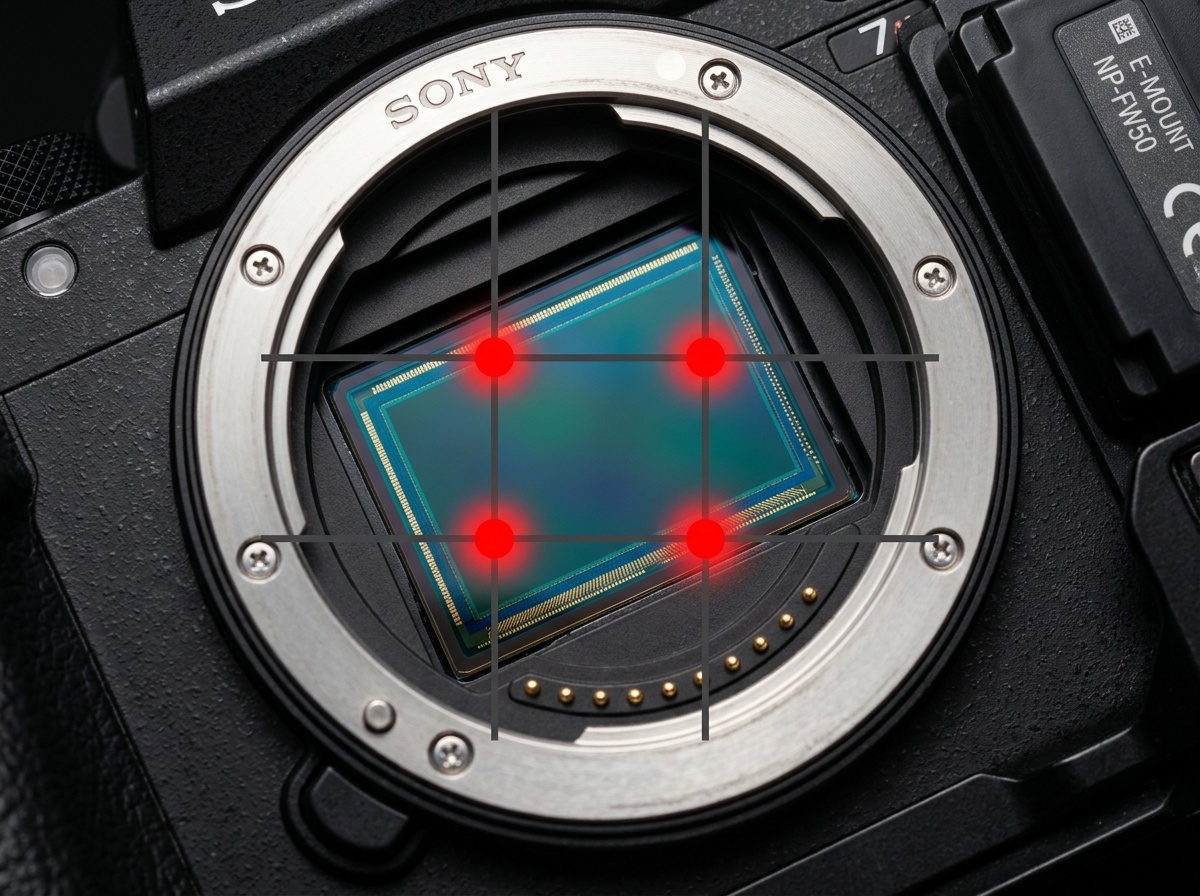
To master rule of thirds photography, we first need to visualize the structure. Imagine your camera’s viewfinder or LCD screen is divided into nine equal rectangles. This is achieved by drawing two equally spaced horizontal lines and two equally spaced vertical lines.
The magic happens at the four points where these lines cross. In the industry, we often call these “power points,” “crash points,” or “intersection points.” Research and eye-tracking studies suggest that when people view an image, their eyes naturally gravitate toward these intersections rather than the dead center of the frame.
By placing your point of interest—whether it’s a person’s eye, a solitary tree, or a distant boat—on one of these points, you create a sense of balance that feels more “right” to the human brain. It creates visual tension and energy, encouraging the viewer’s eye to wander around the frame rather than getting stuck in the middle.
Using this grid helps us move away from the “bullseye” effect, where the subject is trapped in the center box. Instead, we allow the subject to interact with the space around it. This is a foundational step in the ultimate guide to better photo composition, as it teaches us to think about the relationship between our subject and the environment.
For more technical details on the geometry, you can explore the Rule of thirds Wikipedia entry.
The History and Science of Off-Center Composition
While it feels like a modern photography “hack,” the rule of thirds photography concept actually predates the camera. The term was first coined by John Thomas Smith in 1797 in his book, Remarks on Rural Scenery.
Smith wasn’t looking at a digital screen; he was analyzing paintings. He expanded on ideas from Sir Joshua Reynolds, the famous painter, regarding the balance of light and dark. Smith argued that a ratio of two-thirds to one-third was far more harmonizing and “picturesque” than a precise 50/50 split. He believed that dividing lines or groups in a 2:1 ratio provided a better medium for breaking up masses in a landscape.
However, not everyone in history was a fan. In 1845, George Field expressed skepticism, warning that following such a rule too strictly could lead to “monotonous practice.” This historical debate reminds us that even 200 years ago, artists knew that guidelines are meant to assist, not imprison, the creative mind.
Rule of Thirds vs. The Golden Ratio
You might have heard of the Golden Ratio (also known as the Phi Grid or the Fibonacci Spiral). While they are related, they aren’t the same. The Golden Ratio is based on the mathematical constant 1.618 and is often seen as the “ultimate” harmony found in nature—from seashells to galaxies.
| Feature | Rule of Thirds | Golden Ratio (Phi Grid) |
|---|---|---|
| Grid Structure | 1:1:1 (Equal thirds) | 1:0.618:1 (Center is narrower) |
| Complexity | Simple, easy to visualize | More complex, mathematical |
| Visual Effect | Dynamic, off-center | Natural, organic harmony |
| Best For | Beginners and quick shots | Fine art and complex landscapes |
The Golden Ratio tends to pull the intersection points closer to the center of the frame than the Rule of Thirds. For most of us, the Rule of Thirds is a much more practical “rule of thumb” to use while we are out in the field. You can read more about the evolution of these concepts at Rule of thirds .
Applying Rule of Thirds Photography in the Field
Knowing the theory is one thing; applying rule of thirds photography while a bird is about to fly away or the sun is setting is another. The goal is to make this second nature.
When we look through the lens, we should identify the “hero” of our shot. Once identified, we nudge that hero toward one of the vertical lines or power points. This immediately creates “negative space” on the other side of the frame, giving the subject room to “breathe.”
This technique is particularly powerful in wildlife photography. For instance, exploring angles and perspectives in bird photography often requires us to place the bird off-center to show the environment it inhabits.
Mastering Rule of Thirds Photography in Landscapes
In landscape photography, the biggest mistake we see is placing the horizon line directly in the middle of the photo. This effectively cuts the image in half, leaving the viewer confused about what is more important: the sky or the ground.
- Emphasis on the Sky: If you have a dramatic sunset or incredible cloud formations, place the horizon on the bottom horizontal line. This gives two-thirds of the photo to the sky.
- Emphasis on the Ground: If you have a winding river, colorful flowers, or interesting rock formations in the foreground, place the horizon on the top horizontal line.
When composing bird photos with urban backgrounds, we use these same lines to align buildings or street features, ensuring the urban elements don’t overwhelm the natural subject.
Using Rule of Thirds Photography for Portraits and Wildlife
When photographing living subjects, the eyes are the most important element. To create a compelling portrait, try to align the subject’s eyes with the upper horizontal line. Even better, place the eye closest to the camera directly on an upper intersection point.
Two key concepts to remember here are Lead Room and Headroom:
- Lead Room (or Look Room): If your subject is looking to the left, place them on the right-side vertical line. This leaves “active space” in the direction they are looking. If you place them on the left, they look like they are staring into a wall, which feels claustrophobic.
- Direction of Movement: For moving subjects, always leave more space in front of the subject than behind it. This allows the viewer to imagine where the subject is going.
Choosing between vertical or horizontal framing tips for bird photography often depends on which orientation allows you to best utilize these “thirds” while maintaining proper lead room.
Beyond the Grid: Breaking Rules and Post-Processing
We’ve spent a lot of time talking about how to follow the grid, but as we grow as photographers, we learn that some of the best shots happen when we throw the grid away.
When to Break the Rule
There are several scenarios where rule of thirds photography might actually weaken your image:
- Symmetry: If you are shooting a perfectly symmetrical building or a reflection in a still lake, centering the subject can emphasize that balance and create a powerful, formal feeling.
- Minimalism: Sometimes, placing a tiny subject at the very edge of the frame or dead center in a vast empty space conveys a stronger sense of isolation or scale.
- Filling the Frame: When you get so close to a subject that it takes up the entire image, the grid lines become less relevant.
- Z-Composition: This involves guiding the eye in a ‘Z’ shape across the frame, which is how we naturally read a page.
Fixing it in Post-Processing
Don’t worry if you didn’t nail the composition perfectly while shooting. Modern editing is incredibly forgiving. Most RAW editors, like Lightroom or Photoshop, have a built-in “Rule of Thirds” overlay within the crop tool.
We often use these crop and composition editing tips to “resurrect” photos that felt a bit off. By simply tightening the crop and moving the subject onto a power point, you can transform a “snapshot” into a professional-looking photograph. This is a non-destructive way to experiment with different compositions after the pressure of the shoot is over.
Frequently Asked Questions about Rule of Thirds Photography
Is the rule of thirds a strict law I must always follow?
No. Think of it as a “training wheel” for your artistic eye. It’s a fantastic starting point that guarantees a balanced image most of the time. However, once you understand why it works (balance and tension), you can intentionally break it to achieve specific moods like confrontation or extreme isolation.
How does the rule of thirds differ from the Golden Ratio?
The Rule of Thirds is a simplified version of mathematical proportions. The Golden Ratio (1.618:1) creates a grid where the lines are closer together in the center. While the Golden Ratio is often considered more “organic,” the Rule of Thirds is much easier to apply quickly while shooting.
Can I apply the rule of thirds to my photos after I’ve already shot them?
Absolutely! This is one of the most common uses of the crop tool in post-processing. By enabling the grid overlay in your editing software, you can re-align horizons and subjects to fit the rule, often improving the balance of the image significantly.
Conclusion
Mastering rule of thirds photography isn’t about being a math expert or following rigid orders. It’s about developing your “compositional intuition.” By moving your subject away from the center, you invite the viewer to engage with the entire frame, telling a more complete visual story.
At Ciber Conexão, we believe that great photography is a blend of technical knowledge and creative freedom. As Hugo Andrade often emphasizes, the goal of learning these techniques is to eventually reach a point where you don’t even need to think about the grid—you just “feel” when a shot is balanced.
So, grab your camera, turn on that grid overlay, and start practicing. Whether you’re capturing landscapes, pets, or people, those four intersection points are your best friends. Once you’ve mastered the basics, don’t be afraid to experiment and find your own unique style.
Ready to take your skills even further? Check out More expert photography tips and tutorials to keep growing your photographic eye!
