
Why Birds in Flight Photography Is So Challenging (And So Rewarding)
Birds in flight photography is one of the most exciting — and most frustrating — challenges in all of wildlife photography. Get it right, and you have a stunning, dynamic image that captures something truly wild. Get it wrong, and you have a blurry smear where a bird used to be.
Here’s a quick overview of what it takes to succeed:
Key requirements for sharp birds in flight photos:
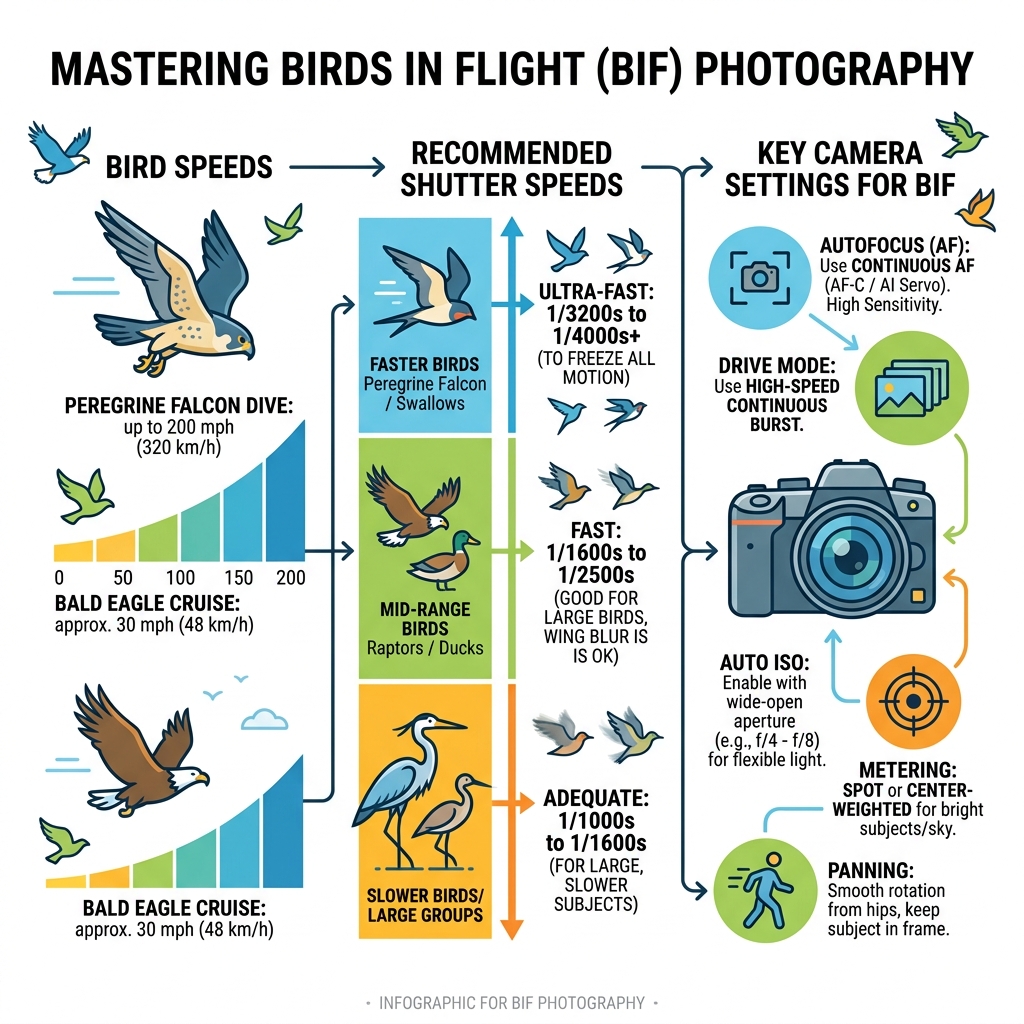
- Fast shutter speed — at least 1/1600s, ideally 1/4000s to freeze wing motion
- Continuous autofocus — AF-C (Nikon/Sony) or AI Servo (Canon) to track moving birds
- Long focal length — 400mm minimum, 600mm or more for small or distant birds
- Wide aperture — f/5.6 to f/8 balances sharpness with enough depth of field
- Auto ISO — lets the camera adapt to changing light while you lock in shutter speed
- Smooth panning — full-body rotation from the hips, tracking the bird before you shoot
- Clean background — sky or water helps autofocus lock on the bird, not the clutter
Most beginners struggle because they simply don’t use a fast enough shutter speed. Birds cruise at 20–30 mph — and some, like the peregrine falcon, can hit 200 mph in a dive. Your camera needs to keep up.
The good news? With the right settings and a bit of practice, anyone can go from missed shots to keepers. This guide walks you through everything, step by step.
Essential Gear for Birds in Flight Photography
When we talk about birds in flight photography, gear isn’t everything, but it certainly helps level the playing field. To capture a creature moving at 60 mph, your equipment needs to be fast, responsive, and offer enough “reach” to fill the frame.

The Camera Body: Speed is King
In BIF, we look for two main things in a camera: a high frame rate and a sophisticated autofocus system. Modern mirrorless cameras have revolutionized this. For instance, the Nikon Z8 can shoot at 20 frames per second (fps) in RAW or up to 120 fps in JPEG, while the Sony ⍺1 II pushes the limits of what’s possible for professional wildlife shooters.
Full-frame sensors are generally preferred for their better low-light performance and higher dynamic range, which helps when you’re shooting at high ISOs to maintain fast shutter speeds. However, don’t discount crop sensors (APS-C); they give you an “effective” reach advantage. For example, a 600mm lens on a Canon 7D Mark II provides an effective reach of 960mm!
Stability: Tripod vs. Monopod
While many pros prefer to shoot handheld for maximum mobility, a gimbal head on a sturdy tripod is a lifesaver for long sessions with heavy lenses. A gimbal allows the camera to “float,” making it easy to track a bird’s flight path without fighting the weight of the gear. If you’re on the move, a monopod offers a middle ground between stability and portability.
Selecting the Right Lens
Your lens is arguably more important than your camera body. For birds in flight photography, we generally recommend a focal length of at least 400mm.
- The Pro Choice: The NIKKOR Z 600mm f/4 TC VR S is a dream lens with a built-in teleconverter, but it comes with a premium price tag.
- The Budget Revolution: Lenses like the Sigma 150-600mm Contemporary have changed the game. Weighing just 4.3 pounds and costing under $1,000, it allows hobbyists to get incredible reach without breaking the bank.
Before you buy, check out our guide on camera-settings-for-bird-lenses to see how to get the most out of your glass.
Mastering Camera Settings for Sharp Action
The biggest “eye-opener” for most photographers is realizing that their “fast” shutter speed of 1/500s is actually quite slow for a bird. To get those pin-sharp feathers, we need to dive into manual control.
| Bird Type | Recommended Shutter Speed | Aperture | ISO Strategy |
|---|---|---|---|
| Large (Eagles, Herons) | 1/1600s – 1/2000s | f/7.1 – f/8 | Auto ISO |
| Medium (Gulls, Ducks) | 1/2500s – 1/3200s | f/5.6 – f/7.1 | Auto ISO |
| Small/Fast (Swallows) | 1/4000s+ | f/5.6 | Auto ISO (High) |
Manual Mode and Auto ISO: The Secret Combo
We highly recommend using Manual Mode (M) with Auto ISO. This allows us to lock in our shutter speed and aperture while letting the camera handle the exposure as the bird flies from a bright sky into a dark treeline. It’s the most elegant way to handle dynamic flight conditions.
If you are struggling with focus or exposure, take a look at our deep dives on mastering-camera-settings-for-bird-photography and avoiding-blurry-images-in-bird-photography.
Optimal Shutter Speeds for Birds in Flight Photography
To freeze the action of a peregrine falcon or even a common gull, 1/1600th of a second is your bare minimum. However, 1/4000th is often the “sweet spot” to ensure even the wingtips are frozen. Remember: it is always better to have a slightly noisy image from a high ISO than a blurry image from a slow shutter speed. We can fix noise in post-processing, but we can’t fix blur!
Mastering Focus for Birds in Flight Photography
The days of “focus and recompose” are over. For BIF, you must use Continuous AF (AF-C on Nikon/Sony or AI Servo on Canon).
- Subject Detection: Modern mirrorless cameras like the Canon EOS R1 have “Bird Eye Detection” that is almost like magic.
- Back Button Focus: This moves the focus function from the shutter button to a button on the back of the camera. It allows you to track and focus continuously without accidentally taking a photo before the bird is in the right position.
- Group Area AF: If your camera doesn’t have bird detection, use a “Group” or “Zone” AF mode. This gives the camera a larger target area to grab the bird against a clear sky.
Field Techniques and Environmental Factors
You can have the best gear in the world, but if you’re standing in the wrong place, your photos will suffer.
The Power of Wind and Sun
Birds are like airplanes; they prefer to land and take off into the wind. If you position yourself with the wind at your back, the birds will fly toward you, slowing down as they approach.
Similarly, keep the sun at your back. We like to follow the “shadow line” — if you point your shadow at the bird, you’ll get the best illumination, beautiful catchlights in the eye, and minimal harsh shadows under the wings.
Panning Mechanics: The Athletic Stance
Tracking a bird isn’t just about moving your arms; it’s a full-body movement.
- The Stance: Stand with your feet shoulder-width apart, knees slightly bent.
- The Rotation: Don’t just move the camera with your wrists. Lock your elbows into your sides and rotate your entire upper body from the hips and core. This creates a much smoother panning motion.
- Follow Through: Just like a golf swing, don’t stop moving the moment you press the shutter. Keep panning even after the burst is finished to ensure the last few frames are sharp.
Understanding Bird Behavior and Wing Positions
In birds in flight photography, not all frames are created equal. When reviewing your bursts, look for these key positions:
- Wings-Up: This often shows the bird’s body clearly and conveys a sense of grace.
- Wings-Down: This conveys power and acceleration.
- Banking: When a bird turns, it stretches its wings wide, often revealing beautiful feather patterns and catching the light perfectly.
- Avoid the “Pancake”: This is when the wings are perfectly flat and level with the bird’s body. It usually looks static and lacks the “energy” of a great flight shot.
For more on timing your shots, read our guide on capturing-swift-movements-bird-in-flight-photography.
Capturing Small Birds and Artistic Motion
Small birds like hummingbirds or nuthatches are the “final boss” of bird photography. They move erratically and incredibly fast.
High-Speed Challenges
To capture small birds, we often use extreme settings. Some photographers use frame rates up to 120 fps to catch that split-second when a bird leaves a feeder. Pre-release capture (available on cameras like the Nikon Z9/Z8) is a lifesaver here — it starts recording images the moment you half-press the shutter, so even if your reaction time is slow, the camera has already “saved” the take-off.
Artistic Motion: The Slow Pan
While we usually want to freeze action, sometimes a “slow pan” creates a more artistic, “painterly” feel. By using a slower shutter speed (1/30th to 1/125th of a second) and matching the bird’s speed exactly as you pan, you can keep the head sharp while the wings and background become a beautiful blur of motion. It’s hard to master, but the results are stunning.
Post-Processing and Composition for Impact
Once you’ve come home with a memory card full of images, the real work begins. At Ciber Conexão, we believe that post-processing is where a “good” photo becomes a “professional” one.
Cleaning Up the Image
Even the best cameras produce noise at high ISOs. Tools like Topaz Photo AI (you can get a discount here with code nickdale15) are essential for modern wildlife photographers. They use AI to remove noise and add “intelligent” sharpening to feathers without making the image look “crunchy.”
Editing for Professional Results
Strategic Cropping: This is our specialty. When cropping a bird in flight, always leave more space in front of the bird than behind it. This is called “active space,” and it gives the bird “room to fly” into the frame. If the bird is too close to the edge it’s flying toward, the composition feels cramped and uncomfortable.
Selective Sharpening: Don’t sharpen the whole image. Use a mask to sharpen only the bird (especially the eye and head). If you sharpen the background, you’ll just bring out more noise and distract from your subject.
Shadow Recovery: Birds’ underwings are often in shadow. Using the “Shadows” slider in Lightroom can reveal hidden colors and textures that make the image pop. You can even use free Lightroom presets as a starting point to see which styles fit your work.
Frequently Asked Questions
What is the best shutter speed for birds in flight?
For most situations, 1/2500s is a great starting point. If you are shooting very fast, small birds, move up to 1/4000s. For large, slow-gliding birds like pelicans, you can sometimes get away with 1/1600s.
Should I use a tripod for flight photography?
It depends on your gear. If you’re using a heavy 600mm f/4 prime lens, a tripod with a gimbal head is highly recommended. However, for lighter zoom lenses like a 100-400mm or 150-600mm, many photographers prefer the freedom of shooting handheld.
How do I stop my camera from focusing on the background?
Use a smaller focus area (like Zone or Group AF) rather than the “Auto Area” mode. If your camera has subject detection, enable it. Also, try to shoot when the bird is against a “clean” background like the sky; if there are trees or buildings behind the bird, the camera’s AF system can easily get “distracted.”
Conclusion
Mastering birds in flight photography is a journey of patience. You will have days where you come home with 1,000 photos and delete 999 of them — and that’s perfectly normal! Even pros rarely have a “keeper rate” higher than 50%.
The secret is deliberate practice. Start with “easy” subjects like gulls at a local beach or pigeons in a park. They are predictable and abundant, making them perfect for honing your panning and focus skills. As you get more comfortable, move on to faster, more challenging species.
Remember to keep your eyes on the wind, your back to the sun, and your shutter speed high. For more tips on how to refine your shots in the digital darkroom, explore our More photography tips and editing guides. Happy shooting!
