
The Bird Photography Exposure Triangle: Balancing the Three Pillars
To master the bird photography exposure triangle, we have to view it as a three-way scale. If you add “weight” to one side, the others must shift to maintain balance. In our case, that “weight” is light. If we tighten the aperture to get more detail, we lose light, meaning we must either slow down the shutter or crank up the ISO to compensate.
Aperture and Artistic Bokeh
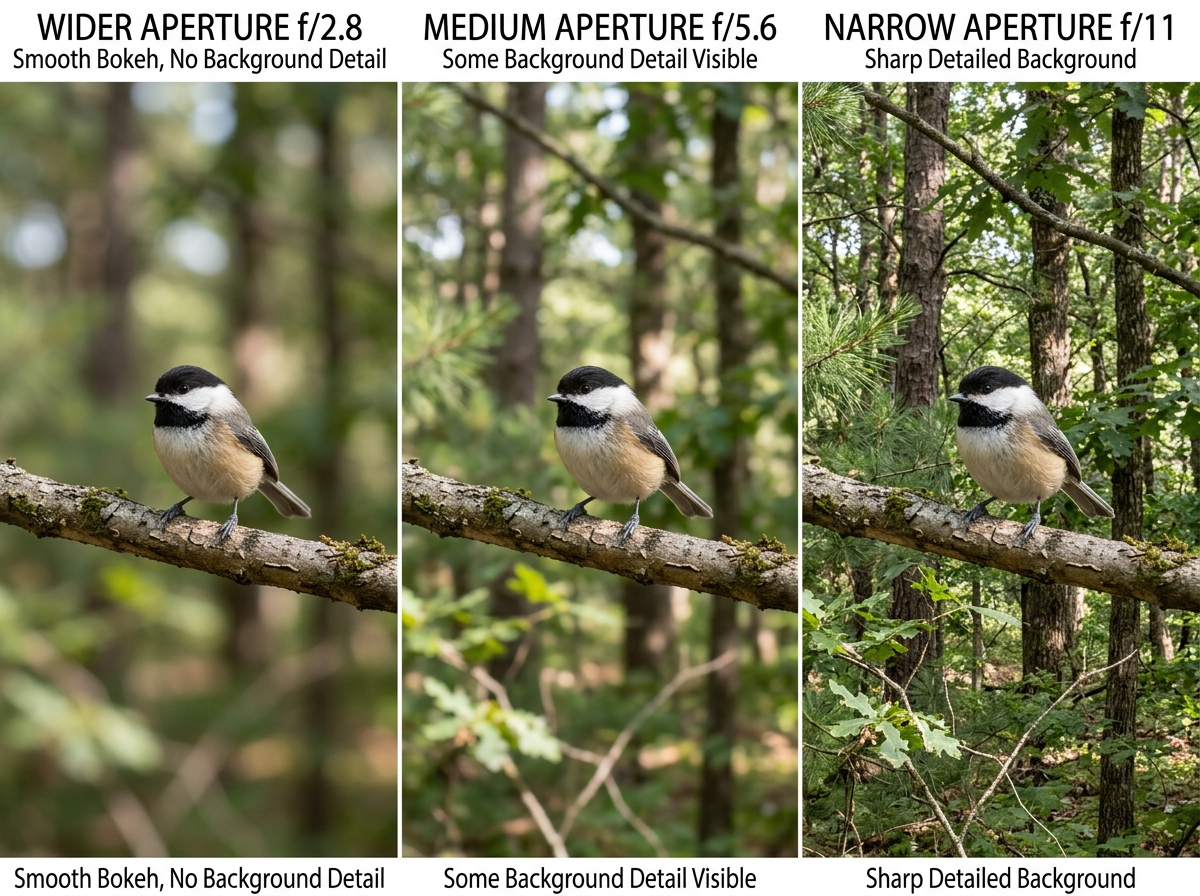
Aperture is the size of the opening in your lens. It is measured in f-stops, such as f/4, f/5.6, or f/8. In bird photography, aperture serves two primary purposes: controlling light and creating “bokeh” (that creamy, blurred background).
Most bird photographers prefer a wide aperture (a low f-number like f/4 or f/5.6). This allows the maximum amount of light to hit the sensor, which is vital because we usually need very fast shutter speeds. Strategically, a wide aperture isolates the bird from distracting branches or messy foliage.
However, there is a catch. Shooting “wide open” at f/4 creates a very thin depth of field. If you are close to a bird, its beak might be sharp while its eyes are blurry. We often recommend “stopping down” to f/7.1 or f/8 for larger birds or when they are close, ensuring the entire head stays tack-sharp. You can learn more about controlling exposure—aperture, shutter speed, and ISO to see how these f-stops translate to real-world detail. For a deeper dive into the mechanics of light, check out our guide on adjusting exposure for bird photos.
Shutter Speed for Freezing Action
If aperture is about character, shutter speed is about clarity. Birds are high-speed subjects; even a “still” songbird flinches and twitches at speeds the human eye can barely register.
To freeze a bird in flight, we generally start at 1/2000s. For smaller, erratic flyers like hummingbirds or swallows, you might even need 1/4000s. If the bird is simply perched and preening, you can drop to 1/500s or 1/1000s to keep your ISO lower. Using a slow shutter speed by accident is the number one cause of “soft” images. We’ve put together a specific resource on avoiding blurry images in bird photography to help you troubleshoot these motion issues.
ISO and Image Quality
ISO is the third pillar, representing your sensor’s sensitivity to light. Think of it as an electronic amplifier. If your aperture is as wide as it can go and your shutter is as fast as it needs to be, but the image is still too dark, you raise the ISO.
The trade-off is “noise” or grain. While modern mirrorless cameras can produce clean images at ISO 3200 or even 6400, lower is always better for preserving the fine detail in feathers. We always aim for the “Base ISO” (usually 100) when light is plentiful, but we aren’t afraid to push it higher to maintain a fast shutter speed. A noisy, sharp photo is fixable in editing; a blurry photo is garbage.
Choosing the Right Shooting Modes and Metering Techniques
Knowing the bird photography exposure triangle is one thing; applying it while a hawk is diving at 80 mph is another. This is where your camera’s shooting modes come into play.

Mastering the Bird Photography Exposure Triangle for Action and Art
Many beginners start in “Program” or “Auto,” but these modes are easily fooled by a bright sky. Instead, most pros use Aperture Priority (A or Av) or Manual (M) with Auto ISO.
- Aperture Priority: You set the aperture (e.g., f/5.6) and the ISO. The camera chooses the shutter speed. This is great for portraits. However, if a cloud passes by, the camera might drop the shutter speed to 1/100s, causing blur.
- Manual with Auto ISO: This is the “secret weapon” for many. You lock in your shutter speed (1/2000s) and your aperture (f/5.6), and let the camera move the ISO up and down to maintain the exposure. This ensures your action is always frozen while the camera handles the light fluctuations.
For more tips on choosing the right foundation, see this beginners guide to bird photography key settings or read the Audubon perspective on how to get the right exposure for photographing birds.
Spot Metering vs. Evaluative Metering
Metering is how your camera “sees” the light.
- Evaluative/Matrix Metering: The camera looks at the whole scene. If you have a dark bird against a bright sky, the camera sees all that bright sky and underexposes the bird, leaving you with a silhouette.
- Spot Metering: The camera only measures light from a tiny dot in the center (or at your focus point). This is crucial for birds. By metering off the bird’s feathers, you ensure the subject is perfectly exposed, even if the background goes completely white or black.
Technical Essentials: RAW, White Balance, and Histograms
To truly master the technical side, we have to look “under the hood” at how the data is recorded.
Using Histograms to Prevent Blown Highlights
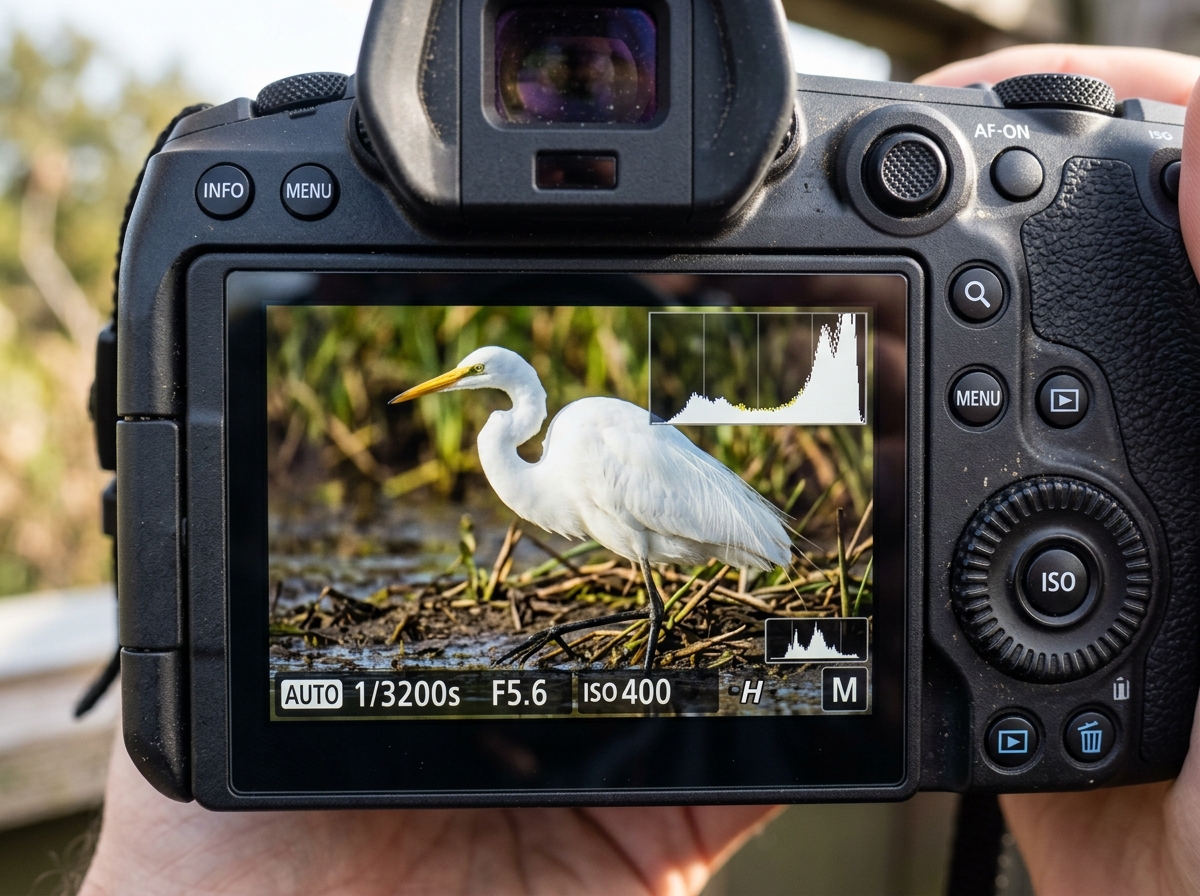
A histogram is a graphical representation of the tones in your image. The left side represents blacks, and the right side represents whites.
- Clipping: If the graph touches the far-right edge, your highlights are “blown.” This means there is zero data in the whites (like the white feathers on an egret), and you cannot recover that detail in editing.
- Exposing to the Right (ETTR): We often try to push the graph as far to the right as possible without touching the edge. This captures the most data and reduces noise in the shadows.
If you struggle with harsh shadows or bright sun, our guide on correcting lighting in bird images offers practical post-processing fixes.
Autofocus and White Balance Strategies
While not strictly part of the exposure triangle, these settings impact your success rate.
- RAW Format: Always shoot in RAW. It preserves significantly more “dynamic range” than JPEG, allowing you to fix exposure mistakes later.
- Back-Button Focus: This separates the focus trigger from the shutter button. It allows you to track a moving bird and take a photo without the camera trying to re-focus every time you click.
- White Balance: Set this to “Auto” if shooting RAW. You can easily adjust the “temperature” (cool vs. warm) in your editing software later without losing quality.
Practical Strategies to Master the Bird Photography Exposure Triangle
Mastery comes from the field, not the manual. Here is how we balance the triangle when things get chaotic.
Balancing the Triangle in Dynamic Scenarios
Imagine a bird moving from a sunlit branch into the dark shadows of a tree. If you are in full Manual mode, you’ll be fumbling with dials and miss the shot. Our strategy: Set your shutter speed for the “worst-case scenario” (the fastest movement you expect) and use Exposure Compensation. If you see the bird is too dark on your LCD, dial in +0.7 or +1.0 exposure compensation. This tells the camera, “I know you think this is right, but make it a little brighter.”
This is especially helpful during the “Golden Hour”—the hour after sunrise or before sunset—where light changes by the minute. For a structured approach to these settings, read our guide on mastering camera settings for bird photography.
Practical Tips for Beginner Bird Photographers
- The 1/Focal Length Rule: If you are shooting handheld with a 600mm lens, your shutter speed should be at least 1/600s just to stop your own hands from shaking the camera.
- Start Wide: Keep your aperture at its lowest f-number (like f/5.6) to start. It gives you the most light to work with.
- Check Your “Blinkies”: Turn on “Highlight Alerts” in your camera settings. If part of the bird flashes black or red on your screen after a shot, it’s overexposed. Turn your exposure down!
- Burst Mode: Always use continuous shooting. Birds blink and move their heads constantly. Taking 5–10 shots in a second increases the odds that one will have the perfect “catchlight” in the eye.
Frequently Asked Questions about Bird Exposure
What is the best shutter speed for birds in flight?
For large, slow birds like herons or pelicans, 1/1250s is often enough. For small songbirds or raptors in a chase, we recommend 1/2500s to 1/4000s to ensure the wingtips are sharp.
Should I use Auto ISO for bird photography?
Yes, but with a limit. Most modern cameras allow you to set an “Auto ISO Range.” We suggest setting your maximum to 3200 or 6400. This prevents the camera from choosing a super-grainy ISO 12800 in very dark spots.
Why is my bird subject always a silhouette against the sky?
This happens because the camera’s meter sees the bright sky and tries to turn it into a neutral gray, which makes the bird much darker. To fix this, use Spot Metering or dial in +1.0 to +2.0 Exposure Compensation to force the camera to brighten the bird.
Conclusion
Mastering the bird photography exposure triangle is the bridge between “taking a picture” and “creating an image.” It’s about more than just brightness; it’s about choosing how you want to tell the bird’s story. Do you want a sharp, frozen moment of a hawk’s strike? Or a soft, painterly portrait of a sparrow in the mist?
Once you have the raw file with the correct exposure, the real magic happens in the edit. At Ciber Conexão, we believe that a great photo is born in the camera but perfected through thoughtful editing. Hugo Andrade’s expert tips on crop and composition can transform a well-exposed shot into a gallery-worthy masterpiece.
By understanding the technical balance of light and the artistic intent of your settings, you’ll find yourself coming home with fewer “throwaway” shots and more captures that truly soar. For more info about photography tips, keep exploring our resources and get out into the field!
