
Why Manual Mode Gives You Total Control Over Bird Photos
manual mode bird photography lets you lock in your shutter speed, aperture, and ISO yourself — so the camera stops guessing and you stay in charge.
Here’s the quick answer if you need it fast:
How to shoot birds in manual mode:
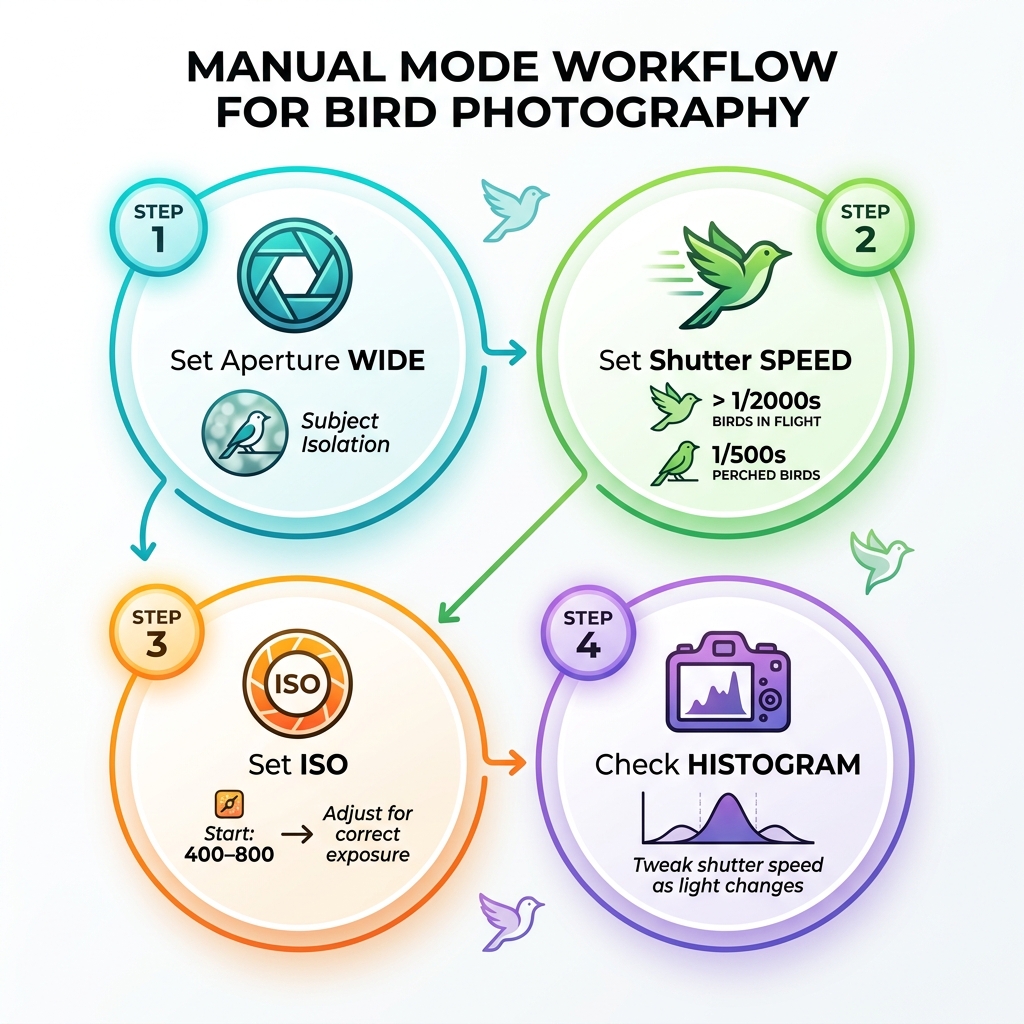
- Set your aperture wide open (or 1 stop down) for subject isolation
- Set shutter speed to at least 1/2000s for birds in flight, 1/500s for perched birds
- Set ISO high enough to expose correctly — start around ISO 400–800 and adjust
- Check your exposure on the histogram and tweak shutter speed as light changes
- Recheck every few minutes by metering off a mid-tone like gray bark or grass
Here’s the problem with letting your camera decide.
Modern cameras are smart — but they meter for the whole scene, not for your bird. A small dark warbler against a bright sky? The camera exposes for the sky. A white egret fills the frame? The camera pulls back exposure and blows the details.
Auto modes like aperture priority and shutter priority constantly react to background changes. Every time your bird hops from a shadowed branch to an open perch, your exposure shifts. That means inconsistent shots, even in the same session.
Manual mode breaks that cycle. Once you dial in the right exposure for the light hitting your subject, it stays locked — whether the background is dark foliage or a bright white sky.
It sounds harder. In practice, most experienced bird photographers find they’re really only adjusting one setting throughout the day: shutter speed. Everything else stays put.
Why Manual Mode Bird Photography is the Gold Standard
When we talk about the “Gold Standard” in wildlife circles, we aren’t just being fancy. manual mode bird photography is the most reliable way to ensure that the bird—not the sky, the trees, or the water—is perfectly exposed.
In automated modes like Aperture Priority (Av) or Shutter Priority (Tv), the camera’s light meter is constantly trying to turn the world into a boring 18% middle-gray. If a bright white swan enters the frame, the camera panics and underexposes the image to “fix” the brightness. If a dark raven lands on a sunny branch, the camera overexposes everything to try and find detail in the black feathers.
By taking full manual control, we tell the camera: “I know what the light is doing. Stop ‘helping’ me.” This is especially crucial because, in most birding scenarios, the light falling on the bird remains constant even if the bird moves in front of different backgrounds. If you are standing in an open field at 10:00 AM, the sunlight hitting a hawk is the same whether it’s flying against a deep blue sky or a dark forest. Manual mode keeps that exposure locked, giving us consistent files that are much easier to edit later.
For more on the foundations of these choices, check out our guide on mastering-bird-photography-essential-camera-settings.
Recommended Settings for Manual Mode Bird Photography
Getting started can feel like juggling flaming torches, but it’s simpler than it looks. We follow a specific hierarchy of settings to ensure we get the shot.
- Aperture: Most of the time, we want this “wide open” (the lowest f-number your lens allows, like f/4 or f/5.6). This lets in the most light and creates that creamy, blurred background that makes the bird “pop.” If you are using a teleconverter, you might want to stop down by 0.5 to 1.5 stops to sharpen things up, but generally, wide open is the way to go.
- Shutter Speed: This is our most critical setting. For a perched bird, you can get away with 1/500s. For small, active songbirds, we jump to 1/1250s. For birds in flight (BIF), 1/2000s is the bare minimum, and 1/3200s or 1/4000s is even better to freeze the wingtips.
- ISO: Don’t be afraid of high ISO. Modern sensors are incredible. It’s better to have a sharp, slightly grainy photo at ISO 3200 than a blurry, “clean” photo at ISO 400. We recommend setting your ISO last to balance out the light needed for your chosen shutter speed and aperture.
We’ve detailed how different glass impacts these choices in our article on camera-settings-for-bird-lenses.
Overcoming Background Shifts with Manual Mode Bird Photography
One of the greatest frustrations in bird photography is the “background jump.” Imagine a Kingfisher perched on a dark branch over a bright, reflecting pond.
If you use an auto mode, the camera will see that bright water and darken the whole image, turning your bird into a silhouette. If the bird flies up against the dark trees, the camera will brighten the image, likely blowing out the highlights on the bird’s feathers.
In manual mode bird photography, we set the exposure for the bird. Once it’s set, the bird stays perfectly exposed regardless of where it flies. This “set it and forget it” approach allows us to focus entirely on the bird’s behavior and our own composition, rather than fighting with an exposure compensation dial every two seconds.
Handling Tricky Scenarios: Birds in Flight and Backlit Subjects
Birds in flight (BIF) represent the ultimate test of a photographer’s skill. The backgrounds are often chaotic—switching from bright sky to dark trees in a fraction of a second.
When we use manual mode for BIF, we are essentially creating a “safety net.” By metering for the light on the bird before it takes off, we ensure that every frame in a 20-shot burst is usable. If we relied on auto-exposure, half those shots would likely be ruined as the camera’s meter reacted to the passing scenery.
Backlit subjects—like an Egret with the sun behind its wings—are another area where manual mode shines. Auto-exposure will almost always underexpose the bird to compensate for the bright light behind it. By manually setting our exposure to “expose for the highlights” or using a spot meter on the bird’s body, we can capture that ethereal “rim light” without losing the bird in the shadows.
For a deeper dive into these complex lighting situations, see our captivating-bird-photography-a-guide-to-camera-settings.
Manual Mode with Auto ISO vs. Fixed ISO
There is a heated debate in the birding community: should you use “Full Manual” (Fixed ISO) or “Manual with Auto ISO”?
We believe both have their place. Manual with Auto ISO is essentially a semi-automatic mode. You pick the Shutter Speed and Aperture, and the camera adjusts the ISO to keep the exposure “correct” according to its meter. This is great for rapidly changing light—like a bird moving in and out of thick jungle shadows.
However, Full Manual (Fixed ISO) is superior when the light on the subject is constant but the background is changing.
| Feature | Full Manual (Fixed ISO) | Manual + Auto ISO |
|---|---|---|
| Best For | Consistent light, BIF, open fields | Changing light, deep forests, “action” |
| Exposure Stability | Perfect consistency across all shots | Changes based on what the camera “sees” |
| Mental Load | Higher (must check light changes) | Lower (camera handles brightness) |
| Risk | Can over/underexpose if light changes | Can blow highlights on white birds |
If you’re a beginner, we suggest starting with our beginners-guide-to-bird-photography-key-settings to get a handle on the basics before diving into the deep end of full manual.
Real-Time Tools and Camera Customizations for Efficiency
To master manual mode bird photography, you need to use the tools your camera provides. We don’t just “guess” the exposure; we use data.
- The Histogram: This is your best friend. It’s a little graph that shows the distribution of light in your shot. We want to “Expose to the Right” (ETTR). This means pushing the graph as far to the right as possible without “clipping” (touching the right edge), which would mean lost detail in the highlights.
- Zebras (Highlight Warnings): Many mirrorless cameras offer “Zebras”—striped patterns that appear on your screen over areas that are overexposed. These are incredible for white birds like Egrets or Swans.
- Spot Metering: Instead of letting the camera look at the whole scene, set it to “Spot.” Point that spot at a mid-tone—like green grass or a gray tree trunk in the same light as the bird—and set your exposure to “0” on the meter.
- Custom Buttons: We recommend assigning a button to quickly toggle between Manual and an auto mode (like Aperture Priority) just in case the light changes so fast you can’t keep up.
For more advanced tips on setting up your specific body, visit mastering-camera-settings-for-bird-photography.
Frequently Asked Questions about Manual Mode
Why is manual mode better than aperture priority for birds?
Aperture priority is great for landscapes, but for birds, the background changes too fast. If a bird flies from a dark bush into the bright sky, Aperture Priority will change your exposure, often ruining the shot. Manual mode keeps the bird’s exposure locked, regardless of the background.
What is the best shutter speed for birds in flight?
For most birds, 1/2000s is the “safe” starting point. For very fast birds like swallows or hummingbirds, you may need 1/3200s or even 1/4000s. If you are trying to capture a sense of motion with blurred wings, you can drop down to 1/60s, but that takes a lot of practice!
When should I avoid using manual mode?
Avoid full manual mode in rapidly changing light—like a day with fast-moving clouds where the sun is popping in and out every few seconds. In those cases, Manual with Auto ISO or even Aperture Priority with Exposure Compensation is often more effective.
Conclusion
Mastering manual mode bird photography isn’t about being a “purist”—it’s about being a professional. It’s about ensuring that when that rare bird finally lands in your sights, you have the settings dialed in to capture every feather in perfect detail.
At Ciber Conexão, we know that capturing the shot is only half the battle. Once you have that perfectly exposed manual file, the real magic happens in the edit. Hugo Andrade and our team specialize in helping you refine those shots through expert cropping and composition techniques that turn a good photo into a masterpiece.
Ready to take your images to the next level? More photography tips and expert advice are waiting for you on our blog. Happy shooting!
