
Why Getting the Right Shutter Speed for Birds in Flight Changes Everything
Shutter speed for birds in flight is the single most important camera setting you need to master if you want sharp, frame-worthy photos of flying birds.
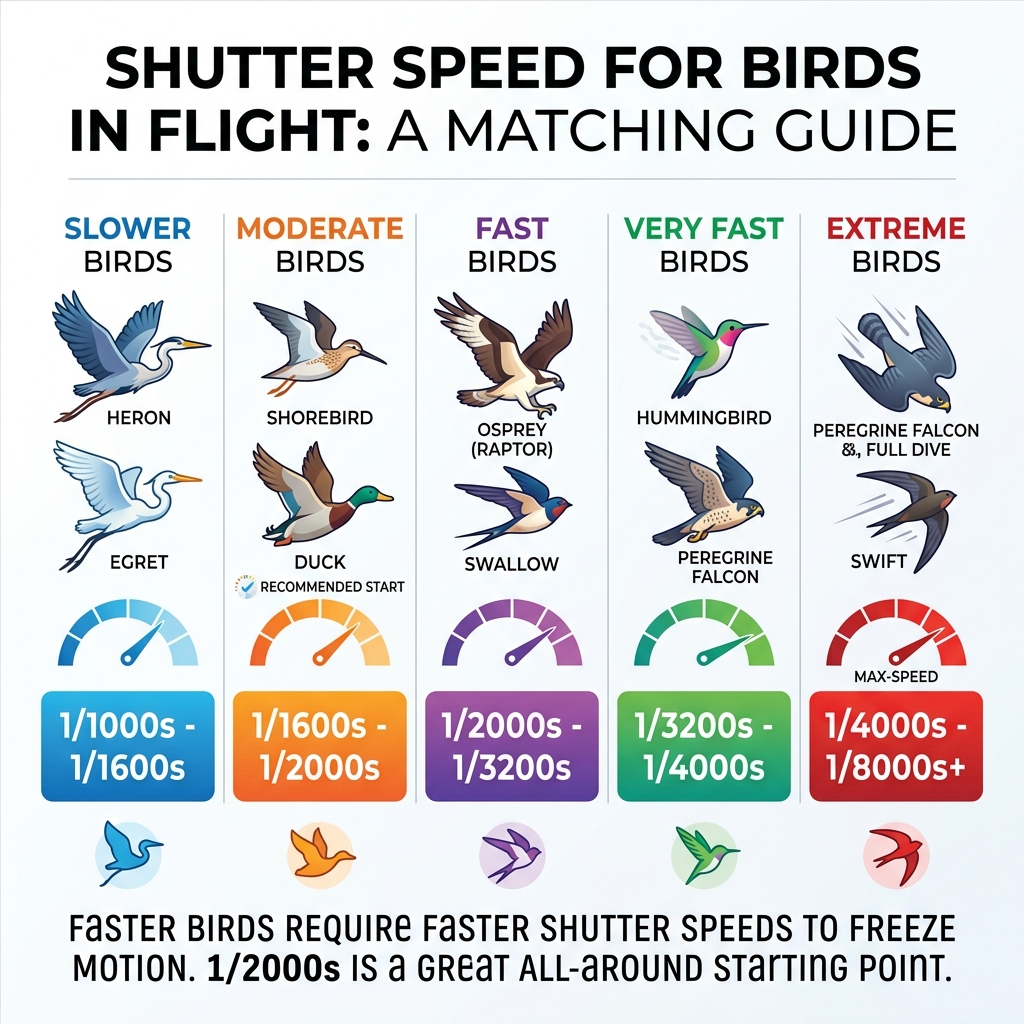
Here is a quick reference to get you started:
| Bird Type | Recommended Shutter Speed |
|---|---|
| Herons, egrets (slow, large) | 1/1000s – 1/1600s |
| Waterfowl, shorebirds | 1/1600s – 1/2000s |
| Raptors, ducks, songbirds | 1/2000s – 1/3200s |
| Swallows, hummingbirds | 1/3200s – 1/4000s |
| Falcons, swifts (diving) | 1/4000s – 1/8000s+ |
The short answer: Start at 1/2000s for most birds in flight. Go faster (1/3200s or more) for small or fast-moving birds. Use 1/1000s only for large, slow-gliding birds like herons.
Most beginners set their shutter speed way too slow. The result? Wings that look like a smeared paintbrush and a photo you can’t use.
Birds are fast. Even a large goose cruising along at 20-30 mph can produce motion blur at 1/500s. A peregrine falcon in a dive hits speeds of around 200 mph — it needs an entirely different approach.
The good news is this: once you know the right starting shutter speeds, the rest falls into place quickly. You don’t need expensive gear or advanced skills. You just need the right numbers and a little practice.
Determining the Ideal Shutter Speed for Birds in Flight
When we talk about the shutter speed for birds in flight, we are essentially trying to win a race against time. A bird’s wing can flap several times per second. If your shutter stays open too long—even for a thousandth of a second—those feathers will move across the sensor, creating blur.
To achieve a high “keeper rate” (the percentage of sharp photos versus blurry ones), we generally recommend a standard of 1/2000s. While 1/1600s is often adequate for larger birds, 1/2000s provides a safety net that accounts for sudden bursts of speed or erratic wing beats. If you are dealing with extreme action—think an Osprey hitting the water or a falcon in a high-speed chase—don’t be afraid to push to 1/4000s or even higher.
The goal is a total “motion freeze.” We want to see the individual barbs on the feathers, not a soft smudge. Research suggests that moving from 1/1000s to 1/3200s can dramatically improve your success rate because it removes human error (camera shake) and subject movement simultaneously.
How Bird Size and Species Affect Shutter Speed for Birds in Flight
Not all birds are created equal. According to research on the 18,000 species of birds in the world, each species presents a unique photographic challenge based on its behavior and physiology.
- Large Raptors and Herons: Birds like Great Blue Herons or Bald Eagles have a slower wing-beat frequency. Because they are large in the frame and move more predictably, you can often get away with 1/1000s to 1/1600s.
- Waterfowl and Songbirds: Ducks and geese are deceptively fast, often cruising at 60 mph. Small songbirds are even trickier because their flight is erratic. For these, 1/2000s to 1/2500s is your sweet spot.
- The Speed Demons: Hummingbirds, swallows, and falcons require extreme speeds. To freeze a hummingbird’s wings entirely, you might need 1/4000s to 1/8000s.
Understanding bird behavior is half the battle. A bird gliding on a thermal requires less speed than the same bird taking off from a branch. When a bird “spooks” and takes flight, that initial explosion of energy is when you need your fastest settings.
Impact of Flight Direction and Distance on Shutter Speed for Birds in Flight
The physics of photography dictates that the apparent speed of the bird matters just as much as its actual speed. This is where many photographers get tripped up.
- Across the Frame: If a bird is flying horizontally (left to right), it is passing across the pixels of your sensor at maximum velocity. This requires a faster shutter speed for birds in flight—at least 1/2000s.
- Towards the Camera: If a bird is flying directly at you, its position relative to the sensor change is much smaller. You can often capture sharp images at 1/1000s or 1/1250s in this scenario, though you’ll need a top-tier autofocus system to keep up with the changing focus distance.
- Distance and Magnification: The closer you are to the bird, the faster your shutter speed needs to be. Why? Because a bird that fills the frame magnifies every tiny movement. If you’re using a 600mm lens on a subject only 20 feet away, even a tiny twitch looks like a massive blur.
For more tips on keeping your subjects crisp, check out our guide on avoiding blurry images in bird photography.
Essential Camera Settings to Complement Fast Shutter Speeds
You can’t just set a fast shutter speed and hope for the best. Photography is a balancing act of light and focus. If you set 1/4000s in a dark forest, your image will be black. If your focus is off, a fast shutter won’t save you.
The Power of Manual Mode + Auto ISO
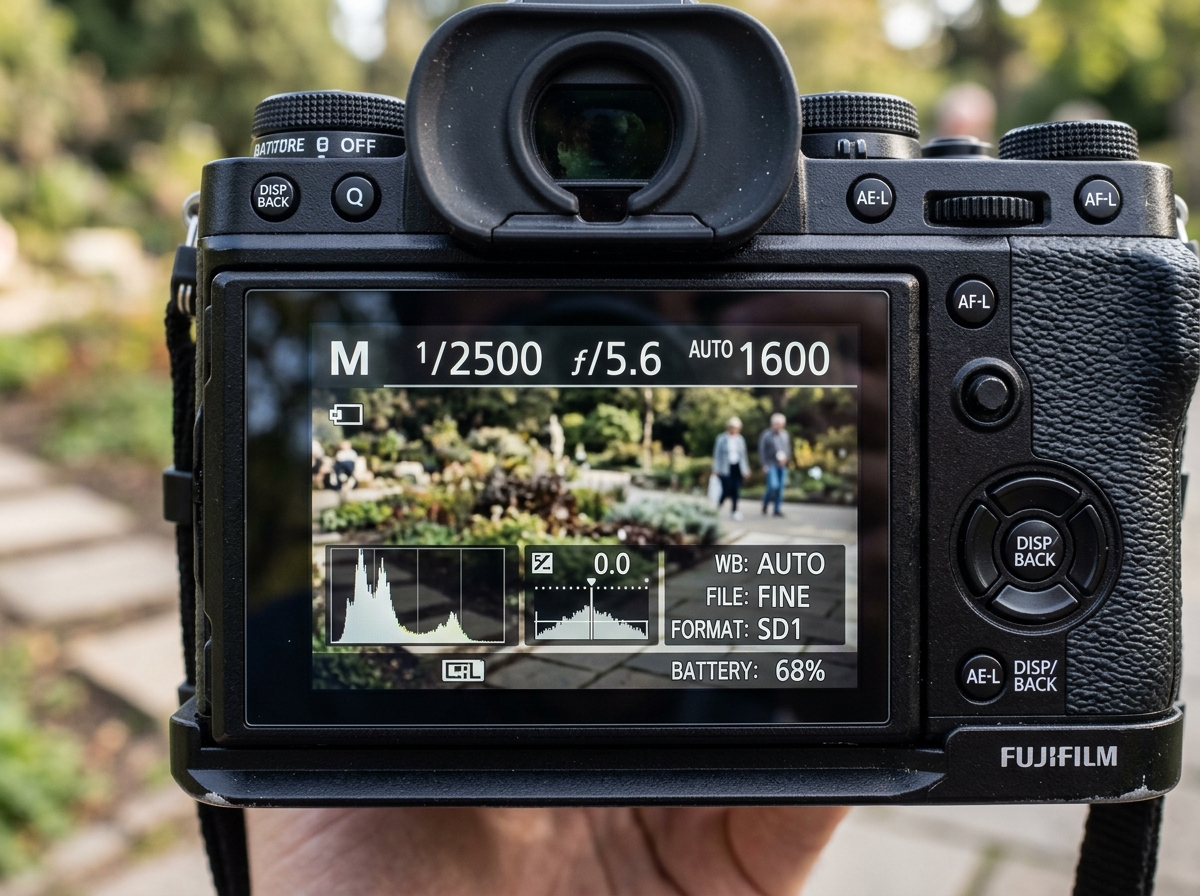
Most pros use Manual Mode with Auto ISO. This allows you to lock in your shutter speed (to freeze motion) and your aperture (to control depth of field), while the camera automatically adjusts the ISO to ensure the image is properly exposed. This is vital for BIF (Birds in Flight) because a bird might fly from a dark background (trees) into a bright background (sky) in a split second.
Aperture and Depth of Field
In bird photography, we usually want the widest aperture our lens allows (like f/4 or f/5.6) to let in as much light as possible. However, if you are very close to a bird with a long telephoto lens, your depth of field might be so thin that the beak is sharp but the eyes are blurry. In bright light, stopping down to f/7.1 or f/8 can give you that extra bit of “sharpness insurance.”
Autofocus: The “Continuous” Rule
You must use Continuous AF (AI Servo for Canon, AF-C for Nikon/Sony). This tells the camera to never stop focusing as long as the shutter button is half-pressed or the AF-ON button is held. Pair this with Zone AF or Bird Eye Tracking if your camera has it. Modern mirrorless cameras have revolutionized the “keeper rate” by locking onto the bird’s eye mid-flight.
Mastering these basics is the foundation of professional-looking wildlife shots. You can dive deeper into these configurations in our article on mastering camera settings for bird photography.
Advanced Techniques for Sharper Flight Images
Once you have the settings dialed in, it’s time to work on your “field craft.” Even with the perfect shutter speed for birds in flight, your physical technique determines the final quality.
The Art of Panning
Panning is the act of moving your camera in perfect synchronization with the bird. A common mistake is trying to move the camera with just your arms. Instead, tuck your elbows in, plant your feet, and rotate your entire torso from the hips. This creates a much smoother motion.
If you pan perfectly, you can actually use a slower shutter speed (like 1/500s) to create a beautiful “motion blur” background while keeping the bird’s head sharp. However, for standard sharp shots, panning helps the autofocus system stay locked onto the subject.
Burst Mode and Shutter Types
- Continuous High Speed: Always use your camera’s fastest burst rate. Whether it’s 10 frames per second (fps) or 30 fps, shooting in bursts increases the chance of catching that perfect wing position (the “up-stroke” or “full-stretch”).
- Mechanical vs. Electronic Shutter: Be careful with electronic shutters on older mirrorless cameras. They can cause “rolling shutter,” where the bird’s wings look unnaturally curved or distorted. If you see this, switch back to the mechanical shutter.
For a deeper look at these physical techniques, read our guide on capturing swift movements in bird-in-flight photography.
Balancing Light and ISO for High-Speed Action
The biggest enemy of a fast shutter speed is low light. To shoot at 1/3200s, your sensor needs a lot of light in a very short window. This is why bird photographers love the “Golden Hour”—the hour after sunrise and before sunset.
Bumping ISO Without Fear
Many beginners are afraid of high ISO because they fear “grain” or noise. Here is a secret: Noise is better than blur. You can fix noise in post-processing using modern AI software, but you can never fix a blurry photo. Don’t hesitate to “bump” your ISO to 1600, 3200, or even 6400 to maintain a fast shutter speed in low light.
Exposure Compensation and ETTR
When shooting birds against a bright sky, your camera might be fooled into underexposing the bird, leaving it as a dark silhouette. We often use Exposure Compensation (adding +0.7 or +1.0) to ensure the bird’s feathers have detail. Conversely, for white birds like Egrets, you might need to underexpose (-0.3) to avoid “blowing out” the white highlights.
To see how these settings change throughout the day, check out our comparison of capture morning vs evening birds camera settings.
Frequently Asked Questions about BIF Shutter Speeds
Is 1/1000s fast enough for birds in flight?
It depends on the bird. For a large, slow-moving bird like a Pelican or a Great Egret gliding on the wind, 1/1000s can work beautifully. However, for almost anything else, 1/1000s is the “danger zone” where you will likely see blur in the wingtips. We prefer 1/2000s as a safe starting point for almost all flight photography.
Should I use image stabilization for fast shutter speeds?
This is a debated topic. At very high shutter speeds (above 1/2000s), image stabilization (IS/VR/OS) doesn’t do much to stop subject motion, but it does help stabilize your view in the viewfinder, making it easier to track the bird. If your lens has a “Mode 2” or “Sport Mode” specifically for panning, use it! If you find your autofocus “hunting” or acting sluggish, try turning it off to see if performance improves.
How do I avoid grainy photos when using high shutter speeds?
The key is proper exposure. Grain (noise) is most visible in the dark, underexposed areas of a photo. By using the ETTR (Expose To The Right) technique—pushing your exposure as bright as possible without losing highlight detail—you can minimize noise even at high ISOs. Additionally, modern post-processing tools are incredibly effective at cleaning up high-ISO images.
Conclusion
Mastering the shutter speed for birds in flight is a journey of practice and patience. There is no “magic number” that works for every situation, but starting at 1/2000s and adjusting based on the bird’s speed and the available light will put you ahead of 90% of amateur photographers.
The goal isn’t just to take a photo; it’s to capture a moment of natural wonder with clarity and impact. Here at Ciber Conexão, we believe that the right technical foundation allows your creativity to soar. Once you’ve captured those sharp images, our expert tips from Hugo Andrade can help you refine your crops and compositions to turn a good shot into a masterpiece.
Ready to head out into the field? Start with our beginners guide to bird photography key settings and start filling your memory cards with tack-sharp action shots!
