
Why Every Photographer Needs a Photography Composition Rules PDF
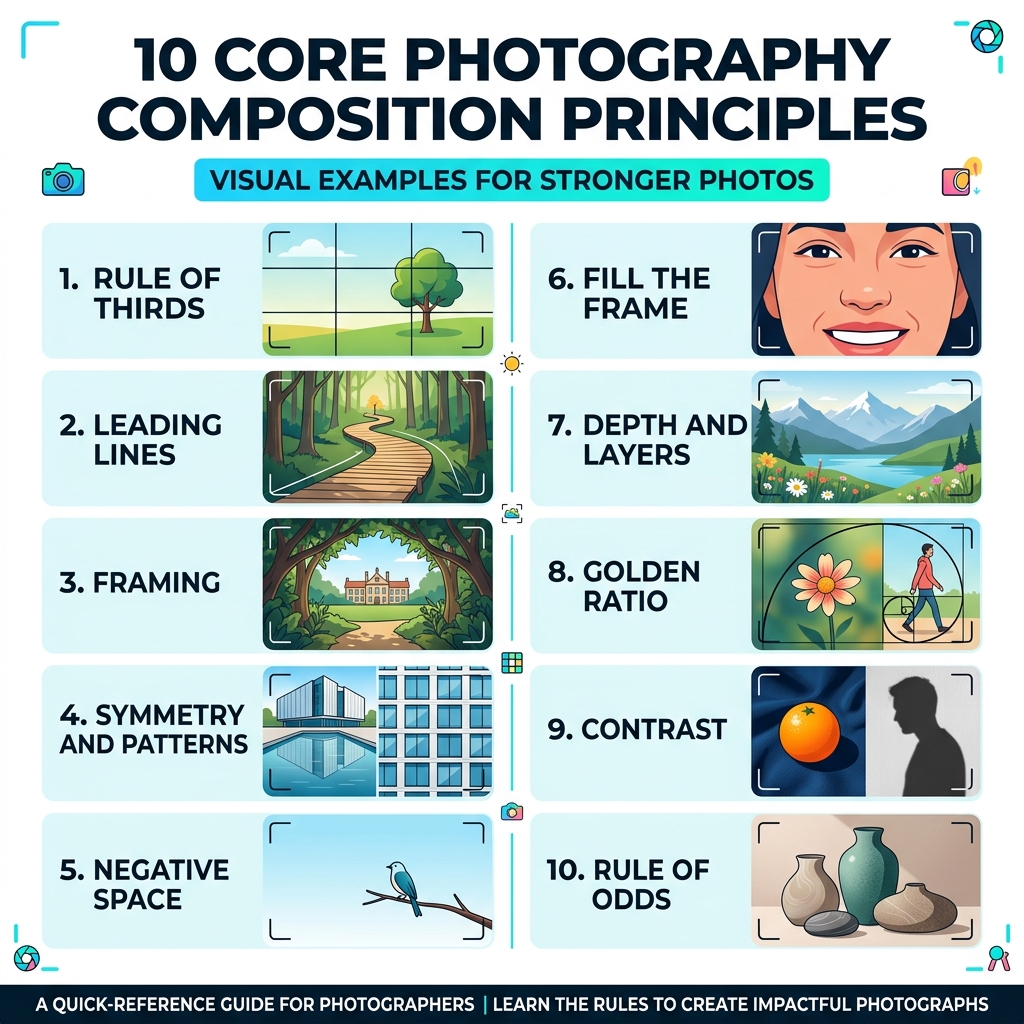
A photography composition rules pdf is a quick-reference guide that summarizes the core visual principles used to create stronger, more intentional photographs. Here are the most essential rules covered in these guides:
- Rule of Thirds – Divide your frame into a 3×3 grid and place your subject along the lines or intersections
- Leading Lines – Use roads, fences, or rivers to guide the viewer’s eye toward your subject
- Framing – Surround your subject with natural or architectural elements like doorways or branches
- Symmetry and Patterns – Use mirror-like balance or repeating elements for visual rhythm
- Negative Space – Leave empty space around your subject to create focus and emotion
- Fill the Frame – Move closer to eliminate distractions and demand attention
- Depth and Layers – Use foreground, middle ground, and background to add dimension
- Golden Ratio – An advanced off-center placement guide based on the natural ratio of 1:1.618
- Contrast – Use differences in color, tone, or texture to create visual interest
- Rule of Odds – Odd numbers of subjects tend to create more pleasing compositions
As Ansel Adams famously put it: “You don’t take a photograph, you make it.”
That single idea separates a snapshot from a real photograph. And the difference almost always comes down to composition – the intentional arrangement of visual elements inside your frame.
The good news? You don’t need expensive gear or advanced software to compose a great shot. Whether you’re shooting on a smartphone or a DSLR, the same timeless principles apply. These rules have been used by painters, filmmakers, and photographers for centuries – and once you know them, you’ll see them everywhere.
This guide breaks down every major composition rule in plain language, with practical steps you can use right away.
Mastering the Basics: Why Composition Matters
When we first pick up a camera, we usually point it at something pretty and press the shutter. That’s a “snapshot.” But when we start thinking about where the subject sits, how the light hits the edges, and what’s happening in the background, we are practicing composition.
Composition is essentially the “grammar” of photography. Just as words need to be arranged in a certain order to make sense, visual elements—points, lines, shapes, and colors—need a structure to tell a story. Without good composition, even the most beautiful sunset can look flat and uninteresting.
Good composition helps us manage “visual weight.” This is the idea that some elements in a photo pull the viewer’s eye more than others. A bright red apple in a basket of green ones has a lot of visual weight. By understanding these rules, we can guide the viewer exactly where we want them to look, creating an emotional impact that lingers long after they’ve scrolled past.
For those who want to dive deep into the theory, the Photography: The Art of Composition PDF offers a wonderful look at how visual skills are foundational to mastering the craft. It emphasizes that “learning to see” is a skill that can be developed through practice and observation.

The Rule of Thirds and Beyond
If you’ve ever looked at your camera settings and seen a 3×3 grid, you’ve met the Rule of Thirds. This is the “bread and butter” of photography composition rules pdf guides because it works for almost every genre.
The concept is simple: imagine your frame is divided into nine equal rectangles by two horizontal and two vertical lines. Instead of putting your subject dead-center (which can feel static or “boring”), you place the most important elements along those lines or at the four points where they intersect.
Why does this work? It creates a sense of tension and energy. By placing a subject off-center, we give them “room to breathe” or space to move into. For example, if you’re taking a portrait, try placing the person’s nearest eye on one of the top intersections. If it’s a landscape, place the horizon on the bottom third line to emphasize a dramatic sky, or the top third line to show off the foreground.
While the Rule of Thirds is a fantastic starting point, it’s just the beginning. Once we master the grid, we can start looking for more complex ways to balance our images, which leads us to the more detailed guides available today.
Essential Photography Composition Rules PDF Guide
When you download a comprehensive photography composition rules pdf, you’ll notice that it often goes far beyond just the grid. Visual storytelling is about using every tool in the shed—lines, frames, and perspective—to build a three-dimensional world on a two-dimensional screen.
One of the most popular resources for this is the 19 Composition Rules PDF, which has been viewed over 8,000 times. It outlines techniques like positioning subjects along gridlines, but it also dives into more nuanced ideas like looking for repeating objects or patterns in the scene to create depth.
Leading Lines and Framing Techniques
Leading lines are one of our favorite ways to add “wow factor” to a photo. These are literal or metaphorical lines that lead the viewer’s eye through the image, usually toward the main subject. Think of a winding road, a row of fence posts, or even the edge of a building.
The key is to position yourself so the lines start near the bottom or the corners of the frame and travel inward. This creates a powerful sense of depth and perspective. In bird photography, for instance, a branch can act as a leading line that points directly to the bird. For more on this, check out our guide on exploring-angles-and-perspectives-in-bird-photography/.
Framing is another clever trick. This is when we use elements within the scene to create a “frame within a frame.” You might shoot through a doorway, under a bridge, or between some overhanging branches. Framing does three things:
- It isolates the subject.
- It adds a sense of depth (the frame is the foreground, the subject is the middle ground).
- It provides context for the location.
Symmetry, Patterns, and Repetition
The human brain is hardwired to love order. This is why symmetry and patterns are so visually satisfying. Symmetry occurs when two halves of a scene are identical—like a mountain reflecting in a perfectly still lake. Placing the line of symmetry right in the middle can create a sense of calm and balance.
Patterns and repetition, on the other hand, create a visual rhythm. A field of tulips or a row of windows on a skyscraper can be mesmerizing. The “pro move” here is to find a pattern and then look for a “break” in it. A single red tulip in a field of yellow ones creates an instant, powerful focal point.
When deciding how to frame these patterns, you might wonder whether a vertical or horizontal layout is best. We’ve put together some vertical-or-horizontal-framing-tips-for-bird-photography/ that apply to almost any subject involving rhythm and height.
Advanced Techniques for Professional Impact
Once you’re comfortable with the basics, it’s time to level up. Advanced composition tools like the Golden Ratio and Power Shapes can turn a good photo into a masterpiece.
The Golden Ratio (also known as the Fibonacci Spiral or Phi) is a mathematical ratio of 1:1.618. It’s found everywhere in nature—from the spiral of a seashell to the arrangement of seeds in a sunflower. While the Rule of Thirds is a simplified version of this, the Golden Ratio places the subject slightly closer to the center, which often feels more “organic” and balanced to the human eye.
[TABLE] Comparing Rule of Thirds and Golden Ratio
| Feature | Rule of Thirds | Golden Ratio (Phi) |
|---|---|---|
| Grid Layout | 3×3 Equal Rectangles | 1:0.618:1 Ratio |
| Subject Placement | Further from the center | Closer to the center |
| Visual Feel | Dynamic and energetic | Balanced and organic |
| Best Used For | Landscapes, quick shots | Portraits, nature, fine art |
| Difficulty | Easy (most cameras have a grid) | Advanced (requires visualization) |
Using Negative Space and Contrast
Sometimes, what you leave out of a photo is just as important as what you put in. This is the power of “Negative Space.” By surrounding your subject with a large area of “empty” space (like a clear sky or a plain wall), you create a minimalist look that forces the viewer to focus entirely on the subject. It creates a sense of scale, isolation, or even peace.
Contrast is another heavy hitter. We’re not just talking about the “Contrast” slider in your editing app. We mean:
- Color Contrast: A bright orange bird against a cool blue sky.
- Tonal Contrast: A bright white building against a dark, stormy background.
- Texture Contrast: A smooth, glass-like lake next to rough, jagged rocks.
Using these techniques helps your subject “pop.” If you’re shooting in a city, for example, you can use these principles to make making-urban-birds-stand-out-in-photos/ even when the background is busy.
Camera Modes vs. Composition Rules PDF
Your camera’s built-in modes are actually designed to help with composition and focus. Understanding them is a key part of any photography composition rules pdf curriculum:
- Portrait Mode: Uses a shallow depth of field (blurry background) to isolate the subject, which is a form of “simplification” in composition.
- Landscape Mode: Tries to keep everything from the foreground to the background in sharp focus, which is essential for “Depth and Layers.”
- Macro Mode: Allows for extreme close-ups, which naturally “Fills the Frame” and highlights small details.
- Sports Mode: Increases shutter speed to freeze motion, allowing you to capture the “peak moment” of a composition.
Practical Application and Common Pitfalls
Even with all the rules in the world, it’s easy to make mistakes. One of the most common is the “cluttered background.” You might have a perfect subject, but if there’s a telephone pole “growing” out of their head, the composition is ruined.
Another common pitfall is the tilted horizon. Unless you’re intentionally going for a “Dutch Angle” for a sense of unease, a crooked horizon line is usually just distracting. Most smartphones have a built-in level indicator—use it!
We also need to watch out for “merging elements.” This happens when two objects in your photo overlap in a way that looks confusing. Moving just a few inches to the left or right can often separate these elements and give each one “room to breathe.” For help with cleaning up your shots, see our tips on removing-distractions-from-bird-photos/.
Combining Multiple Rules for Stronger Images
The strongest photographs rarely use just one rule. They layer them. You might use the Rule of Thirds to place your subject, Leading Lines to guide the eye toward them, and Framing to add depth.
Think about “Juxtaposition”—placing two contrasting things together. A tiny, delicate flower growing through a crack in a hard, grey concrete sidewalk uses contrast, leading lines (the crack), and storytelling all at once. This kind of intentionality is what separates the pros from the amateurs.
When to Break the Rules for Unique Shots
Once you know the rules, you have our full permission to break them! But here’s the secret: you have to break them intentionally.
Centering a subject can be incredibly powerful if the scene is perfectly symmetrical. Cutting off part of a subject can create a sense of mystery. Shooting at a weird, experimental angle can make a common object look like an abstract piece of art. The goal of a photography composition rules pdf isn’t to put you in a cage—it’s to give you the tools to build whatever you want.
Refining Your Vision in Post-Processing
Composition doesn’t end when you press the shutter button. In fact, many of the best compositions are finalized during the editing process. This is where “Digital Cropping” comes into play. If you couldn’t get close enough to your subject in the field, a thoughtful crop can fix your composition, remove distracting edges, and realign your subject with the Rule of Thirds grid.
However, keep in mind that every time you crop, you lose a bit of image resolution. That’s why we always recommend getting the composition as close to perfect as possible “in-camera.”
Aspect ratios also play a huge role. A 1:1 square crop is great for Instagram and feels very balanced, while a 16:9 wide crop is perfect for cinematic landscapes. Understanding how color theory—like using complementary colors—can balance a frame is another post-processing superpower. For a deeper dive, check out our crop-and-composition-editing-tips/.
Downloading Your Photography Composition Rules PDF
Having a physical or digital “cheat sheet” is one of the fastest ways to improve. You can keep a photography composition rules pdf on your phone to glance at while you’re out on a shoot. It serves as a reminder to:
- Check your edges for distractions.
- Look for a different angle (get low or get high).
- Ensure your horizon is straight.
- Try a “frame within a frame.”
For those interested in how these rules apply to specific environments, such as urban settings, our guide on composing-bird-photos-with-urban-backgrounds/ offers practical workflows for real-world scenarios.
Frequently Asked Questions about Photography Composition
What is the most important composition rule for beginners?
The Rule of Thirds is widely considered the most important starting point. It’s easy to understand, built into almost every camera’s software, and immediately makes your photos look more professional by moving the subject away from the dead center.
Can I fix poor composition during photo editing?
To an extent, yes. You can use cropping to re-center subjects, straightening tools to fix horizons, and “content-aware fill” to remove small distractions. However, you can’t change your perspective or the way light hits your subject once the photo is taken, so “getting it right in the camera” is always best.
How do I use the Golden Ratio in mobile photography?
Since most phones don’t have a “Golden Ratio” grid, you have to visualize it. Imagine a spiral starting from one corner of your frame and curling inward toward the center. Place your main point of interest where the “eye” of the spiral would be. It’s slightly more “central” than the Rule of Thirds intersections.
Conclusion
Mastering photography isn’t about having the most expensive lens; it’s about how you see the world through the one you have. By using a photography composition rules pdf as your roadmap, you can transform everyday scenes into compelling visual stories.
At Ciber Conexão, we believe that everyone has an artistic vision waiting to be refined. Whether you’re using the Rule of Thirds to capture a portrait or the Golden Ratio for a landscape, the key is to keep experimenting. As Hugo Andrade often says, the best way to improve is to shoot often, edit thoughtfully, and never stop learning.
Ready to take your skills to the next level? Explore more photography tips and tutorials and start making photos that truly stand out. Happy shooting!
