
What Makes Street Photography So Compelling
Street photography examples show us something powerful: ordinary life, frozen in time.
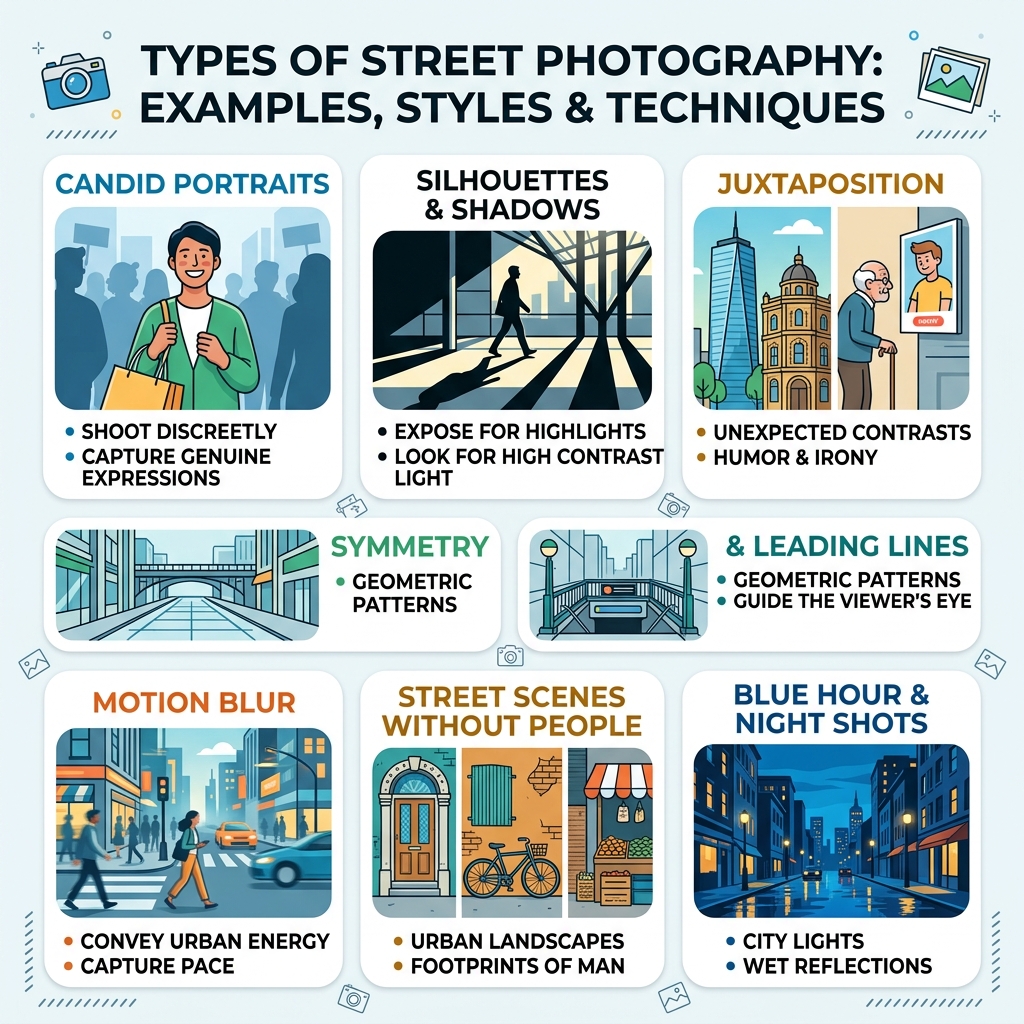
Here are some of the most common and inspiring types of street photography examples to get you started:
- Candid portraits – real people caught in unposed, genuine moments
- Silhouettes and shadows – dramatic contrast using light and urban shapes
- Juxtaposition – two contrasting elements placed side by side for visual impact
- Symmetry and leading lines – architecture and geometry guiding the viewer’s eye
- Motion blur – conveying the energy and pace of city life
- Street scenes without people – urban landscapes, textures, and “footprints of man”
- Blue hour and night shots – city lights reflected on wet pavement
These styles range from deeply human to beautifully abstract — and all of them are within reach of any photographer, beginner or not.
Henri Cartier-Bresson called it the “decisive moment” — that split second when everything in the frame aligns perfectly. You don’t need expensive gear or years of experience to find it. You just need to show up and pay attention.
Street photography is also one of the most honest art forms. There are no studio lights, no retakes, no posing. What you see is what was real.
The challenge? Knowing what to look for — and how to frame it when you find it.
That’s exactly what this article is here to help with. Whether you’re drawn to bustling city intersections or quiet rainy alleys, the examples below will give you a clear, practical sense of what great street photography looks like and how to start creating your own.
Iconic Street Photography Examples and Their Stories
To truly understand the power of a single frame, we have to look at the masters who defined the genre. One of the most famous street photography examples in history is Rue Mouffetard, Paris (photograph)). Captured by Henri Cartier-Bresson in 1954, it depicts a young boy named Michel Gabriel proudly carrying two large bottles of wine.
What makes this image iconic isn’t just the subject; it’s the “decisive moment.” The boy’s triumphant smile, the blurred figures of onlookers in the background, and the light-hearted atmosphere all converge in a fraction of a second. It captures genuine human emotion and social interaction without any forced posing. It reminds us that street photography is, at its heart, about storytelling.
Fast forward to the modern era, and we see how the genre has evolved across cultures. In Tokyo Street Photography – A One Shot Story, we see how serendipity plays a massive role. The photographer describes a split-second reaction to a man in a straw hat in the Ginza district. Using a vintage film camera, they captured a fleeting moment that revealed hidden details—like another photographer in the background—only after the film was processed.
These examples teach us that being a street photographer means being a hunter of moments. You aren’t just taking a picture; you are documenting a cultural context that will never exist in exactly that way again. Whether it’s a boy in Paris or a salaryman in Tokyo, the goal is to find the extraordinary within the ordinary.
Mastering Composition in Street Photography Examples
Great street photography often looks accidental, but the best shots are usually built on a foundation of strong composition. When we walk through a city, we are surrounded by geometric shapes, leading lines, and natural frames. Learning to see these elements is the first step toward creating impactful street photography examples.
Compositional elements like silhouettes and shadows allow you to play with mystery. By underexposing your subject against a bright background, you can create a silhouette that focuses the viewer’s attention on shape and gesture rather than identity. This is not only visually striking but also a clever way to handle privacy concerns in public spaces.
We often talk about composing bird photos with urban backgrounds here at Ciber Conexão, and the principles are exactly the same for humans. You want to place your subject in a way that feels balanced yet dynamic. A great example of this is the Urban Street Scene in Contemporary London – Dave Bullock / eecue, where the photographer uses a wide-angle lens from a low “pavement level” perspective. This emphasizes the texture of the street and creates a powerful sense of place.
Using Symmetry and Lines in Street Photography Examples
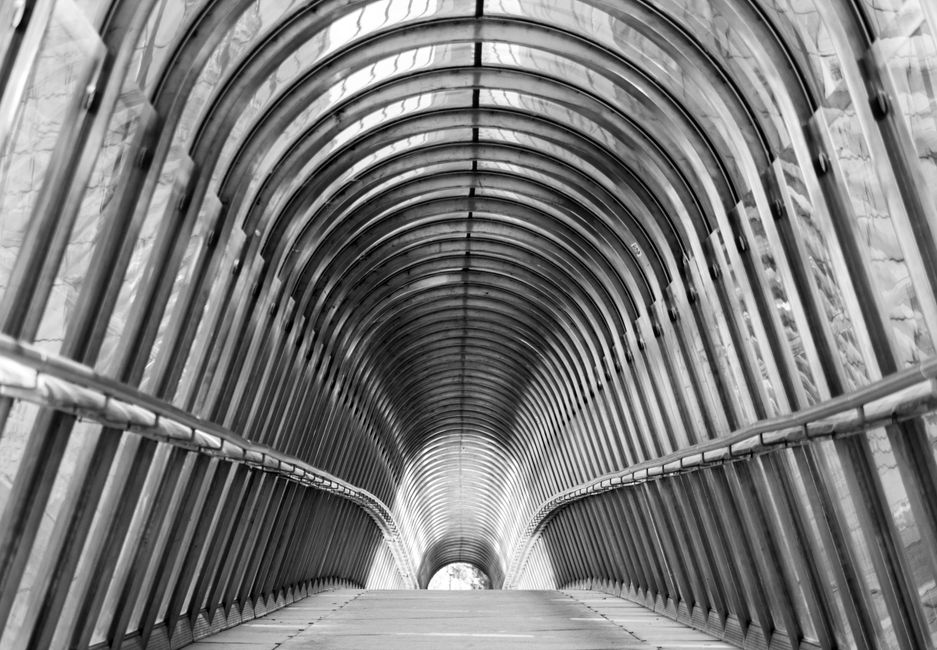
The urban environment is a playground of lines. Sidewalks, skyscrapers, and even power lines can serve as “leading lines” that pull the viewer’s eye toward your subject. When you find a vanishing point—where parallel lines seem to meet in the distance—you create a sense of immense depth.
Symmetry is another powerful tool. In a chaotic city, finding a perfectly symmetrical building or a reflection in a puddle provides a sense of visual relief and order. We can apply the same logic used for making-urban-birds-stand-out-in-photos to street photography: look for clean backgrounds and repetitive patterns. A row of identical windows or a series of pillars can frame a person walking by, making them the “exclamation point” in a sea of repetition.
Creative Framing and Juxtaposition in Street Photography Examples
Framing involves using elements within the scene—like an archway, a doorway, or even the gap between two parked cars—to “box in” your subject. This adds layers to your image and creates a “peeping tom” feel that enhances the candid nature of the shot.
Juxtaposition, however, is where the humor and irony of the street come alive. This is the act of placing two contrasting elements together. Think of a businessman in a suit standing next to a piece of colorful, rebellious graffiti, or a “Fast Food” sign next to a person moving very slowly with a cane.
A classic example of subject placement and contrast can be seen in The shot – Los Angeles, United States – Black and white street photography. By stripping away color, the photographer forces us to focus on the interplay of light and the specific placement of the subject within the sprawling urban landscape of LA.
Exploring the Urban Environment Without People
Does street photography require people? Not necessarily. Some of the most haunting and beautiful street photography examples focus on the “footprints of man”—the things we leave behind.
Urban landscapes can be just as expressive as portraits. An empty chair in a courtyard, a lone payphone, or a discarded umbrella on a rainy sidewalk tells a story of absence. This approach allows you more control over your lighting and composition because your “subject” isn’t going to walk away!
Take a look at Modern London Street Scene at Dusk – Dave Bullock / eecue. This image captures the “blue hour,” where the sky turns a deep indigo and city lights begin to glow. The wet pavement reflects the neon signs and headlights, creating a painterly, abstract texture.
Even animals can be the stars of your street scenes. We’ve discussed photographing-pigeons-in-the-city as a way to practice your timing and reactions. Pigeons are the ultimate urban residents, and capturing them interacting with architectural contrasts—like a bird perched on a cold, glass skyscraper—adds a layer of nature vs. machine to your portfolio.
Overcoming Challenges and Ethical Considerations
Street photography comes with its own set of hurdles, both technical and moral. The biggest challenge for many is the “fear of the street”—the anxiety of pointing a camera at a stranger.
In Copenhagen – As I See It: A Street Photographer’s Perspective, the author shares a story of capturing a mother breastfeeding on a cargo bike. It was an instinctive, quiet moment. He relied on “preset focus” (also known as zone focusing), which allowed him to take the shot without fiddling with buttons, keeping the moment authentic and respectful.
Ethics are just as important as settings. Just because something is legal doesn’t always mean it’s right. While you generally have the right to photograph in public spaces where there is no expectation of privacy, you should always lead with empathy.
| Aspect | Legal Standard (General) | Ethical Standard (Ciber Conexão Recommendation) |
|---|---|---|
| Public Spaces | Generally legal to shoot anything in view. | Be mindful of vulnerable individuals. |
| Children | Legal in many regions if in public. | Always best to ask or keep identities obscured. |
| Commercial Use | Requires a signed model release. | Don’t sell someone’s likeness without permission. |
| Harassment | Illegal if you follow or impede someone. | If someone looks uncomfortable, stop and move on. |
If you’re feeling nervous, start small. Much like our urban-backyard-bird-photography-tips, start by observing from a distance. Use a longer lens if you must, though most street photographers prefer the intimacy of a 35mm or 50mm lens.
Frequently Asked Questions about Street Photography
Is street photography legal without permission?
In most democratic countries, it is perfectly legal to take photographs in public spaces (streets, parks, plazas) without explicit permission. This is because there is no “reasonable expectation of privacy” in these areas. However, local regulations vary. For instance, France has stricter privacy laws regarding the publication of images. If you plan to sell the photo for advertising (commercial use), you will almost always need a model release. For artistic or editorial use, you are usually in the clear.
What is the best lens for street photography?
The “gold standard” is a 35mm or 50mm prime lens. These lenses are close to the human eye’s field of view, making the images feel natural and immersive.
- 35mm: Great for including more of the urban environment and context.
- 50mm: Excellent for “standard” views and candid portraits with a bit of background blur.
- Wide-angle: Useful for “stretching” a scene or shooting in tight alleys. Interestingly, we often recommend the best-lenses-for-photographing-pigeons for those who want to stay further back; a telephoto lens can compress a scene and make a crowd look much denser than it actually is.
How do I get over the fear of photographing strangers?
The best way to overcome fear is through “waist-level shooting” or using a camera with a tilt-screen. This allows you to compose your shot without holding the camera to your eye, making you look less like a “paparazzo” and more like someone checking their settings.
Another tip is to use “zone focusing.” Set your aperture to f/8 or f/11, pre-focus your lens to a distance of about 3 meters, and then you don’t have to focus at all when the moment happens. Just point and shoot! Finally, never underestimate the power of a smile and a nod. If someone catches you taking their photo, a friendly acknowledgment usually de-escalates any tension.
Conclusion
The world of street photography is a never-ending gallery of human stories and urban beauty. From the “decisive moments” of Paris to the neon reflections of a London dusk, there are endless street photography examples to draw inspiration from.
At Ciber Conexão, we believe that the shot you take in the street is just the beginning. The real magic often happens in the “digital darkroom.” Hugo Andrade and our team specialize in helping you refine those raw moments through expert photo editing. Sometimes, a “good” street photo becomes a “great” one simply by finding the right crop or adjusting the composition to remove a distracting telephone pole or trash can.
If you’re ready to take your urban shots to the next level, why not start with some of our specific guides? You can learn about top-tips-for-photographing-urban-pigeons to sharpen your reflexes, or Improve your skills with our expert Photography Tips to master the art of the edit.
Grab your camera, head outside, and start looking for your own “decisive moment.” The street is waiting!
