
Why the Golden Ratio in Photography Changes How You See Every Shot
The golden ratio in photography is a composition technique based on the mathematical proportion of 1:1.618, used to position subjects and elements in a frame so the image feels naturally balanced and pleasing to the eye.
Here is a quick overview of how it works in practice:
- What it is: A ratio (roughly 1 to 1.618) found throughout nature, art, and architecture
- How to use it: Place your main subject at the focal point of a golden spiral or along the lines of a phi grid
- Key tools: The Fibonacci spiral, the phi grid, and golden triangle overlays
- Where to apply it: Landscapes, portraits, street photography, architecture — virtually any genre
- Quickest way to start: Use the golden spiral overlay in Lightroom (press
Owhile in the crop tool)
Most photographers learn the rule of thirds first. It is simple, it works, and almost every camera has a grid for it built in.
But at some point, your photos start to feel a little flat. Technically correct, but missing something.
That is usually a sign you are ready for the golden ratio.
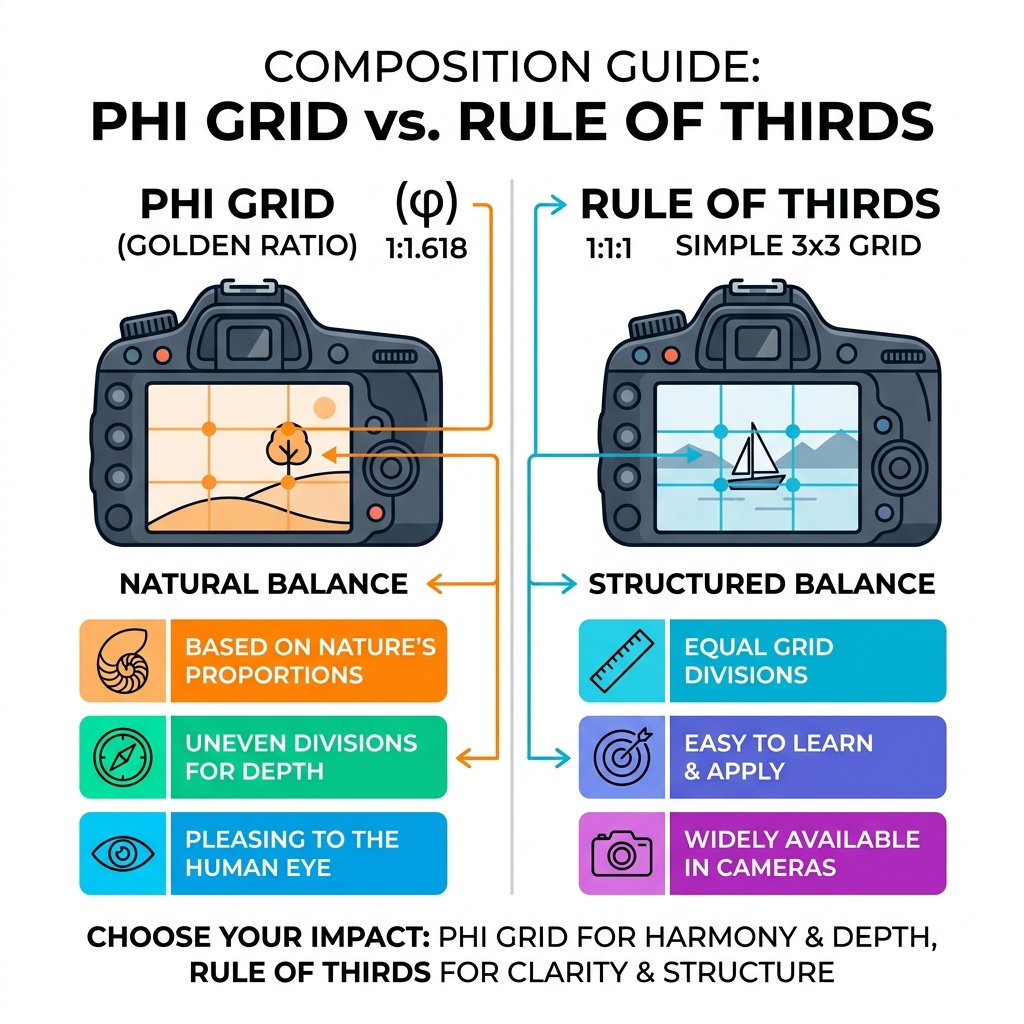
The rule of thirds splits your frame into nine equal boxes. The golden ratio uses a subtler, unequal division — closer to how the human eye actually moves across a scene. It appears in nautilus shells, sunflowers, and galaxies. Our brains seem wired to find it satisfying, even when we cannot explain why.
The good news? You do not need to be a mathematician to use it. You just need to know where to look and what to do with it.
This guide will walk you through everything — from the basic math to practical tools you can use right now, whether you are shooting landscapes, portraits, or street scenes.
What is the Golden Ratio in Photography?
When we talk about the golden ratio in photography, we are diving into a concept that has guided creators for millennia. From the majestic columns of the Parthenon to the brushstrokes of Leonardo da Vinci, this “Divine Proportion” has been the secret ingredient for visual harmony. In its simplest form, it is a mathematical ratio of approximately 1:1.618, represented by the Greek letter Phi (φ).
In photography, we use this ratio to create a sense of organic balance. Unlike the Rule of Thirds, which is a modern simplification, the Golden Ratio is deeply rooted in the natural world. It isn’t just a “rule” we follow; it is a description of how things grow and how our eyes prefer to consume information.
The Math Behind the Magic
Don’t let the word “math” scare you away from better photos! The Golden Ratio is inextricably linked to the Fibonacci sequence. This is a series of numbers where each number is the sum of the two preceding ones (0, 1, 1, 2, 3, 5, 8, 13, 21, 34…).
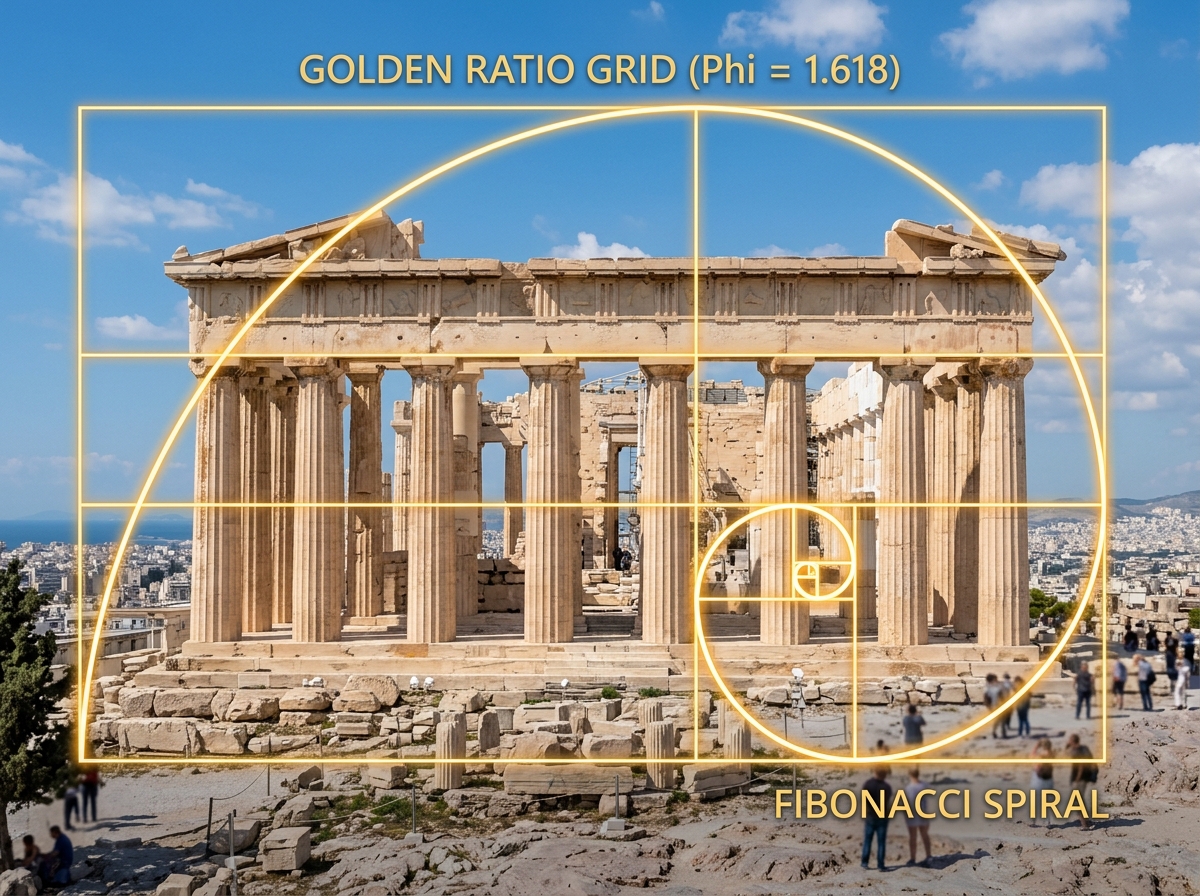
As these numbers grow larger, the ratio between them gets closer and closer to 1.618. When you translate these numbers into shapes, you get the Golden Rectangle. If you draw an arc through the corners of these squares, you create the famous Fibonacci Spiral (or Golden Spiral).
Why does this matter to us as photographers? Because this pattern appears everywhere: in the seeds of a sunflower, the arms of a galaxy, and even the proportions of the human face. Scientific research on the Golden Ratio and aesthetic preference suggests that our brains are literally “wired” to process images using this ratio more efficiently, leading to a feeling of “rightness” or beauty.
| Feature | Rule of Thirds | Phi Grid (Golden Ratio) |
|---|---|---|
| Grid Division | 1:1:1 (Equal sections) | 1:0.618:1 (Unequal sections) |
| Line Placement | 33% and 66% from edges | 38% and 62% from edges |
| Visual Feel | Static, energetic tension | Natural, harmonious balance |
| Best Use Case | Moving subjects, simple scenes | Landscapes, organic shapes, portraits |
Why It Beats the Rule of Thirds
We often hear that the Rule of Thirds is the “gold standard” for beginners. While it is a great starting point, it can sometimes feel a bit formulaic or “obvious.” The golden ratio in photography offers a more sophisticated alternative.
The Phi Grid—a grid based on the Golden Ratio—places its intersecting lines closer to the center of the frame than the Rule of Thirds does. This subtle shift creates a more centralized tension that feels less forced. It allows for an organic flow that guides the viewer’s eye through the image rather than just pointing at a single spot. By using the Golden Ratio, we can achieve a professional aesthetic that feels like the subject naturally belongs exactly where it is placed.
Core Techniques: The Phi Grid and Fibonacci Spiral
To master the golden ratio in photography, we primarily look at two visual tools: the Phi Grid and the Fibonacci Spiral.
The Phi Grid looks similar to the Rule of Thirds grid, but the middle “box” is smaller. This creates a 1:0.618:1 ratio. The Fibonacci Spiral, on the other hand, is a series of nested “Golden Rectangles” that form a curve. This curve acts as a powerful leading line, drawing the viewer from the edges of the frame into the heart of the subject.
Applying the Golden Ratio in Photography Landscapes
In landscape photography, the Golden Ratio is a game-changer for horizon placement and foreground interest. Instead of splitting your photo exactly at the one-third mark, try the 38% rule. Placing the horizon at the 38% line (either from the top or bottom) gives more weight to the most important part of your scene without making it look lopsided.
Master photographers like Ansel Adams often utilized these proportions intuitively. Imagine a winding river that enters from the bottom corner and curves its way across the frame, eventually leading the eye to a distant mountain peak located at the center of the Golden Spiral. This creates a visual journey that feels inevitable and satisfying.
For those looking to dive deeper into these foundational concepts, we recommend checking out More info about better photo composition to see how these grids interact with light and color.
Using the Golden Ratio in Photography Portraits
When it comes to portraits, the Golden Ratio helps us move beyond simple “headshots.” We can use the Phi Grid to align the subject’s eyes. Placing the dominant eye at one of the four “Golden Points” (the intersections on the Phi Grid) creates a more natural, engaging gaze.
In group portraits or environmental shots, the Golden Ratio can help manage the subject-background relationship. Legendary photographers like Annie Leibovitz often use complex geometric arrangements—sometimes referred to as inverted triangles or golden triangles—to balance multiple people in a single frame. By using the spiral, you can lead the viewer’s eye from a person’s hand, along the curve of their shoulder, and finally to their face, creating a narrative flow within a single still image.
Practical Tools for Composition and Editing
We don’t expect you to carry a calculator into the field! Most of the “magic” happens through visualization and post-processing. Many modern cameras allow you to change the viewfinder grid from the Rule of Thirds to a Phi Grid or even a Golden Spiral.
If your camera doesn’t have this, don’t worry. This is where your editing workflow comes in. In Adobe Lightroom, the crop tool is your best friend.
Pro Tip for Lightroom Users:
- Select the Crop Tool (or press
R). - Press
Oto cycle through the different overlays until you see the Fibonacci Spiral. - Press
Shift + Oto rotate or flip the spiral so it aligns with your subject.
This allows us to refine our composition after the shot is taken, ensuring the focal points hit the “sweet spots” of the ratio.
Training Your Eye for Intuitive Composition
Henri Cartier-Bresson, the father of modern photojournalism, spoke often about the “Decisive Moment.” He believed that composition should be intuitive, not a rigid set of “schema grills” applied over a scene. He studied classical paintings to understand geometry so that when he was on the street, he could recognize these patterns in a split second.
To train your eye, we suggest practicing “mental framing.” Look at the world around you through a Golden Ratio lens. When you are walking down the street, try to spot natural spirals—a staircase, a curled leaf, or the way a crowd moves around a corner. The goal is to make these proportions second nature so that you aren’t thinking about math when you press the shutter; you are just feeling the balance.
Frequently Asked Questions about the Golden Ratio
When should I break the Golden Ratio rule?
Rules are made to be broken—once you understand why they exist! There are several scenarios where the golden ratio in photography might not be the best choice:
- Symmetry: If you are shooting a perfectly symmetrical building or a reflection in a still lake, centering the subject often works better to emphasize the mirror image.
- Minimalism: Sometimes you want extreme negative space to create a sense of isolation or tension. Placing a subject at the very edge of the frame can be more powerful than a “balanced” Golden Ratio placement.
- Creative Intent: If your goal is to make the viewer feel uncomfortable or “off-balance,” intentionally ignoring these ratios is a valid artistic choice.
What are common mistakes when using the Golden Ratio?
The most common pitfall is forcing the spiral. Not every scene has a natural curve. If you try to force a straight-edged architectural shot into a Fibonacci spiral, it will look awkward and “over-edited.”
Another mistake is ignoring the subject in favor of the grid. A perfectly composed photo of a boring subject is still a boring photo. Always prioritize the story and the light; use the Golden Ratio to enhance them, not replace them. Lastly, many beginners confuse the Phi Grid with the Rule of Thirds. The Phi Grid lines are closer to the center!
Is the Golden Ratio applicable to mobile photography?
Absolutely! Your smartphone is a powerful tool for this. Many camera apps allow for custom grid overlays. Even without them, the portability of a phone makes it easier to move your body and find the exact angle where the elements of a scene align with the Golden Ratio. Because you get instant feedback on a large screen, mobile photography is actually a fantastic way to practice visualizing these complex compositions.
Conclusion
Mastering the golden ratio in photography is a journey from technical shooting to artistic intuition. It is about moving beyond “putting things on the lines” and starting to see the underlying geometry of the world. Whether you are using the Phi Grid to balance a vast landscape or the Fibonacci Spiral to guide a viewer through a street scene, these tools help you create images that feel “right” at a biological level.
At Ciber Conexão, we believe that expert editing and a deep understanding of composition are what separate a snapshot from a masterpiece. Hugo Andrade and our team are dedicated to helping you refine these skills through practical, expert advice.
The best way to learn is to get out there and shoot. Take a photo using the Rule of Thirds, then try to recompose it using the Golden Ratio. Compare them. Which one draws you in? Which one feels more “alive”? With practice, you will find that these “divine” proportions start to appear everywhere you look.
Ready to take your skills to the next level? Dive into The Ultimate Guide to Better Photo Composition and start your journey toward compositional mastery today!
