
Why Getting the Best Camera Settings for Hummingbird Pictures Is Harder Than It Looks
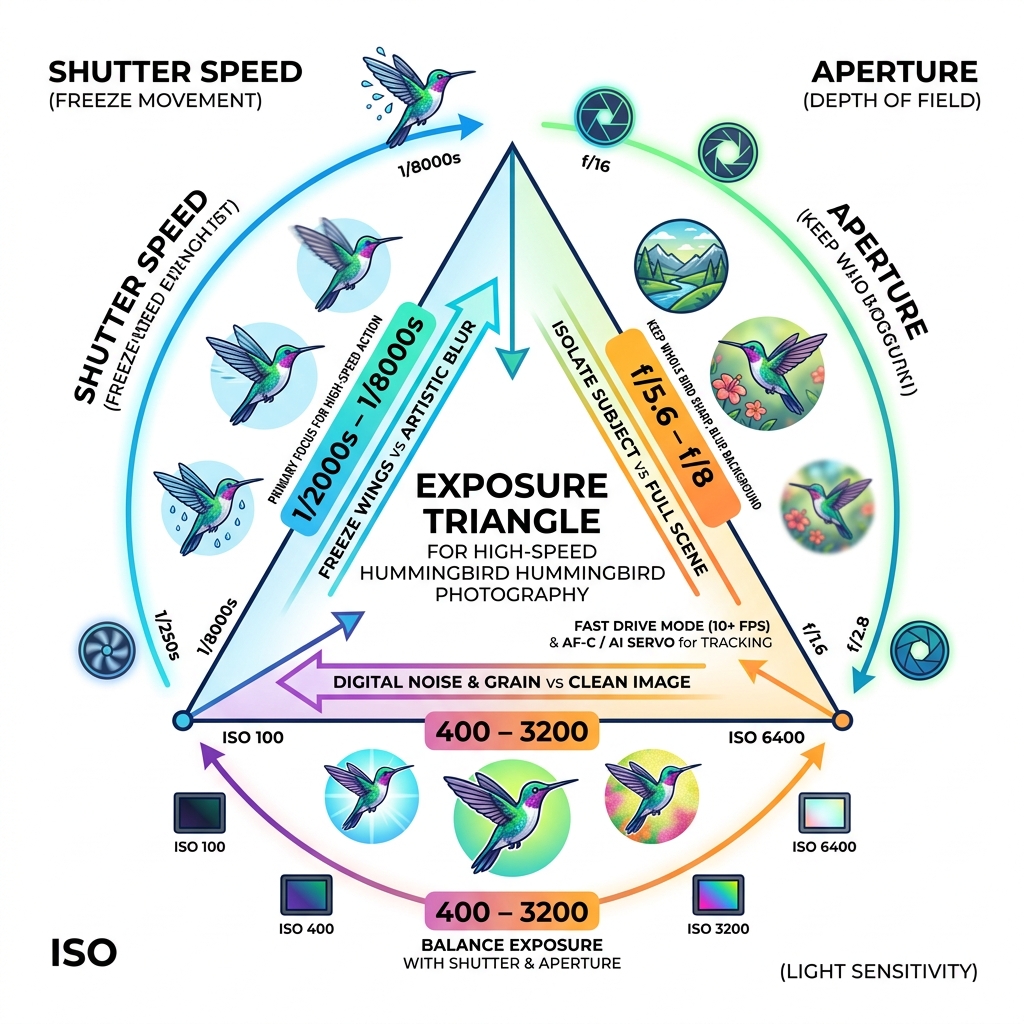
The best camera settings for hummingbird pictures come down to a few key choices that work together:
| Setting | Recommended Value | Goal |
|---|---|---|
| Shutter Speed | 1/2000s – 1/8000s | Freeze wings or allow artistic blur |
| Aperture | f/5.6 – f/8 | Keep whole bird sharp, blur background |
| ISO | 400 – 3200 | Expose correctly for available light |
| Focus Mode | AF-C / AI Servo | Track fast, erratic movement |
| Drive Mode | Burst (10+ fps) | Maximize keeper rate |
Hummingbirds are tiny, lightning-fast creatures. Their wings beat 60 to 80 times per second — sometimes faster. That means even at 1/2000s, you may still see some wing blur in your shots.
On top of that, their iridescent feathers change color depending on the angle of light. One wrong move and that brilliant ruby throat turns a dull gray.
The result? Most photographers end up with a blurry smudge where a beautiful bird should be.
The good news is that the right combination of shutter speed, aperture, and autofocus settings solves most of these problems — even if you’re just getting started with your camera.
Mastering the Best Camera Settings for Hummingbird Pictures
When we talk about the best camera settings for hummingbird pictures, we are essentially trying to solve a physics problem. How do we capture something moving at 55 km/h that is only three to five inches long?
The answer starts with your shutter speed. This is the single most important setting in your arsenal. Depending on your creative goal, you have three main “tiers” of speed to choose from.
- 1/2000 sec: This is our absolute minimum for birds in flight. At this speed, the body and eyes will be tack-sharp, but the wings will have a soft, beautiful blur. This is often preferred for a more “natural” look that conveys the energy of the bird.
- 1/3200 sec: This speed starts to freeze the wings at the “back” and “forward” points of their stroke. You will still see some mid-beat blur, but the definition becomes much clearer.
- 1/8000 sec: This is the gold standard for a total freeze. At 1/8000, we can see individual feather details on the wings even during a powerful downstroke.
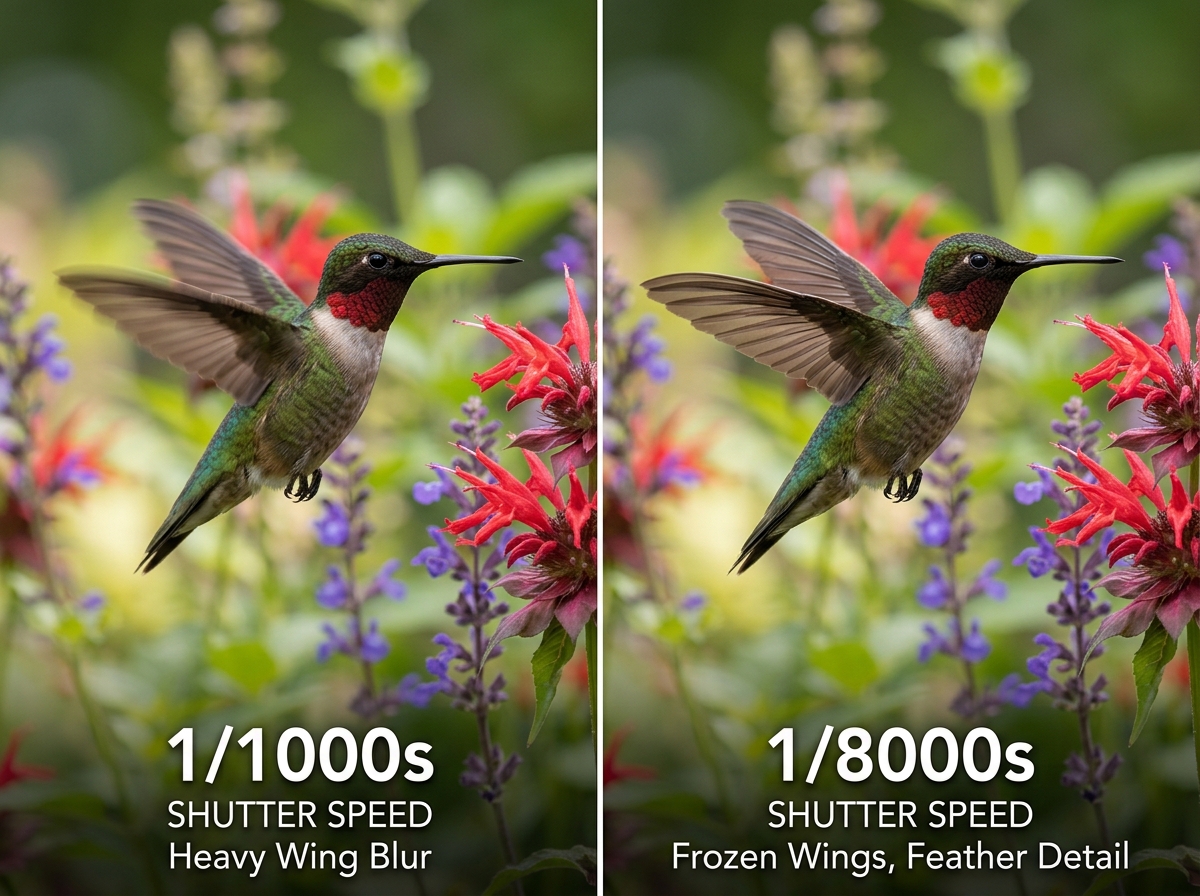
We often find that wing position matters just as much as the setting itself. Hummingbird wings are sharpest for a split second when they change direction. If you aren’t getting the results you want, you might need to check out our guide on avoiding blurry images in bird photography to troubleshoot your technique. For those who need a refresher on the technical side, understanding shutter speed basics is a great place to start.
Choosing the Best Camera Settings for Hummingbird Pictures in Natural Light
In an ideal world, we would all shoot in bright, midday sun. But hummingbirds are often most active in the early morning or late afternoon when light is low. To manage this, we recommend using Manual Mode with Auto ISO.
By setting your shutter speed to at least 1/4000 sec and your aperture to f/5.6, you can let the camera decide the ISO. Yes, this might lead to some “noise” or grain in the image, but in our experience at Ciber Conexão, a sharp, noisy image is always better than a clean, blurry one. You can always fix noise in post-processing, but you can’t fix a lack of focus.
If you find your images are coming out too dark or too bright because of the bird’s iridescent feathers, use Exposure Compensation. Dialing it to -0.3 or -0.7 can help preserve the details in those shiny throat feathers (the gorget) that tend to “blow out” in bright light. For more tailored advice, see our guide to bird photography settings.
Balancing Aperture and Depth of Field
Aperture is a double-edged sword. On one hand, a wide aperture like f/2.8 lets in a lot of light, which is great for keeping your ISO low. On the other hand, the “depth of field” (the area in focus) becomes razor-thin. At 10 feet away, an f/2.8 aperture might make the bird’s eye sharp while its tail and wingtips are a total blur.
We suggest a “sweet spot” of f/5.6 to f/8. This range provides enough depth to keep the entire bird sharp from beak to tail while still creating that creamy, out-of-focus background we call bokeh.
When you use a long telephoto lens, the background naturally blurs more anyway. By staying at f/6.3 or f/7.1, you get the best of both worlds: subject isolation and enough sharpness to see every tiny feather. If you’re curious about how this works, you can read more about understanding aperture and light.
Advanced Autofocus and Subject Tracking
Tracking a hummingbird is like trying to lasso lightning. They don’t fly in straight lines; they dart, hover, and zip away in the blink of an eye. This is where modern autofocus (AF) systems save the day.
For the best camera settings for hummingbird pictures, you must use a continuous focus mode. Depending on your camera brand, this is called AI Servo (Canon) or AF-C (Nikon/Sony). This tells the camera to keep focusing as long as the bird is moving.
- Eye Detection: If your camera has “Animal Eye AF,” turn it on! It is a game-changer for hummingbirds.
- Single-Point AF: If Eye AF struggles because the bird is too small in the frame, switch to a single point or a small “Zone.” Aim for the bird’s head or chest.
- Back-Button Focus: This is a pro technique where you move the focus function from the shutter button to a button on the back of the camera. It allows you to track the bird continuously without accidentally taking a photo before you’re ready.
Mastering these bird photography essentials will significantly increase your “keeper” rate. If you want to dive deep into the tech, check out more about AI Servo technology.
Freezing Motion with Flash and Burst Mode
Sometimes, even 1/8000 sec isn’t enough to get that “frozen in time” look. This is especially true in shaded gardens. In these cases, we use flash.
The secret to flash photography with hummingbirds isn’t the shutter speed—it’s the flash duration. When you set a flash to a very low power (like 1/16 or 1/32), the burst of light is incredibly short—sometimes as fast as 1/15,000th of a second! This “pops” the bird into focus and freezes the wings instantly.
To capture the perfect wing position, you also need a high-speed drive mode (burst mode). We recommend at least 10 frames per second (fps). Modern mirrorless cameras can go up to 20 or 30 fps. Just be careful: you can easily take 500 photos in a few minutes, which means a lot of work for us later in the editing room! For more on this, read our tips for capturing swift movements.
Best Camera Settings for Hummingbird Pictures Using Flash
Using a flash requires a “manual” mindset. You want the flash to provide the light, not the sun. Here is a starting setup:
- Mode: Manual Exposure
- Shutter Speed: 1/250 sec (your camera’s max sync speed)
- Aperture: f/16 (to block out ambient light and keep the bird sharp)
- ISO: 400
- Flash Power: 1/16 or 1/32 with a diffuser
Using multiple flashes on stands can eliminate shadows and create a “studio” look in your backyard. For a professional perspective on this high-tech approach, the Audubon’s guide to exquisite hummingbird photos is an excellent resource.
Field Techniques and Ethical Photography
Having the best camera settings for hummingbird pictures is only half the battle. You also have to find the birds! Hummingbirds are creatures of habit. They often follow a “trap-line,” visiting the same flowers or feeders at the same time every hour.
| Time of Day | Lighting Condition | Strategy |
|---|---|---|
| Morning (Golden Hour) | Soft, directional light | Best for showing iridescence and “glow” |
| Midday | Harsh, overhead light | Use high shutter speeds; watch for shadows |
| Evening | Low, warm light | Great for silhouettes or using flash |
| Overcast | Even, soft light | Ideal for capturing true feather colors without glare |
We always recommend checking eBird to see which species are active in your area. Once you find a spot, stay still. Hummingbirds have a high metabolism and need to eat constantly; if you are patient, they will eventually ignore you and fly within a few feet of your lens.
Ethics Matter: Never trap or “cage” a bird to get a shot. Also, be careful with flash. While a few pops won’t hurt them, a constant barrage of high-power flashes can be stressful. Always prioritize the bird’s welfare over the photograph. You can compare more morning vs evening bird settings to see how light shifts your strategy.
Frequently Asked Questions about Hummingbird Settings
What is the minimum shutter speed to freeze hummingbird wings?
To see individual feathers without any blur, you generally need 1/4000 sec or faster. However, at 1/2000 sec, you can freeze the bird’s body and eyes perfectly while keeping a sense of motion in the wings. Their wings can beat up to 80 times per second, so you are fighting extreme speed!
How do I handle high ISO noise in low light?
Don’t be afraid of ISO 3200 or even 6400. Modern cameras handle noise very well, and software can clean up the rest. Always shoot in RAW format. This gives you the most data to work with during editing. A “noisy” photo can be saved; a “blurry” photo is a delete.
Is flash safe for hummingbirds?
Yes, when used responsibly. Use low power settings (1/16 or lower) and diffusers to soften the light. Avoid pointing the flash directly into their eyes from inches away. If the bird seems startled or stops feeding, turn the flash off and stick to natural light.
Conclusion
Capturing the perfect hummingbird photo is a thrilling challenge that blends technical skill with a bit of luck. By mastering the best camera settings for hummingbird pictures—prioritizing high shutter speeds, choosing a stable aperture, and utilizing advanced tracking—you’ll transform those blurry snapshots into gallery-worthy art.
At Ciber Conexão, we believe the magic doesn’t stop when you click the shutter. Our expert, Hugo Andrade, emphasizes that great bird photography is often made in the “crop.” Because hummingbirds are so small, you will likely need to crop your images to perfect the composition. Using a high-resolution sensor and sharp lenses allows you to zoom in during post-processing without losing that exquisite feather detail.
We invite you to keep practicing, stay patient, and enjoy the process of observing these “flying jewels.” For more advice on refining your images, explore our other mastering photography tips and techniques. Happy shooting!
