
Why Finding the Best Camera for Taking Pictures of Birds Is Harder Than It Looks
The best camera for taking pictures of birds depends on three things: how far away the birds are, how fast they move, and how much you want to spend. Here’s a quick answer before we dive deeper:
Top picks at a glance:
| Camera | Best For | Price Range |
|---|---|---|
| Sony A1 | Professional, ultimate performance | ~$5,500+ |
| Nikon Z9 | Professional, high resolution + speed | ~$5,500 |
| OM System OM-1 Mark II | Enthusiast, compact + fast | ~$2,400 |
| Fujifilm X-H2S | Enthusiast, APS-C speed | ~$2,499 |
| Canon EOS R7 | Mid-range, great reach + value | ~$1,499 |
| Sony RX10 IV | All-in-one compact, travel-friendly | ~$1,300-1,700 |
| Canon EOS R10 | Budget-friendly, beginner mirrorless | ~$879 |
Birds don’t wait. They dart, dive, and disappear in a fraction of a second. That split second is exactly why most general-purpose cameras frustrate birders.
Imagine finally spotting a rare bird perched in a tree — you raise your camera, and by the time it locks focus, the bird is gone. Or you get a shot, but it’s a tiny blurry speck because your lens simply doesn’t reach far enough. These are real problems that the right gear solves directly.
Bird photography sits at the demanding end of photography. You need serious telephoto reach (at least 400mm, ideally 600mm or more), blazing-fast autofocus that can track a moving subject through branches, and burst shooting fast enough to freeze a wingbeat. That’s a lot to ask of a camera.
The good news? Camera technology has advanced dramatically. Modern mirrorless cameras now include AI-powered bird detection autofocus that locks onto a bird’s eye automatically — something that would have seemed like science fiction just a few years ago. And options exist across every budget, from under $1,000 to professional setups that cost as much as a used car.
This guide cuts through the noise and helps you find the right camera for your birding style, skill level, and budget.
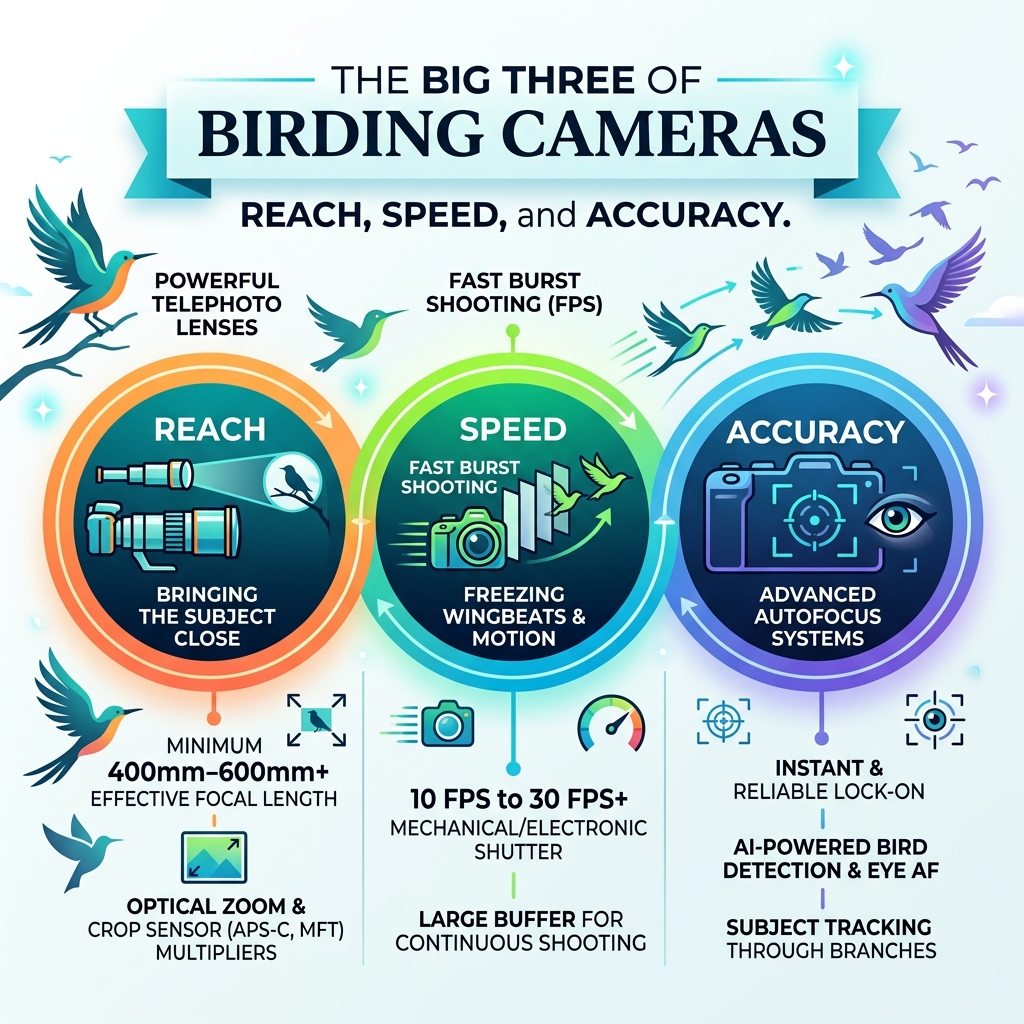
Essential Features of the Best Camera for Taking Pictures of Birds
When we go out into the field, we aren’t just taking pictures; we are participating in a high-speed chase. To win that chase, your camera needs specific “superpowers.” If you’ve ever tried to photograph a hummingbird with a smartphone, you know that frustration is the default setting without the right features.
AI Subject Detection and Animal Eye AF
In the past, photographers had to manually move a single focus point onto a bird’s head. Today, the best camera for taking pictures of birds uses artificial intelligence. Systems like Sony’s Real-time Tracking or Canon’s Dual Pixel CMOS AF II can recognize a bird’s shape and, more importantly, lock onto its eye. This is a game-changer because if the eye isn’t sharp, the photo usually goes in the digital trash bin.
Burst Rate and Frames Per Second (FPS)
Birds move their wings incredibly fast. To capture that perfect “wings-up” or “wings-spread” moment, you need a high frame rate. We recommend at least 10 fps (frames per second), though modern mirrorless monsters like the Nikon Z9 can hit 120 fps in certain modes. Think of it like a movie: the more frames you have, the more likely you are to find the “hero” shot.
Buffer Depth
There is nothing worse than your camera “freezing” while it saves images to the memory card right as the action gets good. This is called hitting the buffer. High-end cameras like the Sony A1 or Nikon Z9 have massive buffers that let you shoot hundreds of RAW files without stopping.
Weather Sealing
Birds don’t care if it’s raining, and neither should your gear. If you’re trekking through a misty cloud forest to find a Resplendent Quetzal, you need a body that can handle moisture and dust. Professional-grade weather sealing is a must for serious outdoor birding.
To make the most of these features, we highly recommend checking out our guides on Mastering Camera Settings for Bird Photography and Captivating Bird Photography: A Guide to Camera Settings to ensure your hardware and software are working in perfect harmony.
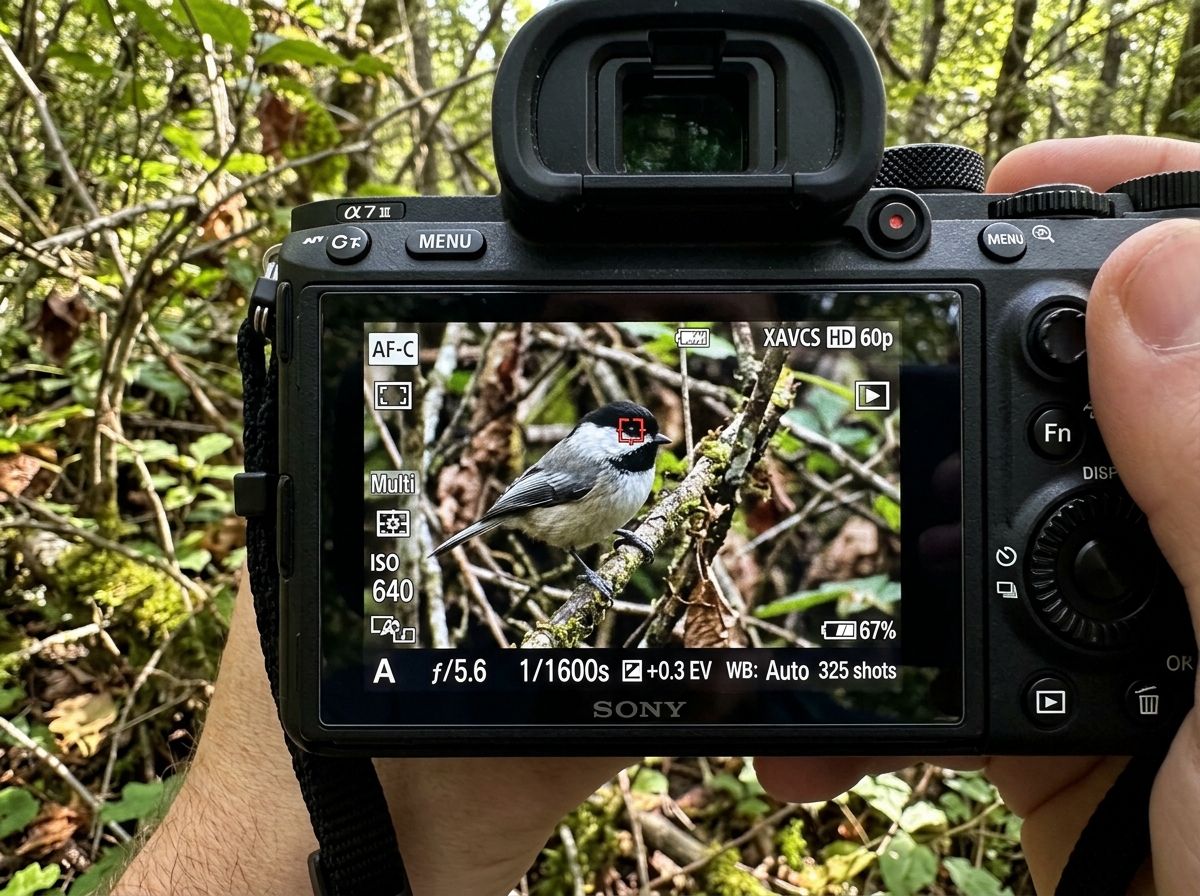
Understanding Sensor Sizes and Camera Types
Choosing the best camera for taking pictures of birds often comes down to a trade-off between image quality and “reach.” This is where sensor size becomes critical.
Full-Frame: The Quality King
Full-frame sensors (like those in the Sony A1 or Nikon Z9) offer the best low-light performance and the highest dynamic range. However, they don’t provide any “extra” zoom. What you see is what you get. They are ideal if you can get close to the birds or if you have a massive, expensive lens.
APS-C: The “Free” Zoom
APS-C sensors are smaller, which creates a “crop factor” (usually 1.5x or 1.6x). If you put a 400mm lens on a Canon EOS R7 (an APS-C camera), it behaves like a 640mm lens! This extra reach is a massive advantage for birders on a budget who can’t afford $12,000 prime lenses.
Micro Four Thirds: Portability and Reach
The OM System OM-1 Mark II uses an even smaller sensor with a 2x crop factor. This means a tiny 300mm lens gives you the reach of a 600mm lens on a full-frame camera. It’s the ultimate setup for hikers who want to stay light.
Bridge Cameras and 1-Inch Sensors
Bridge cameras like the Sony RX10 IV or the Nikon Coolpix P1000 have fixed lenses with incredible zoom ranges. While their 1-inch (or smaller) sensors don’t perform as well in low light, they offer an all-in-one solution that fits in a small bag.
| Sensor Type | Crop Factor | Effective 400mm Reach | Best For |
|---|---|---|---|
| Full-Frame | 1.0x | 400mm | Professional Quality |
| APS-C (Nikon/Sony/Fuji) | 1.5x | 600mm | Reach + Value |
| APS-C (Canon) | 1.6x | 640mm | Maximum Crop Reach |
| Micro Four Thirds | 2.0x | 800mm | Portability |
For a deeper dive into which system suits your style, see our comparison of DSLR vs Mirrorless for Bird Photography.
Top Recommendations Across Every Budget
Whether you are a professional looking for the pinnacle of technology or a beginner just starting your backyard birding journey, there is a perfect setup for you.
Professional Powerhouses: Sony A1 and Nikon Z9
If money is no object, these two are the undisputed titans.
- Sony A1: This camera is often called the “King of Everything.” It packs a 50.1MP sensor and can shoot at 30fps with full autofocus tracking. Its bird-eye AF is legendary, locking onto subjects so fast it almost feels like cheating.
- Nikon Z9: Nikon’s flagship is a “no-compromise monster.” It has no mechanical shutter, meaning it is completely silent — perfect for not spooking skittish owls. It can shoot 11MP JPEGs at a staggering 120fps and has a buffer that seems to last forever.
Best Mid-Range Camera for Taking Pictures of Birds: Canon EOS R7
The Canon EOS R7 is arguably the most exciting APS-C camera released in years. For around $1,499, you get:
- A high-resolution 32.5MP sensor.
- A 1.6x crop factor that turns modest lenses into super-telephotos.
- Dual Pixel CMOS AF II, which provides “sticky” eye tracking even in thick brush.
- In-Body Image Stabilization (IBIS) to help keep those handheld shots steady.
It’s a lightweight powerhouse that we often recommend for those who find full-frame gear too heavy or expensive. You can learn more about building a manageable kit in our guide to Lightweight Bird Photography Gear.
Best Budget Camera for Taking Pictures of Birds: Canon EOS R10 and Sony RX10 IV
You don’t need to spend $5,000 to get great shots.
- Canon EOS R10: At under $1,000, this is a fantastic entry point. It’s tiny, weighs only 0.8 lbs, and can shoot at 23fps (electronic shutter). It’s perfect for Beginner Bird Photography Kits.
- Sony RX10 IV: This is the “king of bridge cameras.” It features a built-in 24-600mm equivalent Zeiss lens. With 24fps burst shooting and 315 phase-detect AF points, it’s a “travel-friendly beast” that eliminates the need to carry multiple heavy lenses.
The Critical Role of Lenses and Accessories
We often say: “Spend on the glass, save on the body.” A $6,000 camera with a cheap lens will produce mediocre bird photos, but a $900 camera with a great lens can create masterpieces.
Focal Length: The 400mm Rule
For bird photography, 400mm is the bare minimum. Birds are small and shy. If you try to use a 200mm lens, you’ll end up with what we call “bird-scapes” — a tiny bird lost in a giant landscape. To get those intimate feather details, 600mm is the “sweet spot.”
Prime vs. Zoom
- Zooms (like the Tamron 150-600mm or Sony 200-600mm) offer flexibility. If a bird flies closer to you, you can zoom out to keep it in the frame.
- Primes (like a 400mm f/5.6 or 600mm f/4) usually offer sharper images and faster autofocus, but they are more expensive and less versatile.
Essential Accessories
Don’t forget the support gear! A gimbal head on a sturdy tripod is vital for long sessions with heavy lenses. If you prefer to stay mobile, a monopod can take the weight off your arms while allowing you to move quickly.
For more advice on choosing lenses, check out Camera Settings for Bird Lenses. When selecting your next piece of gear, it is helpful to ask yourself, “What shots am I missing?” to identify the gaps in your current setup. You can also research specific lens performance on manufacturer sites like Sony’s lens resource center to see how modern optics can improve your reach and clarity.
Advanced Techniques for Better Bird Photos
Having the best camera for taking pictures of birds is only half the battle. How you use it matters just as much.
Back-Button Autofocus
Traditionally, the shutter button both focuses and takes the picture. Professional birders often decouple these functions. By using a button on the back of the camera (usually AF-ON) to focus, you can keep tracking a bird without accidentally taking a photo every time you want to refocus. This is a “game changer” for birds in flight.
Manual Mode with Auto ISO
In bird photography, light changes constantly as birds move from sun to shade. We recommend setting your Shutter Speed (e.g., 1/2500s for flight) and your Aperture (e.g., f/5.6), then letting the camera adjust the ISO automatically. This ensures your action is always frozen while the exposure remains consistent.
The Power of RAW
Always shoot in RAW format. Birds often have tricky highlights (white feathers in bright sun) and deep shadows. RAW files give us the data we need at Ciber Conexão to help you with advanced editing. As Hugo Andrade often emphasizes, being able to recover detail in a “missed” exposure can save a once-in-a-lifetime shot.
For more tips on making the most of what you have, read our guide on Harnessing Limited Gear for Breathtaking Bird Photos.
Frequently Asked Questions about Birding Cameras
Is the Nikon Coolpix P1000 good for birding?
The P1000 is the “Hubble Telescope” of compact cameras. Its 24-3000mm equivalent zoom is mind-boggling. However, there are trade-offs. The small 1/2.3-inch sensor struggles in low light (like deep forests), and the autofocus isn’t as snappy as a mirrorless system. It’s excellent for “identification” shots of distant birds but harder to use for birds in flight.
What is the best sensor size for distant birds?
If you are constantly shooting distant birds on water or raptors high in the sky, APS-C is often the winner. The crop factor gives you more “pixels on subject.” A 32.5MP APS-C sensor (like in the Canon R7) puts more detail onto a small, distant bird than a 24MP full-frame sensor would.
Can I use a smartphone for bird photography?
Yes, but with limits. Smartphones are great for “backyard birding” near feeders or for “digiscoping” (holding the phone up to a spotting scope). However, for birds in motion, they simply lack the reach and focus speed. If you’re using a phone, check out our Smartphone Settings for Stunning Birding Shots to maximize your results.
Conclusion
Finding the best camera for taking pictures of birds is a journey of balancing speed, reach, and budget. Whether you choose the professional-grade Sony A1, the reach-heavy Canon EOS R7, or the all-in-one Sony RX10 IV, the most important thing is to get out there and start shooting.
At Ciber Conexão, we believe that the camera is just the beginning. The real magic happens when you master your tools and refine your vision. Our expert, Hugo Andrade, always reminds us that even a technically perfect shot can be improved with the right crop and composition. A slight adjustment in post-processing can turn a “good” bird photo into a “breathtaking” one by emphasizing the bird’s gaze or removing distracting branches.
Don’t let your gear sit on a shelf. Grab your camera, find your “bridge to the birds,” and start capturing the incredible avian world around you. For more help refining your final images, explore our Photography Tips Category for expert advice on taking your birding portfolio to the next level.
