
Finding the Best F-Stop for Bird Photography: The Sweet Spot
When we talk about the “sweet spot” of a lens, we are referring to the aperture setting where the lens performs at its absolute optical peak. For most telephoto lenses used in wildlife, this isn’t actually the widest setting (like f/4 or f/5.6). Instead, lenses usually get sharper when you “stop down” by one or two clicks.
Research and field experience show that the best f stop for bird photography typically falls between f/5.6 and f/8. Within this range, you minimize lens aberrations and vignetting while maximizing edge-to-edge sharpness. If you shoot a high-end prime lens wide open at f/4, it will be very sharp, but stopping down to f/5.6 often reveals even finer feather details.
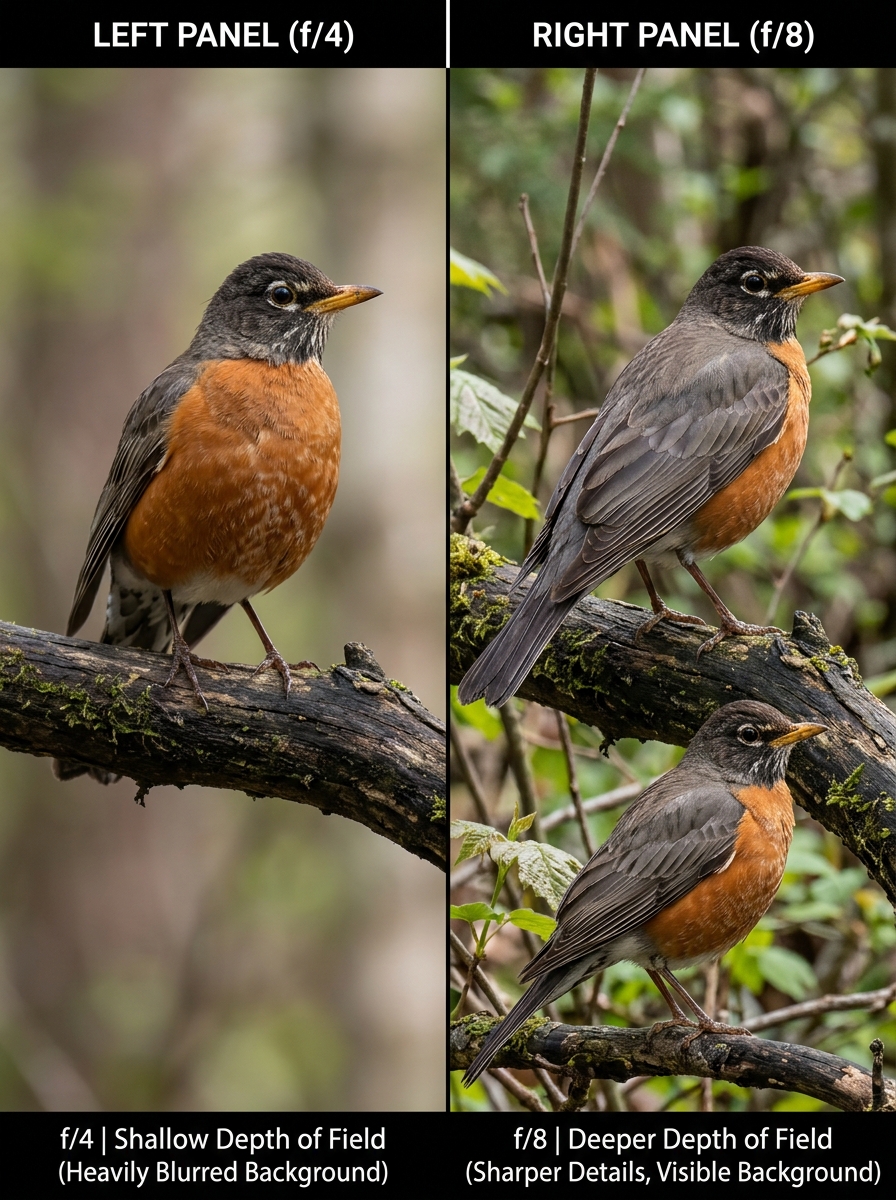
However, there is a limit. If you stop down too far—say to f/16 or f/22—you hit a physical phenomenon called diffraction. This is where light waves begin to interfere with each other as they pass through a tiny opening, actually making the image appear softer. To keep your images crisp, we recommend improving clarity in bird shots by staying within that f/5.6 to f/8 “goldilocks” zone whenever light allows.
To find your own lens’s sweet spot, we suggest a simple “brick wall” or “tree bark” test. Mount your camera on a tripod, focus on a textured surface, and take a series of photos from your widest aperture down to f/11. When you zoom in to 100% on your computer, you’ll likely see that the shots at f/7.1 or f/8 have just a bit more “bite” than those at f/4. For more technical insights, you can explore discussions on Optimal Aperture for Birds in Flight.
Why f/7.1 is the best f stop for bird photography portraits
If we had to pick one “set it and forget it” number for bird portraits, it would be f/7.1. Many expert bird photographers consider this the “perfect all-rounder.”
Why f/7.1? When you are close to a bird, the depth of field (the area in focus) becomes incredibly thin. At f/4, if you focus on a bird’s eye, its beak or the tips of its wings might already be blurry. By moving to f/7.1, you widen that slice of focus just enough to ensure the entire head and the front of the body are tack-sharp.

This aperture also helps when the bird isn’t perfectly parallel to your camera sensor. If a heron turns its head slightly, f/7.1 gives you the buffer needed to keep both eyes in focus. It balances this sharpness with enough light-gathering ability to keep your ISO from skyrocketing. This is a core part of mastering bird photography: essential camera settings.
Choosing the best f stop for bird photography in motion
When birds take to the sky, the rules change slightly. For birds in flight (BIF), our primary enemy isn’t depth of field—it’s motion blur. To freeze a hawk mid-dive, you need a shutter speed of 1/2000s or faster.
To achieve those blazing-fast speeds without making your image pitch black, you often need to open your aperture wider (f/4 or f/5.6). This allows the maximum amount of light to hit the sensor. Interestingly, at the distances typical for flight photography (80 feet or more), your depth of field actually increases naturally.
For example, using a 600mm lens with a 1.4x teleconverter (840mm) at 80 feet:
- At f/5.6, your depth of field is about 1 foot.
- At f/8, it increases to 1.42 feet.
- At f/10, it reaches 1.78 feet (a 75% increase over f/5.6).
While f/5.6 is often sufficient for a single bird in the sky, stopping down to f/8 can significantly increase your “keeper rate” by providing a larger margin for error if your autofocus misses the eye by an inch or two. We always emphasize avoiding blurry images in bird photography by balancing these settings carefully. You can use a DOF Calculator for Telephoto Lenses to see how these numbers change based on your specific gear.
How Distance and Focal Length Change Your Aperture Strategy
Aperture does not work in a vacuum. Your distance to the bird and the focal length of your lens (e.g., 400mm vs 600mm) drastically change how much of the bird stays sharp.
The closer you are to your subject, the shallower the depth of field becomes. If you are lucky enough to be 15 feet away from a tiny songbird using a 600mm lens, even f/8 might not be enough to get the whole bird sharp. In these “macro-style” wildlife moments, you might need to stop down to f/10 or f/11 just to keep the tail feathers from turning into a blur.

Conversely, if the bird is far away, you can safely use a wider aperture like f/5.6 to gather more light, as the depth of field will naturally be deep enough to cover the entire bird. If you use teleconverters, remember they “eat” light. A 1.4x converter turns an f/4 lens into an f/5.6 lens. This makes choosing the best f stop for bird photography even more critical, as you are starting with less light to begin with. Understanding these camera settings for bird lenses is vital for consistent results.
Managing the Trade-offs: Aperture, Shutter Speed, and ISO
In bird photography, we are always playing a game of give-and-take. This is known as the Exposure Triangle. If you decide to stop down to f/8 for more sharpness, you are closing the “window” of your lens, meaning less light gets in. To compensate, you must either slow your shutter speed (risking blur) or raise your ISO (risking noise).
| F-Stop Change | Light Impact | Shutter Speed Needed | ISO Result |
|---|---|---|---|
| f/4 to f/5.6 | 1 stop less light | Needs 2x longer exposure | ISO must double (e.g., 400 to 800) |
| f/5.6 to f/8 | 1 stop less light | Needs 2x longer exposure | ISO must double (e.g., 800 to 1600) |
| f/8 to f/11 | 1 stop less light | Needs 2x longer exposure | ISO must double (e.g., 1600 to 3200) |
Fortunately, modern cameras are incredible at handling high ISO. We often tell our students that a “noisy but sharp” photo is always better than a “clean but blurry” one. With modern AI Denoising tools in software like Lightroom, you can often clean up a photo shot at ISO 6400 or even 12800 with ease.
To manage this, we recommend using Manual Mode with Auto ISO. You set the shutter speed (e.g., 1/2500s) and the aperture (e.g., f/7.1), and let the camera decide the ISO. Just keep an eye on your histogram to ensure you aren’t clipping your highlights—especially on white birds like Egrets. Optimizing natural light for amazing bird photos involves positioning yourself so the sun is at your back, allowing you to use lower ISOs and narrower apertures simultaneously.
Frequently Asked Questions about Bird Photography Apertures
Should I always shoot wide open at f/4 or f/5.6?
Not necessarily. While shooting wide open gives you the fastest possible shutter speed and the creamiest background, it also leaves you with the thinnest depth of field. If you miss the focus by a hair, the eye will be soft. Most lenses also show a bit of “softness” at their widest setting. Stopping down just a 1/3 or 2/3 of a stop (e.g., from f/5.6 to f/6.3 or f/7.1) often yields a noticeable jump in detail.
Does stopping down to f/8 improve autofocus performance?
This is a common myth. In most modern DSLR and mirrorless cameras, the lens stays wide open while you are focusing and only “stops down” to your chosen aperture the moment you click the shutter. Therefore, choosing f/8 won’t usually help your camera find focus faster, but it will help you keep the bird sharp if it moves slightly out of the initial focus plane.
What aperture is best for photographing groups or flocks?
When you have multiple birds at different distances—like a flock of ducks taking off—you need a much deeper plane of focus. In these cases, we recommend f/11. This ensures that birds slightly in front of or behind your main target stay reasonably sharp.
Conclusion
Choosing the best f stop for bird photography isn’t just about technical settings; it’s about your creative vision. Do you want a clinical, tack-sharp portrait where every barb of every feather is visible? Lean toward f/8. Do you want an artistic, dreamy shot where the bird melts into a sea of bokeh? Open up to f/4.
At Ciber Conexão, we believe that the best photos come from a combination of great in-camera decisions and smart editing. Once you’ve captured that sharp image, you can use photography tips to further refine your crop and composition, highlighting the bird’s natural beauty.
The next time you head out into the field, try starting at f/7.1. It’s the “secret sauce” for many professionals, and it might just be the setting that turns your next shot into a masterpiece. Happy shooting!
