
Building Your Ideal Bird Photography Setup
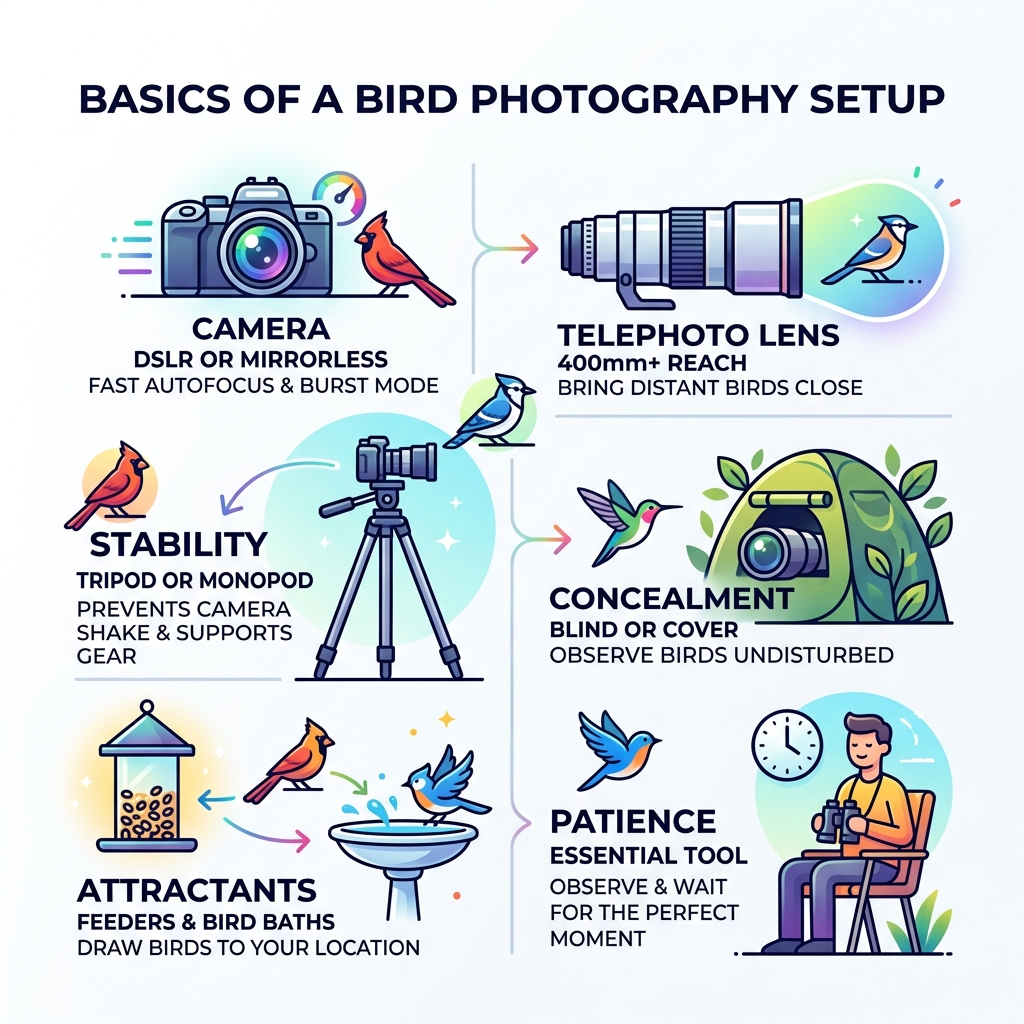
A bird photography setup helps you capture stunning images of feathered visitors. Here’s what it typically includes:
- Camera: A DSLR or mirrorless body with fast shooting capabilities.
- Telephoto Lens: Generally 400mm or longer to bring distant birds closer.
- Stability: A sturdy tripod or monopod to prevent camera shake.
- Attractants: Feeders, bird baths, and natural perches to draw birds.
- Concealment: A blind or strategic position to observe birds without disturbing them.
- Patience: Your most essential tool for successful bird photography.
For many aspiring nature photographers, the dream of capturing a stunning bird photo often starts in their own backyard. Yet, the reality can be a lesson in patience and technical skill. Like many, you might have aimed your camera at a vibrant cardinal, only to find the resulting image blurry, underexposed, or the bird facing the wrong way. This common experience is a great introduction to the joys and challenges of a bird photography setup.
The good news is, you can create professional-looking bird photos right at home. With the right equipment and techniques, your backyard can become a personal wildlife studio. This guide will show you how to set up everything you need.
Essential Gear for Your Bird Photography Setup
When we talk about a professional bird photography setup, the conversation naturally starts with the “big glass” and the bodies that drive them. In the modern era, mirrorless technology has revolutionized how we track fast-moving subjects. High-end bodies like the Sony ⍺1 (boasting 30 fps and a 50MP sensor) or the Nikon Z8 (shooting up to 120 fps in JPEG) are the gold standard for birds in flight.
However, you don’t need to spend $6,000 to get started. The Canon R5, priced around $3,800, is a beloved workhorse known for its incredible tracking autofocus and high ISO performance—we’ve seen sharp shots taken at ISO 10,000! For those on a tighter budget, the Canon R7 is a fantastic choice. It offers a 32MP APS-C sensor at roughly a third of the price of the R5. The “crop factor” of APS-C sensors is actually a secret weapon for birders, as it gives your lenses extra reach. If you are just starting out, we recommend exploring mirrorless-cameras-for-bird-photography-beginners to find a body that balances speed with value.
The lens is arguably more important than the camera body. For bird photography, a minimum of 400mm is the industry standard. While pro-level 600mm f/4 primes are breathtaking, they often cost as much as a small car. Most of us prefer the flexibility of a telephoto zoom. The Sigma 150-600mm Contemporary is a legendary entry-point, costing around $900 while delivering professional-grade sharpness at the long end. If you are looking for more affordable glass, check out our guide on cheap-telephoto-lenses-for-bird-watching.
Essential Accessories for a Portable Bird Photography Setup
Stability is the enemy of blur. While modern Image Stabilization (IS) is impressive, a long lens acts like a lever, magnifying every tiny tremor of your hands. A sturdy carbon fiber tripod paired with a gimbal head is the ultimate setup. A gimbal allows you to balance a heavy lens so perfectly that you can move it with a single finger, making it easy to track a hawk soaring overhead.
For those who prefer to stay mobile, a monopod or a Black Rapid strap combined with a quick-release base allows for fast transitions from carrying to shooting. If you’re shooting from a car window or a garden bench, a simple beanbag can provide surprisingly effective support. We’ve found that camera-tripods-for-urban-photography often offer the perfect blend of weight and stability for backyard use.
Affordable Lens Options for Beginners
You don’t have to break the bank to get “the shot.” Many beginners find success with the Sigma 150-500mm f/5-6.3, which can often be found for around $800. Another trick is using teleconverters (1.4x or 2.0x) to extend the reach of a shorter lens, though be aware this usually reduces your maximum aperture and can slow down autofocus.
Buying used gear is another excellent strategy. Many enthusiasts trade in perfectly good lenses when they upgrade to the latest mirrorless versions. To see what kind of results are possible with budget-friendly glass, we suggest browsing the Sigma Flickr Group to see real-world examples from fellow photographers.
Mastering Camera Settings for Sharp Results
The most expensive bird photography setup in the world won’t help if your settings are off. Birds are twitchy; even when they seem still, their heads are constantly scanning for predators.
For perched birds, we aim for a shutter speed of at least 1/1000s. If the bird is truly motionless, you might drop to 1/500s, but 1/1000s is safer. For birds in flight, you need to crank it up to 1/2000s or 1/4000s to freeze the wingbeats. We recommend using Aperture Priority or Manual Mode with Auto-ISO. This ensures that as the bird moves from light to shadow, your shutter speed stays fast enough to prevent blur.
| Setting | Perched Birds | Birds in Flight |
|---|---|---|
| Shutter Speed | 1/500s – 1/1000s | 1/2000s – 1/4000s |
| Aperture | f/5.6 – f/7.1 (for depth) | Wide open (f/4 – f/6.3) |
| ISO | Auto (Limit to 3200-6400) | Auto (Priority on speed) |
| Focus Mode | Single Point / Eye-AF | Continuous (AF-C / AI Servo) |
| Drive Mode | Low Burst | High-Speed Continuous |
Two technical “must-haves” are Back-Button Focus and Eye-AF. Back-button focus separates the act of focusing from the shutter button, allowing you to lock focus and wait for the perfect moment. Eye-AF (available on most modern mirrorless cameras) is a game-changer, as it automatically tracks the bird’s eye, ensuring the most critical part of the image is tack-sharp. For a deeper dive, read our guide on mastering-camera-settings-for-bird-photography.
Always shoot in RAW format. Bird feathers have incredible detail and high contrast; RAW files give us the “digital negative” required to recover highlights in white feathers or shadows in dark plumage during post-processing.
Designing the Ultimate Backyard Station
Creating a “natural studio” is the heart of a successful bird photography setup. You want to control the environment so that the birds land exactly where you want them, with a beautiful, clean background.

Start by offering a variety of feeders. Tube feeders are great for finches, platform feeders attract cardinals and jays, and suet cages are magnets for woodpeckers. However, we rarely want the feeder itself in the photo—it looks unnatural. The trick is to place natural perches (interesting branches or mossy logs) a few feet away from the feeders. Birds will often land on these “staging perches” to survey the area before hopping onto the feeder.
To get that creamy, out-of-focus background (bokeh), remember the distance ratio: the bird should be as close to you as possible, and the background should be as far away from the bird as possible. Aim for a background that is at least 10–20 feet behind your perch. For more on positioning, the Bird Photography Guide: Feeder Setup offers excellent spatial advice.
Optimizing Lighting for Your Bird Photography Setup
Light is the “make or break” factor. The Golden Hour—the hour after sunrise and before sunset—provides soft, warm light that makes colors pop and adds a catchlight to the bird’s eye. We always try to position our setup so the sun is at our backs. This front-lights the bird and ensures the eye is well-lit.
If you must shoot at midday, watch out for harsh shadows. You can use exposure compensation (+1/3 to +2/3) to help bring out details in the shadows of a bird’s belly. Overcast days are actually wonderful for bird photography because the clouds act as a giant softbox, eliminating harsh shadows and allowing the true colors of the feathers to shine. Since the different directions as sun angles change throughout the seasons, be prepared to move your perches or your shooting position to maintain that optimal light.
Attracting Diverse Species Year-Round
To keep your “studio” busy, you need to cater to the local menu. Black-oil sunflower seeds are the universal favorite, but adding Nyjer seed will bring in colorful goldfinches. In the summer, keep nectar (4 parts water, 1 part sugar) fresh for hummingbirds. In the winter, high-fat suet is vital for birds trying to stay warm.
Don’t forget water! A bird bath with a small dripper or fountain is often more attractive to birds than food. The sound of moving water can bring in species that don’t even visit feeders, like warblers or tanagers. Finally, planting native shrubs provides natural shelter and predator protection, making birds feel safe enough to linger in front of your lens.
Field Preparation and Location Scouting
While the backyard is a great training ground, eventually you’ll want to head into the field. This requires a shift in mindset. Instead of the birds coming to you, you must go to them.
Understanding bird behavior is your greatest asset. Do they take off into the wind? (Usually, yes). Do they poop right before they fly? (Often!). Using apps like Merlin Bird ID for identification and eBird to find local hotspots can save you hours of aimless wandering. For those just starting their journey beyond the garden fence, our getting-started-with-bird-photography-a-guide-for-beginners is an essential resource.
If you find a high-traffic area, consider using a portable blind. Birds react more to movement than sound. Sitting inside a small camouflage tent allows you to observe natural behaviors from just a few feet away without causing stress. If you’re in the UK, the London Wetland Centre is a world-class venue for practicing these field techniques in a controlled environment.
Ethics and Post-Processing Workflow
We believe that the welfare of the bird must always come before the photo. Bird photography ethics are simple: never disturb a nesting bird, never use drones near raptors (which they see as threats), and be extremely cautious with flash, especially with owls whose sensitive eyes can be temporarily dazzled.
Once you’ve captured your images, the real magic happens in the digital darkroom. Even the best bird photography setup can produce “noisy” images if the light was low. Software like Topaz Photo AI or Lightroom‘s Denoise feature can save an image taken at high ISO, making it look clean and professional.
We often focus on cropping to improve composition. A slight crop can remove distracting branches at the edge of the frame and place the bird’s eye on a “rule of thirds” intersection. You can find more tools and discounts for these programs here. The goal of editing is to enhance the natural beauty of the bird, not to create something that wasn’t there.
Frequently Asked Questions about Bird Photography
What is the minimum focal length needed for birds?
We generally recommend at least 400mm. While you can photograph large birds like herons with a 200mm or 300mm lens, smaller songbirds require more reach to fill the frame without you having to get so close that you scare them away.
How do I get a blurry background in bird photos?
This is achieved through a shallow depth of field. Use a wide aperture (like f/5.6 or f/6.3) and maximize the distance between the bird and the background. The closer you are to the bird, the more “compressed” and blurry the background will appear.
Is it ethical to use bird calls to attract subjects?
This is a debated topic. While occasional use might be okay, repeated playback of calls during nesting season can stress birds, as they think a rival is invading their territory. We recommend using patience and food attractants instead of audio lures.
Conclusion
Building a bird photography setup is a journey of both technical mastery and a deepening connection with nature. From choosing the right telephoto lens to strategically placing a mossy perch in your backyard, every step you take brings you closer to that “National Geographic” moment. Equipment is just a tool; your observation of bird behavior and your patience are what will truly set your work apart.
At Ciber Conexão, we are passionate about helping you refine those final touches. Whether it’s mastering the perfect crop or learning how to balance the colors of a sunset-lit wing, our expert advice is designed to take your raw captures and turn them into art.
Master more skills with our photography tips and start building your backyard studio today!
