
What a Golden Ratio Composition Guide Can Do for Your Photos
A golden ratio composition guide is a practical system for placing your subject, horizon, and supporting elements inside a frame so the result feels naturally balanced and pleasing to the eye.
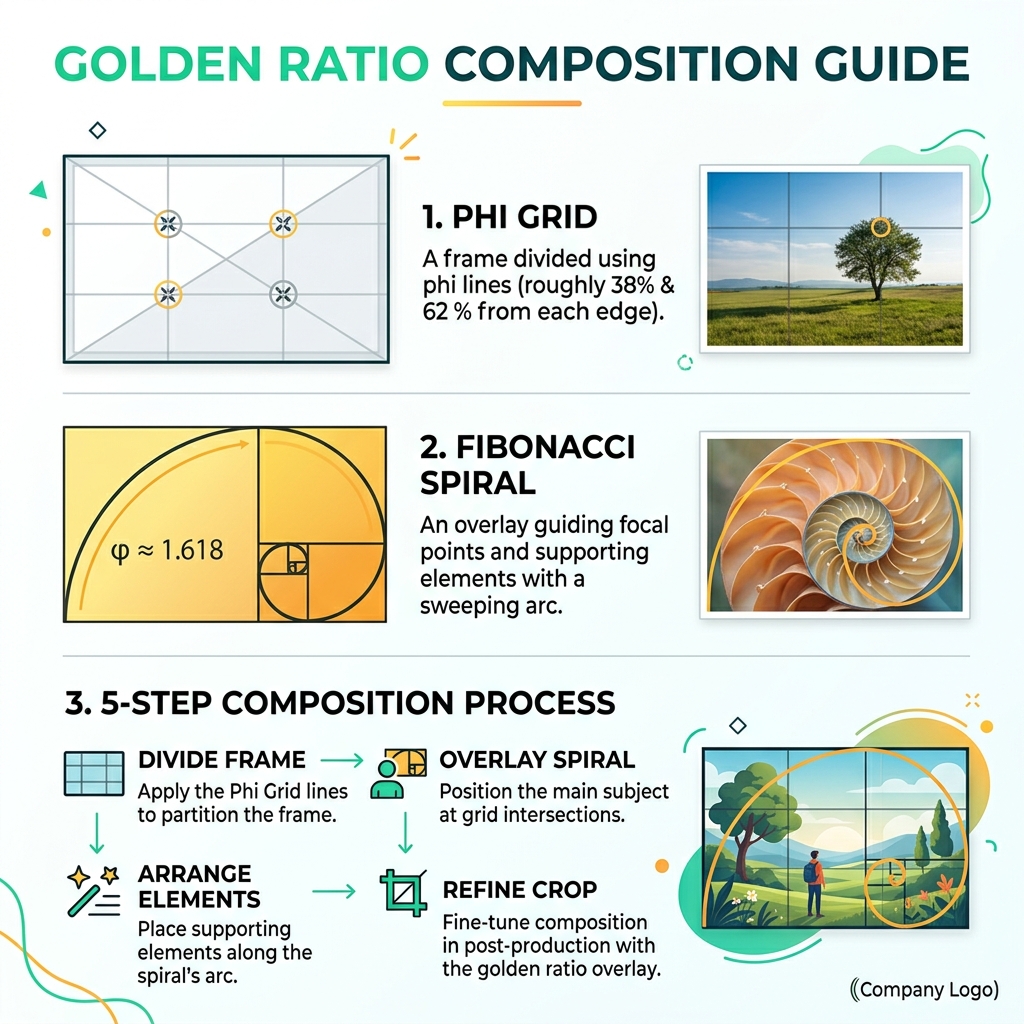
Quick answer — how to use the golden ratio in 5 steps:
- Divide your frame using the phi grid (lines at roughly 38% and 62% from each edge).
- Place your main subject at one of the four intersection points.
- Overlay the Fibonacci spiral and position your focal point at the spiral’s tightest coil.
- Arrange supporting elements along the sweeping arc of the spiral.
- Refine in post-production by cropping with the golden ratio overlay in Lightroom or Photoshop.
The golden ratio is approximately 1.618 (written as φ, or “phi”). It shows up in seashells, sunflowers, Renaissance paintings, and ancient architecture — and it’s the reason some photos immediately feel right while others feel oddly off-balance, even when you can’t explain why.
For amateur photographers, the good news is this: you don’t need to understand the math deeply to use it. You just need to know where to put things.
This guide walks you through every tool, every genre, and every step — including how to fix compositions you’ve already shot.
Understanding the Golden Ratio: Math, History, and Nature
When we talk about a golden ratio composition guide, we are tapping into a principle that has fascinated humanity for over two thousand years. Often called the “Divine Proportion” or the “Golden Mean,” this ratio is more than just a photography trick; it is a mathematical constant found throughout the known universe.
Historically, the Greek mathematician Euclid first described it in his landmark work Elements around 300 BC, referring to it as the “Extreme Ratio.” Later, the sculptor Phidias is believed to have applied these proportions to the Parthenon in Athens, which is why the ratio is represented by the Greek letter Phi (φ) in his honor. During the Renaissance, luminaries like Leonardo da Vinci collaborated with mathematician Luca Pacioli on the book De Divina Proportione, forever cementing the ratio’s place in high art.
Why does it matter to us as photographers and editors? Because our brains are biologically wired to find this specific proportion harmonious. We see it in the spiral of a nautilus shell, the arrangement of seeds in a sunflower, the branching of trees, and even the proportions of the human face. By using a golden ratio composition guide, we aren’t just following a “rule”—we are aligning our images with the natural geometry of the world.
The Math Behind the Golden Ratio Composition Guide
If you start sweating at the mention of algebra, don’t worry—we’ll keep this light! Mathematically, the Golden Ratio is derived from the expression (1 + √5)/2, which results in approximately 1.618.
In practical design terms, if you divide a line into two parts (a and b), the ratio is “golden” if the total length (a+b) divided by the longer segment (a) is equal to the longer segment (a) divided by the shorter segment (b). This creates a 1:0.618 relationship.

This math is inextricably linked to the Fibonacci Sequence (0, 1, 1, 2, 3, 5, 8, 13, 21…). As these numbers increase, the ratio between any two consecutive numbers gets closer and closer to 1.618. When we translate this into a visual grid or a spiral, we create a sense of geometric harmony that feels organic rather than manufactured.
Essential Tools: Phi Grid vs. Fibonacci Spiral
To apply this math to your camera or canvas, we use two primary visual aids: the Phi Grid and the Fibonacci Spiral (also known as the Golden Spiral).
The Phi Grid looks very similar to the Rule of Thirds, but there is a crucial difference in the spacing. While the Rule of Thirds divides the frame into equal 1:1:1 sections, the Phi Grid uses the 1:0.618:1 ratio. This pushes the vertical and horizontal lines closer to the center of the frame.
| Feature | Rule of Thirds | Phi Grid (Golden Ratio) |
|---|---|---|
| Grid Division | Equal thirds (1:1:1) | Uneven (1:0.618:1) |
| Subject Placement | Further from center | Closer to center |
| Visual Feel | Dynamic, bold, sometimes “boxy” | Balanced, harmonious, “polished” |
| Best For | Action, minimalism, quick shots | Portraits, landscapes, thoughtful art |
Mastering the Fibonacci Spiral in Your Golden Ratio Composition Guide
The Fibonacci Spiral is perhaps the most iconic tool in our golden ratio composition guide. It is constructed by drawing quarter-circle arcs through a series of “Golden Rectangles.”
In photography, the spiral acts as a path for the viewer’s eye. You place your main focal point—the most important detail—at the smallest part of the coil. The rest of the scene should ideally follow the sweeping curve of the arc as it moves toward the edge of the frame. This creates a natural flow that mimics how we perceive movement in nature, such as a wave curling or a vine growing.
The Golden Triangle for Dynamic Diagonals
If your scene is filled with strong diagonal lines—think of a mountain range, a winding road, or a reclining subject—the Golden Triangle is your best friend.
You create this by drawing a diagonal line from one corner of the frame to the other. Then, you draw two smaller lines from the remaining corners that meet the main diagonal at a 90-degree angle. Placing your subject at these intersections or aligning leading edges with these triangles creates incredible visual weight and geometric structure without making the photo feel “stiff.”
Practical Application: A Golden Ratio Composition Guide
Now that we have the tools, how do we actually use them in the field? Whether you are shooting birds in a backyard or designing a website, the principles remain the same.
In Portraiture: Instead of centering the face, try placing the subject’s “near eye” (the one closest to the camera) at one of the four intersections of the Phi Grid. This creates an immediate connection with the viewer. For full-body shots, the spiral can guide the viewer from the subject’s feet, up the curve of the body, ending at the face.
In Landscape Photography: The “38/62 rule” is a fantastic way to handle horizons. Instead of putting the horizon in the middle or at the 33% mark (Rule of Thirds), place it at the 38% or 62% line. This allows the foreground or the sky to dominate in a way that feels more immersive. If you are exploring angles and perspectives in bird photography, using the golden ratio can help you balance the small subject against a vast, natural background.
In Architecture and Urban Scenes: Urban environments are full of hard edges. Use the Phi Grid to position the leading edge of a building or a row of windows. When composing bird photos with urban backgrounds, look for architectural curves—like arches or stairways—that mimic the Fibonacci Spiral to frame your subject.
In UI/UX and Graphic Design: The Golden Ratio helps define hierarchy. You can determine font sizes by multiplying your body text size by 1.618 to find your header size (e.g., 12px body x 1.618 = 19px header). It also helps in layout spacing to ensure that sidebars and content blocks feel balanced.
Step-by-Step Instructions for Canvas and Camera
- Identify Your Hero: Before looking at a grid, decide what the “soul” of the photo is. Is it the bird’s eye? The peak of the mountain?
- Choose Your Tool: If the scene has straight lines, use the Phi Grid. If it has curves or a clear “path,” use the Fibonacci Spiral.
- Mind the Negative Space: Don’t crowd the frame. Use the larger sections of the golden rectangles to house “dead space,” which allows the subject to breathe.
- The 3:5 Approximation: If you can’t visualize 1.618, use a 3:5 ratio. Divide your canvas into 8 equal sections; your “sweet spots” are 3 sections in from any side.
- Rotate and Flip: The spiral can start from any of the four corners. Most cameras and editing software allow you to rotate the overlay to fit the natural flow of your scene.
If you are struggling with framing, we recommend checking out our vertical or horizontal framing tips for bird photography for more specific advice on orientation.
Refining Your Composition in Post-Production
Sometimes, the “decisive moment” happens so fast that we don’t have time to align a perfect Fibonacci spiral in the viewfinder. That is where post-production becomes a lifesaver.
In Adobe Lightroom Classic, you can use the Crop tool (shortcut ‘R’). Once the crop tool is active, press ‘O’ to cycle through different overlays. You will eventually see the Phi Grid and the Fibonacci Spiral. If the spiral is facing the wrong way, hold Shift + O to rotate or flip it.
When editing, look for the “visual center of mass.” This isn’t necessarily the largest object, but the one that carries the most “weight”—often the area with the highest contrast or sharpest detail. Use the crop tool to nudge this center of mass onto a golden intersection.
For more advanced techniques on how to save a “messy” shot, our crop and composition editing tips provide a deep dive into refining your vision after the shutter has clicked. The golden ratio is a “whisper, not a whip”—use it to guide your crop, but don’t force a subject into a position that feels unnatural just to satisfy the math.
Frequently Asked Questions
Is the Golden Ratio better than the Rule of Thirds?
“Better” is subjective, but “more refined” is often the consensus. The Rule of Thirds is a great “training wheels” tool—it’s easy to learn and hard to mess up. However, it can sometimes feel a bit formulaic or leave too much “empty” space at the edges. The Golden Ratio (Phi Grid) pulls the subject slightly closer to the center, which often feels more intentional and sophisticated. We like to think of the Rule of Thirds as a bold shout and the Golden Ratio as a rhythmic melody.
How do I see the Golden Ratio without a grid?
It takes practice! Start by training your eye to look for “divisions of three” that aren’t quite equal. When you are out for a walk, scan for natural divides—where a meadow meets a forest, or where a shadow hits a wall. If it feels balanced but isn’t perfectly centered, you are likely looking at a golden proportion. Over time, your brain will start to “feel” the 1.618 ratio instinctively.
When should I break the Golden Ratio?
Always break the rules if the story demands it! Symmetry is a powerful tool for creating a sense of calm or clinical perfection, and it completely ignores the golden ratio. If you want to create a sense of creative chaos or unease, placing subjects right at the very edge of the frame (breaking all grids) can be very effective. Use the golden ratio for harmony; break it for impact.
Conclusion
At Ciber Conexão, we believe that mastering a golden ratio composition guide is one of the most transformative steps you can take in your photography journey. As Hugo Andrade often emphasizes, these tools aren’t meant to replace your artistic instinct; they are meant to sharpen it.
By understanding the “Divine Proportion,” you move away from taking snapshots and begin creating compositions that resonate with a sense of universal balance. Whether you are using the Phi Grid to tighten a portrait or the Fibonacci Spiral to lead a viewer through a landscape, you are using a language of beauty that spans across history and nature.
Ready to take your skills to the next level? Master more photo editing and composition techniques on our blog and start turning your raw captures into masterful works of art. Happy shooting!
