
Why Brazil Is a Dream Destination for Bird Photographers
Brazil bird photography techniques are unlike anything you’ll practice anywhere else on Earth — and for good reason.
Here are the key techniques that work best for bird photography in Brazil:
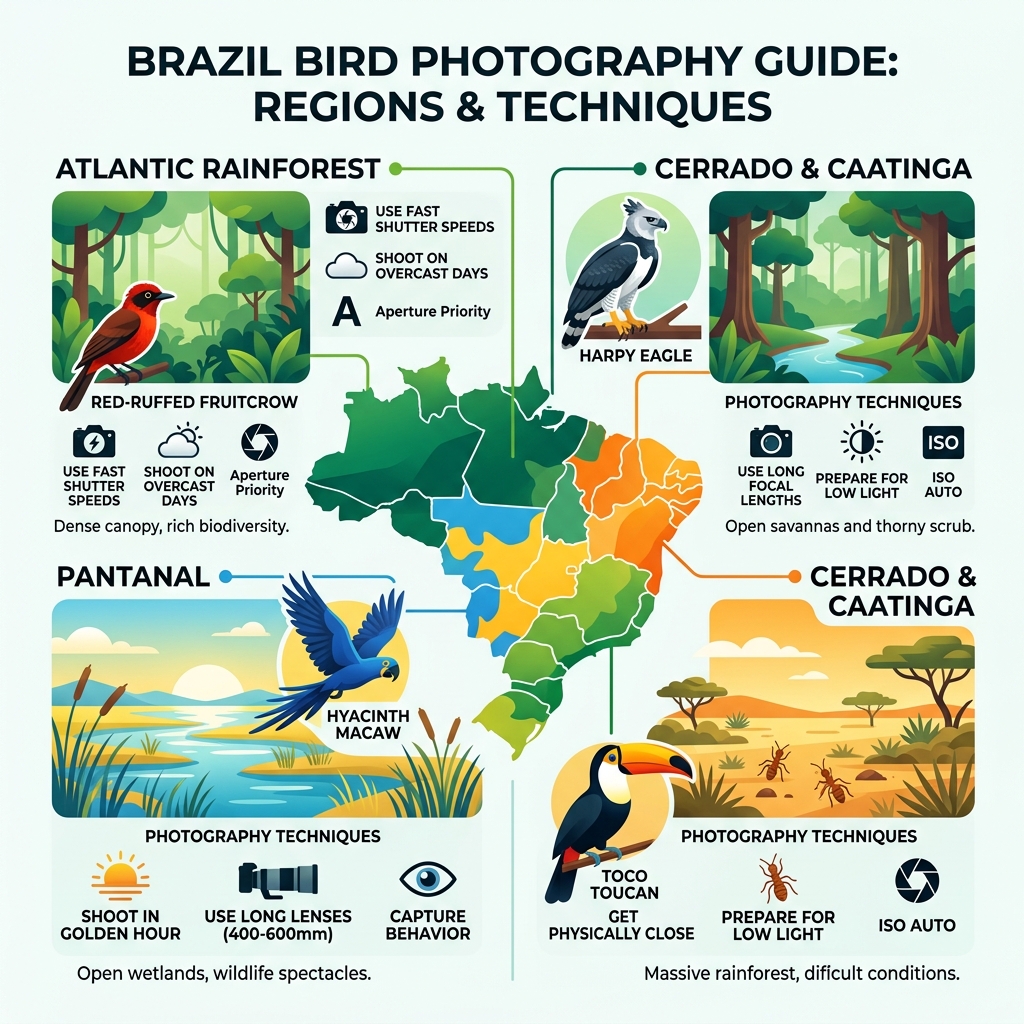
- Use long lenses (400–600mm) to capture birds at a safe distance without disturbing them
- Shoot during golden hour (early morning and late afternoon) for warm, soft light
- Set fast shutter speeds (1/1000s or higher) to freeze wing beats and flight
- Use Aperture Priority with Auto ISO to adapt quickly to changing forest or wetland light
- Shoot on overcast days in dense forest to reduce harsh shadows under the canopy
- Get physically close rather than relying only on focal length for sharper, more detailed shots
- Learn your subject’s behavior — birds that return to the same perch are your best opportunity
Brazil is one of the most biodiverse countries on the planet. The Atlantic Rainforest alone is home to around 830 bird species, with 223 of them found nowhere else on Earth. The Pantanal wetlands hold over 460 bird species, including five breeding species of kingfisher, and the Transpantaneira Highway is famous for its record 82 species of large birds visible from a single road.
Whether you’re pointing your lens at a Hyacinth Macaw gliding over a river or a Toco Toucan perched in the morning mist, the sheer variety of species and habitats makes Brazil a photographer’s paradise — and a serious technical challenge.
The environments here are wildly different from each other. Dense rainforest canopies block light. Open wetlands create harsh midday glare. Urban parks in São Paulo demand discreet gear for safety. Each setting requires a completely different approach.
That’s exactly what this guide covers.
Essential Gear for Brazil Bird Photography Techniques
When we prepare for a Brazilian expedition, our gear bag looks quite different depending on whether we are heading into the deep wetlands or the urban jungle. The right Gear can make or break your ability to execute advanced brazil bird photography techniques.
Lenses: The Long and Short of It
For most Brazilian habitats, a focal length of 400mm to 600mm is the industry standard. Prime lenses like a 500mm f/4 or 600mm f/4 offer incredible subject isolation and creamy backgrounds, which is vital when shooting against the “busy” vegetation of the Pantanal. However, zoom lenses (like a 100-400mm or 200-600mm) offer much-needed flexibility when shooting from a moving boat.
If you’re using an APS-C camera, remember the crop factor! A 400mm lens effectively becomes a 600mm lens on many systems, giving you extra reach without the extra weight.
Stability and Support
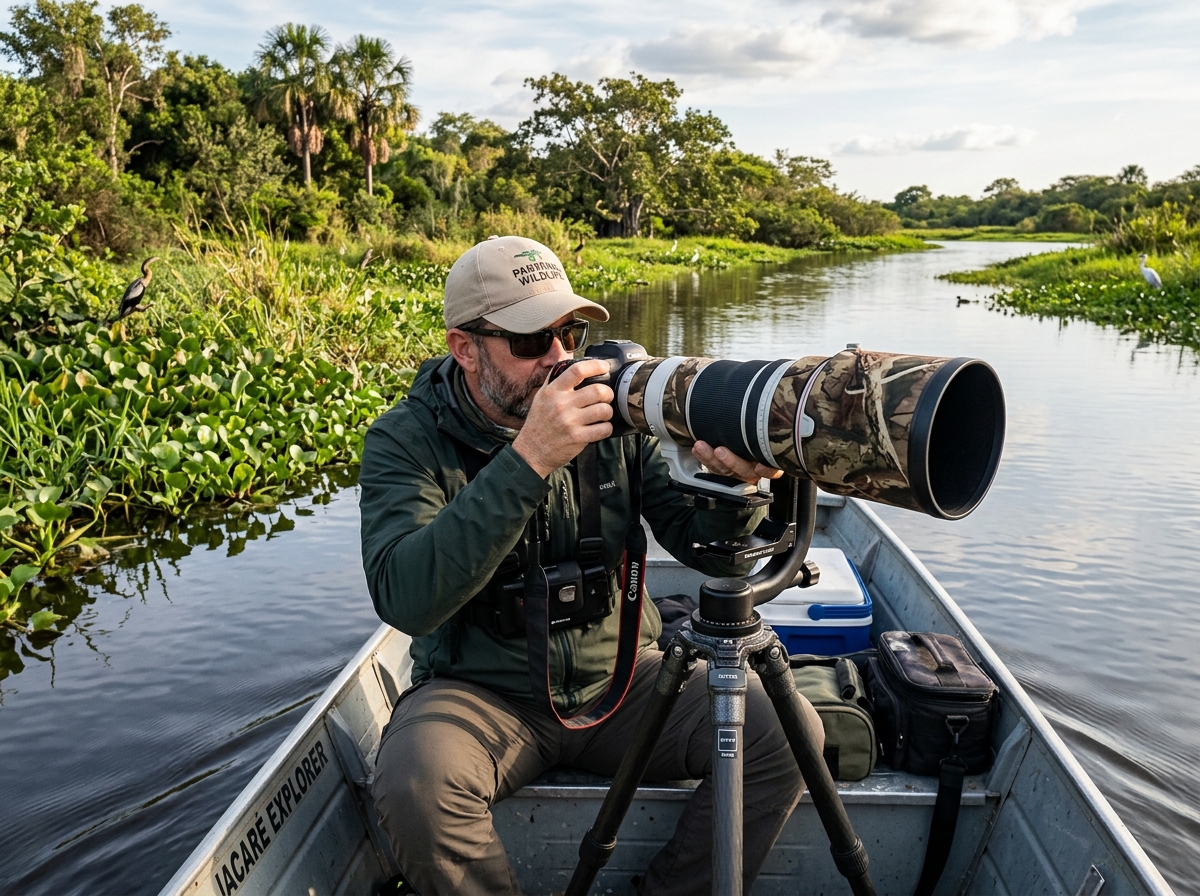
In the Pantanal, we often shoot from boats. While tripods are usually the gold standard, they can be limiting on a cramped vessel. A monopod or even a large beanbag can provide stability without the footprint of a tripod. However, if the water is still, a tripod with a gimbal head is a lifesaver for heavy glass, allowing for fluid movement while tracking a flying Jabiru Stork.
The Urban Secret: Vintage Mirror Lenses
In cities like São Paulo, carrying $10,000 worth of “white glass” can attract unwanted attention. Expert photographers often use discreet, vintage gear. The Tamron 55BB 500mm f/8 mirror lens is a cult favorite. It’s tiny, looks like a cheap kit lens to the untrained eye, but offers a 1:3 reproduction ratio for stunningly close portraits. Just be prepared for the “donut bokeh” characteristic of mirror designs!
| Lens Type | Best For | Pros | Cons |
|---|---|---|---|
| 600mm Prime | Distant birds, portraits | Maximum sharpness, low light | Heavy, very expensive |
| 100-400mm Zoom | Boats, large birds | Flexible framing, lightweight | Slower aperture (f/5.6+) |
| 500mm Mirror | Urban birding (São Paulo) | Discreet, portable | Manual focus, “donut” bokeh |
Mastering Field Settings and Composition
To truly master brazil bird photography techniques, you must move beyond “Auto” mode. Birds in the tropics move fast, and the light changes faster.
The Technical Foundation
- Shutter Speed: For perched birds, 1/500s to 1/1000s is usually enough. For birds in flight or action shots (like a Kingfisher diving), you’ll need 1/2500s to 1/4000s.
- Aperture Priority & Auto ISO: This is our favorite “set and forget” combo for the field. Set your aperture (usually f/5.6 to f/8 for depth of field), and let the camera manage the ISO to maintain your minimum shutter speed.
- Back-Button Focus: This separates the shutter release from the focus trigger, allowing you to lock focus on a perched bird and fire only when the action happens.
Compositional Magic
Great bird photography is about more than just a centered subject. We always recommend using the Rule of Thirds—placing the bird’s eye on one of the grid intersections. Always leave “room to move” in front of the bird’s beak. If the bird is looking to the left, place it on the right side of the frame.
Don’t forget the catchlight! A tiny reflection of light in the bird’s eye gives it life. Without it, the eye looks dull and “dead.” For more on how to frame your shots perfectly, check out our latest Photography Tips.
Mastering Exposure and Brazil Bird Photography Techniques
One of the most common mistakes in tropical photography is overexposing the subject. When a bird with a white chest (like a Tuiuiu/Jabiru) stands against dark green foliage, your camera’s meter will often blow out the highlights.
- Exposure Compensation: We frequently dial in -2/3 EV to protect the highlights. It is much easier to recover shadows in Photo Editing than it is to fix a “blown” white feather.
- High ISO Management: Modern mirrorless sensors are incredible. Don’t be afraid to push your ISO to 3200 or even 6400 if it means getting a sharp shot. Noise can be handled later; a blurry bird cannot.
- Lighting Quality: While golden hour provides that magical warm glow, don’t pack up when the clouds roll in. Overcast light is actually better for forest birding because it eliminates the harsh, “patchy” shadows created by the canopy.
Specialized Approaches for Iconic Brazilian Species
Brazil’s superstars require specialized brazil bird photography techniques. You aren’t just taking a picture; you are telling a story of the ecosystem.
The Toco Toucan and Macaws
Toucans are surprisingly patient but often perch high. To get those iconic portraits, you need an eye-level perspective. In places like Bonito, look for feeders or fruiting trees where you can position yourself at the same height as the bird. For Macaws, especially at Buraco das Araras, you’ll want to track their flight paths. They often follow the same “routes” into the sinkhole, allowing you to pre-focus on a specific area.
Wetland Wonders
In the Pantanal, keep an eye out for interactions. We’ve seen Black Vultures waiting near jaguar kills or Anhingas (the “snake birds”) drying their wings on branches. For Jabiru Storks, wait for them to take flight—their massive wingspan makes for incredible silhouettes against a setting sun.
Advanced Brazil bird photography techniques for the Atlantic Rainforest
The Atlantic Rainforest is the realm of the hummingbird. To capture the iridescent colors and freeze the blur of their wings, many pros use multi-flash photography.
This involves setting up 4 to 6 low-power flashes around a feeder. Because the flash duration is much faster than any shutter speed (often 1/20,000s), it freezes the hummingbird perfectly while allowing the background to remain naturally exposed. This is a highly technical skill, but the results are world-class. You can read more about this in our guide on Multi-Flash Photography.
Navigating the Best Locations and Seasonal Timing
Knowing where and when to go is just as important as knowing how to shoot.
- The Pantanal (Mato Grosso): This is arguably the best wildlife spot on earth. The Transpantaneira Highway is a 147km dirt road with over 136 wooden bridges. Each bridge is a potential birding hotspot.
- Porto Jofre: The end of the road and the gateway to jaguar territory. Here, you’ll find kingfishers, hawks, and herons lining the riverbanks.
- Chapada dos Guimarães: Famous for its red cliffs and soaring raptors. Park hours are often restricted (9 AM – 5 PM), so you have to be efficient with your “golden hour” windows.
- São Paulo Urban Parks: Don’t sleep on the city! Places like Ibirapuera or the Botanical Garden are oases. Photographer Jason Polak famously documented 64 new species in just five months within the city limits.
Timing Your Trip
The dry season (May to October) is the undisputed champion for birding. As the floodwaters recede, fish become trapped in smaller pools, attracting thousands of wading birds. July and August are the peak months for both bird density and jaguar sightings.
For more location-specific advice, explore our curated list of Birding Spots.
Frequently Asked Questions about Brazil Birding
What is the best time of year for bird photography in the Pantanal?
The dry season, from May to October, is ideal. Water levels drop, concentrating birds and their prey into small “pockets.” July and August are particularly good for seeing big predators like jaguars alongside the birds.
How do I safely photograph birds in urban areas like São Paulo?
Use “low-profile” gear. An old vintage lens or a smaller mirrorless body is less likely to attract thieves than a massive prime lens. Always shoot in groups when possible and stick to well-known urban parks.
What are the most effective settings for birds in flight in Brazil?
Use a shutter speed of at least 1/2500s, a wide-zone autofocus tracking mode, and a high-speed burst (8 FPS or higher). If you’re shooting a dark bird against a bright sky, you may need to overexpose slightly (+1 EV) to see the detail in the feathers.
Conclusion
Mastering brazil bird photography techniques is a journey of patience and technical adaptation. From the humid shadows of the Atlantic Rainforest to the sun-drenched plains of the Pantanal, Brazil challenges every aspect of your craft.
At Ciber Conexão, we believe that the shot you take in the field is only the beginning. Professional results often come down to the final touches—knowing how to crop for impact and compose for emotion. Hugo Andrade’s expert advice on Photo Editing can help you take those raw Brazilian files and turn them into gallery-worthy masterpieces.
Remember: respect the wildlife, stay patient, and always keep your camera ready. The “winged wonders” of Brazil are waiting for you.
For more photography tips and editing guides, visit our full library here!
