
Why Bird Photography Tips and Tricks Transform Your Shots (Even on a Budget)
Mastering bird photography tips and tricks can mean the difference between blurry, distant snapshots and sharp, frame-filling images that stop people in their tracks.
Here are the core things you need to know right away:
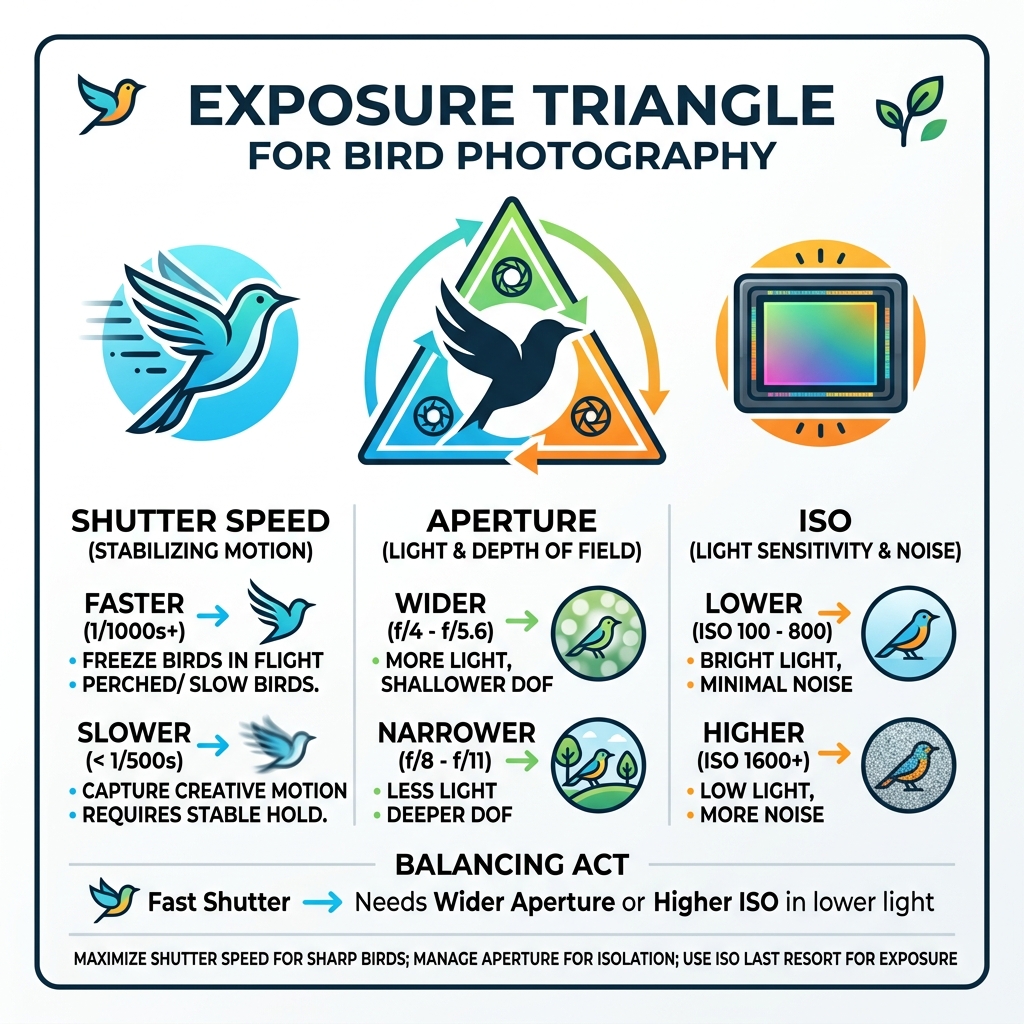
- Use a fast shutter speed – at least 1/1000s for moving birds, 1/2000s or faster for small or quick species
- Shoot during golden hour – the hour after sunrise and before sunset gives you soft light and active birds
- Start with 400mm or more of focal length to fill the frame from a safe distance
- Use continuous autofocus (AI Servo / AF-C) to track birds as they move
- Set aperture to f/5.6 as a starting point to blur backgrounds and let in light
- Shoot in burst mode to capture the decisive moment
- Keep ISO as low as possible, but raise it rather than lose sharpness
- Always focus on the bird’s eye – a sharp eye saves an otherwise imperfect shot
- Shoot at eye level for more intimate, professional-looking results
- Patience matters more than gear – understanding bird behavior beats expensive equipment every time
You don’t need a $15,000 lens or the latest mirrorless body to get great results. Photographers regularly produce award-winning bird images with older DSLRs and mid-range zoom lenses. The fundamentals – light, timing, technique, and knowing your subject – do most of the heavy lifting.
Bird photography sits at the crossroads of nature, science, and art. Birds move fast, hide easily, and don’t take direction. But that challenge is exactly what makes a great shot so satisfying.
This guide covers everything: gear choices for every budget, the right camera settings for perched birds and birds in flight, how to find and approach subjects, composition and lighting, post-processing, and ethical guidelines every bird photographer should follow.
Essential Gear and Lenses for Every Budget
One of the biggest myths in this hobby is that you need a “National Geographic” budget to get started. While pros might carry $12,000 prime lenses, we can achieve stunning results with much humbler kits. The most important factor isn’t the brand on your camera; it’s the reach of your lens.
For bird photography, focal length is king. We generally recommend a minimum of 400mm to fill the frame without distressing the bird. If you are debating between DSLR vs Mirrorless for Bird Photography, know that both are capable. Mirrorless cameras offer incredible subject detection (eye-tracking), but DSLRs like the Nikon D850 or Canon 5D Mark IV remain workhorses in the field, often available at a steal on the used market.
When looking at Beginner Bird Photography Kits, consider the “crop factor.” An APS-C (crop sensor) camera effectively multiplies your focal length. For example, a 300mm lens on a Nikon crop sensor acts like a 450mm lens, giving you “free” reach that helps you stay mobile with Lightweight Bird Photography Gear.
Don’t forget stability. While many modern lenses have excellent image stabilization, a sturdy tripod paired with a gimbal head allows you to track flying birds smoothly without supporting five pounds of glass with your bare arms. For those in the city, there are plenty of Affordable Cameras for Urban Birding that pack enough punch to capture high-speed sparrow action.
Budget-Friendly Bird Photography Tips and Tricks
If you’re looking for Cheap Telephoto Lenses for Birds, the Sigma or Tamron 150-600mm zooms are the gold standard for value, often found for under $1,000 USD. They offer incredible versatility compared to Prime Lenses for Urban Bird Shots, which are sharper but lock you into one perspective.
Another pro tip: use teleconverters (extenders). A 1.4x extender can turn a 300mm lens into a 420mm lens. Just be aware you’ll lose a bit of light (usually one f-stop). When choosing between a Telephoto Lens vs Zoom Lens for Birds, beginners usually find zooms more practical for finding the bird in the viewfinder before zooming in for the kill.

Mastering Camera Settings for Bird Photography Tips and Tricks
Birds are essentially feathered fighter jets. To capture them, your camera needs to be “fast.” This starts with shutter speed. To avoid motion blur, we recommend a minimum of 1/1000s for perched birds and 1/2000s to 1/4000s for birds in flight (BIF). Learning How to Freeze Motion with the Best Shutter Speed for Flying Birds is the single biggest step toward sharper images.
Aperture also plays a vital role. Using The Ideal Aperture for Birds and How to Use It—usually wide open like f/5.6 or f/6.3—allows the maximum amount of light into the sensor, which in turn lets you keep that shutter speed high. It also creates that creamy, blurred background (bokeh) that makes the bird pop.
For focus, we swear by “back-button focus.” This separates the focusing trigger from the shutter button, allowing you to track a moving subject without the camera refocusing every time you take a shot. Combined with Capturing Swift Movements: Bird in Flight Photography techniques and continuous autofocus (AF-C or AI Servo), you’ll find your “hit rate” skyrockets.
| Setting | Perched Portrait | Bird in Flight (BIF) |
|---|---|---|
| Shutter Speed | 1/500s – 1/1000s | 1/2000s – 1/4000s |
| Aperture | f/5.6 – f/8 | f/5.6 (Wide Open) |
| ISO | Auto (Max 1600-3200) | Auto (Max 3200-6400) |
| AF Mode | Single or Continuous | Continuous (AF-C) |
| Drive Mode | Single or Low Burst | High-Speed Burst |
Optimizing Focus and Exposure
Avoiding Blurry Images in Bird Photography often comes down to mastering your AF points. If you have a modern mirrorless camera, enable “Animal Eye AF.” If you’re using a DSLR, stick to the center focus point or a small expanded group for the best accuracy.
Lighting can be tricky, especially with white birds or dark backgrounds. Use Adjusting Exposure for Bird Photos via exposure compensation. If you’re shooting a white heron against a dark forest, dial in -1 or -2 EV to prevent blowing out the white feathers. Conversely, Photographing Rare City Birds: The Role of Camera Settings often involves shooting against bright skies, where you might need +1 EV to see detail in the shadows.
Field Techniques: Finding and Approaching Subjects
You can have the best gear in the world, but if you can’t find the birds, you won’t get the shot. We recommend using tools like eBird to find local “hotspots.” These are community-vetted locations where specific species are frequently sighted.
Timing is equally critical. The Best Times to Photograph City Birds are almost always the “golden hours”—shortly after dawn and just before dusk. Not only is the light more flattering, but birds are most active then, foraging for food. When you Capture Morning vs Evening Birds: Camera Settings Compared, you’ll notice that morning light is often crisper, while evening light provides a warmer glow.
Approaching birds requires the stealth of a ninja. Move slowly, avoid walking directly toward the bird (zigzag instead), and wear muted colors. If you want Up Close and Personal: Camera Settings for Close-Up Bird Shots, sometimes the best approach is to let the birds come to you. Setting up a backyard bird feeder with natural perches (like a beautiful lichen-covered branch) is a fantastic way to practice.
Composition and Lighting for Professional Results
Composition is what separates a “record shot” from a work of art. The most effective of our bird photography tips and tricks is to get down to eye level. Shooting from a high angle makes birds look small and insignificant; Exploring Angles and Perspectives in Bird Photography shows that an eye-level shot creates an intimate connection between the viewer and the subject.
Follow The Ultimate Guide to Better Photo Composition by applying the Rule of Thirds. Don’t just center the bird; place it on one of the vertical grid lines, leaving “negative space” in the direction the bird is looking or flying. Use Vertical or Horizontal Framing Tips for Bird Photography depending on the bird’s posture—tall herons often suit vertical frames, while soaring hawks demand horizontal space.
Background management is just as important as the subject. A distracting branch growing out of a bird’s head can ruin a shot. By Composing Bird Photos with Urban Backgrounds, you can use city lights to create beautiful “bokeh” circles if you position yourself correctly.
Creative Bird Photography Tips and Tricks for Dynamic Action
Once you’ve mastered the basics, it’s time to get creative. Try “slow pans”—using a slower shutter speed (1/30s to 1/100s) while tracking a flying bird. This keeps the head sharp while blurring the wings and background, conveying a sense of incredible speed.
You can also Enhance Colors in Bird Photography by playing with backlighting. A backlit bird can create a “rim light” effect around its feathers, or you can underexpose completely to create a dramatic silhouette against a sunset.
Post-Processing and Enhancing Your Bird Images
The “modern darkroom” is where your RAW files truly come to life. Even the best shots benefit from a little polish. Our Beginner Bird Photo Editing Tips start with two essentials: noise reduction and sharpening.
Because bird photography often requires high ISOs to maintain fast shutter speeds, grain (noise) is inevitable. Software like Topaz Photo AI or Lightroom’s Denoise can work wonders. When Sharpening Bird Images in Post, focus specifically on the eye and the beak. Enhancing Bird Feathers in Editing requires a delicate touch; over-sharpening can make feathers look “crunchy” and unnatural.
At Ciber Conexão, we believe the “crop” is your most powerful compositional tool. Often, we can’t get close enough to fill the frame perfectly in-camera. Using Crop and Composition Editing Tips, you can re-center your subject and remove distracting elements from the edges. The goal is always Natural Looking Edits for Bird Photos—the viewer should never realize the photo was heavily manipulated.
Mobile and Advanced Editing Workflows
You don’t always need a desktop computer. Editing Pigeon Photos on Mobile is now easier than ever with Apps for iPhone Bird Photo Editing like Snapseed or Lightroom Mobile. These apps allow you to Removing Distractions from Bird Photos using “healing” brushes to zap away stray twigs.
For those looking for a specific “look,” Lightroom Presets for Urban Birds can provide a consistent aesthetic. Advanced users might dive into Photoshop Tips for Bird Photos to perform complex masking, while Color Grading for Urban Bird Photography helps blend the bird’s natural tones with the cool or warm hues of a city environment.
Frequently Asked Questions about Bird Photography
What is the best shutter speed for birds in flight?
For most birds in flight, 1/2000s is the “safe” minimum. If you are shooting very small, erratic birds like hummingbirds or swallows, you may need to push to 1/3200s or 1/4000s to completely freeze the wing motion. If you want a little artistic “wing blur” while keeping the head sharp, you can drop down to 1/500s.
How can I get close to birds without scaring them?
Patience is your best friend. Instead of walking toward a bird, try to sit still near a spot where they are likely to land and let them get used to your presence. Using a “zigzag” approach—never looking the bird directly in the eye as you move—can also help. Bird blinds or even shooting from your car (which acts as a great mobile blind) are highly effective techniques.
Is bird photography possible on a budget?
Absolutely. Many pros started with a used entry-level DSLR and a 70-300mm lens. You can find this combination for under $400. Focus on common birds like urban pigeons, backyard songbirds, or local waterfowl. These subjects are often more acclimated to humans, allowing you to get great shots without needing a $10,000 super-telephoto lens.
Conclusion
Mastering bird photography tips and tricks is a journey of constant learning and practice. It requires a unique blend of technical skill, artistic vision, and deep respect for the natural world. The welfare of the bird always comes before the shot—never disturb a nesting bird or use unethical baiting practices just for a “like” on social media.
At Ciber Conexão, we are passionate about helping you turn your raw captures into professional-grade art. Whether you are struggling with a “noisy” high-ISO shot or trying to find the perfect crop to emphasize a bird’s gaze, Hugo Andrade and our team are here to provide the expert editing advice you need.
Ready to take your skills to the next level? Explore more of our Photography Tips and start capturing the sharp, stunning bird images you’ve always dreamed of. Grab your camera, head to the nearest park, and remember: the best bird photo is the one you haven’t taken yet!
Bird Photography: 5 Steps To Help You Get Started | All About Birds
