
Why Hummingbird Shutter Speed Makes or Breaks Your Shot
Hummingbird shutter speed is the single most important camera setting you need to get right before pointing your lens at these tiny, fast-moving birds.
Here’s a quick answer if that’s all you need:
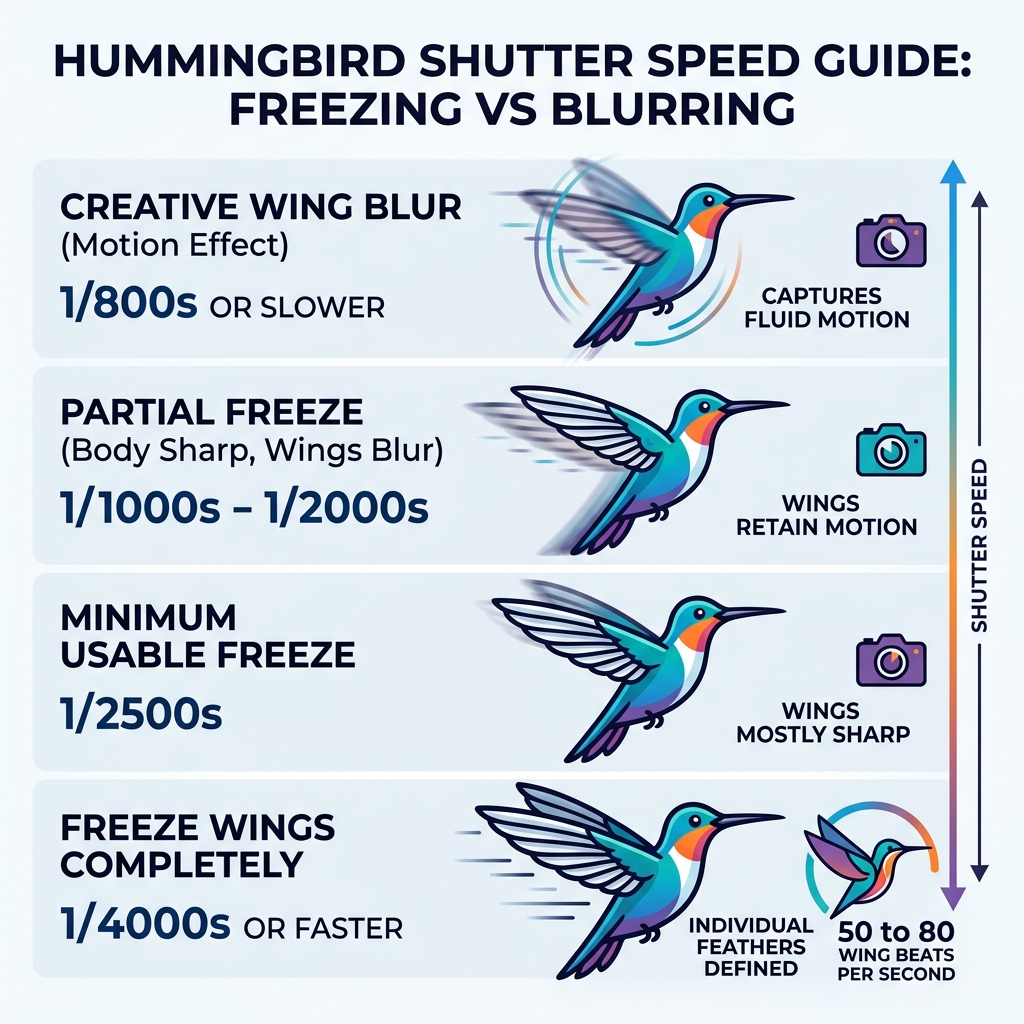
| Goal | Recommended Shutter Speed |
|---|---|
| Freeze wings completely | 1/4000s or faster |
| Minimum usable freeze | 1/2500s |
| Partial freeze (body sharp, wings blur) | 1/1000s – 1/2000s |
| Creative wing blur / motion effect | 1/800s or slower |
Hummingbirds beat their wings 50 to 80 times per second depending on the species. That’s not a typo. At that speed, even a shutter speed of 1/2000s — fast enough to freeze most birds in flight — often only catches the wings at the very top or bottom of their arc, where motion is slowest. Mid-stroke, the wings are still a blur.
The result? Dozens of shots that look almost right, but not quite sharp where it matters.
It’s genuinely one of the trickiest challenges in backyard bird photography. You can nail the focus, frame the shot perfectly, and still walk away with nothing but smeared wings.
The good news: once you understand the relationship between shutter speed and where the wing is in its stroke, you can start making smarter decisions every time you shoot.
Understanding the Physics of Hummingbird Wing Speed
To master hummingbird shutter speed, we first have to respect the sheer physics of these “pocket rockets.” Hummingbirds aren’t just fast; they are biological marvels. While a typical songbird might flap its wings a few times a second, a hummingbird is operating on a completely different frequency.
Most species average around 50 beats per second, but this varies wildly. For example, the tiny Calliope Hummingbird can hit a staggering 80 beats per second. When you realize that 80 beats per second means the wing is moving up and down 80 times in just 1,000 milliseconds, you start to see why a “fast” shutter speed of 1/500th of a second just won’t cut it.
The Arc Endpoints vs. Mid-Stroke Velocity
According to scientific research on hummingbird flight requirements, the wings actually change speed throughout a single flap. At the very top and very bottom of the wing arc (the “endpoints”), the wings pause for a microscopic fraction of a second before reversing direction.
If you shoot at 1/2000s, you might get a “lucky” shot where the wings look frozen because you caught them at that turnaround point. However, if you catch them mid-stroke, where velocity is at its peak, even 1/2000s will show significant blur. This is why we often see photos where the bird’s body is tack-sharp but the wings are a ghostly smudge. To truly stop that mid-stroke motion, we need to push our settings much higher.
Finding the Ideal Hummingbird Shutter Speed for Every Shot
When we head out into the garden, we usually aim for 1/4000th of a second as our gold standard. This is the “sweet spot” where you can consistently freeze wing motion across most species. If the light isn’t cooperating, we consider 1/2500th of a second to be the absolute minimum for a usable freeze. Anything slower, and you are essentially gambling on catching the wing at the arc endpoints.
Capturing these moments requires a blend of technical settings and an understanding of Capturing Swift Movements: Bird in Flight Photography. If you’ve ever struggled with Avoiding Blurry Images in Bird Photography, the culprit is almost always a shutter speed that was “fast” for a human, but “slow” for a hummingbird.
Achieving Total Freeze with Hummingbird Shutter Speed
If you want to see individual feather details on the wing — the kind of shot that looks like time has literally stopped — you should aim for 1/8000th of a second. At this extreme speed, you can overcome even the fastest mid-stroke velocities.
However, shooting at 1/8000s comes with a heavy “light tax.” Because the shutter is open for such a tiny window, you need immense amounts of ambient light or a very high ISO. This is where Improving Clarity in Bird Shots becomes vital; you’ll need to balance that speed with sensor performance to avoid a grainy mess.
Creative Motion Blur and Hummingbird Shutter Speed
Not every great photo needs to be frozen in time. Sometimes, we want to convey the frantic energy of the bird. By dropping your hummingbird shutter speed down to 1/800th of a second or even 1/500th, you can keep the bird’s head and body sharp while allowing the wings to become a beautiful, artistic blur.
This technique creates “wing streaks” that show the path of the movement. It’s a fantastic way to show the “vibe” of a hummingbird rather than just its anatomy. For more on how to dial this in, check out our guide on Mastering Bird Photography: Essential Camera Settings.
Balancing the Exposure Triangle: ISO and Aperture
Choosing a fast hummingbird shutter speed is only half the battle. The other half is making sure your photo isn’t pitch black. This is where the exposure triangle — Shutter Speed, Aperture, and ISO — comes into play.
We generally recommend shooting in Manual Mode with Auto-ISO or Aperture Priority (Av). In Manual mode, you can lock in your 1/4000s speed and your desired aperture, letting the camera adjust the ISO to keep the exposure correct.
The Aperture Sweet Spot
For hummingbirds, we usually stay between f/4 and f/8.
- f/4 or wider: Great for letting in lots of light (which helps keep ISO low) and creating a creamy bokeh background. However, the depth of field is very thin. If the bird moves an inch forward, its eyes might go out of focus.
- f/5.6 to f/8: This is our preferred range. It gives us enough depth of field to keep the entire bird sharp from beak to tail, while still providing a nice background separation.
The ISO Trade-off
To maintain a high hummingbird shutter speed, you will inevitably have to raise your ISO. While we love to keep ISO under 800 to avoid noise, modern full-frame cameras can handle ISO 1600 or even 3200 with excellent results. It is always better to have a sharp photo with a little bit of noise than a clean photo that is blurry. You can always fix noise in post-processing, but you can’t fix a motion-blurred wing. Understanding how to Adjusting Exposure for Bird Photos is key to finding this balance.
Managing Light for High Hummingbird Shutter Speed
Lighting is your best friend. We always try to position ourselves so the sun is behind us, illuminating the bird’s iridescent feathers. This “front lighting” not only makes the colors pop but also provides the maximum amount of light to the sensor, allowing for those 1/4000s speeds without maxing out the ISO.
If you are shooting in the early morning or late afternoon, read our comparison on how to Capture Morning vs Evening Birds: Camera Settings Compared. For those just starting out, our Beginner’s Guide to Bird Photography: Key Settings offers a great foundation for handling tricky light.
Advanced Gear and Techniques for Sharp Results
Having the right settings is one thing; hitting a target the size of a thumb moving at 30 miles per hour is another.
Burst Mode and Autofocus
If your camera supports it, turn your burst rate up to the maximum (15, 20, or even 30 fps). Hummingbird photography is a numbers game. You might take 400 shots in ten minutes just to get five “keepers.”
Use Continuous Autofocus (AF-C or AI Servo). If your camera has Bird-Eye Detection, turn it on! It’s a game-changer for keeping the focus locked on the eye while the wings are flapping wildly. If you’re using specific lenses, make sure you’ve optimized your Camera Settings for Bird Lenses.
Handheld vs. Tripod
While many photographers prefer tripods for stability, we often find that handheld shooting allows for the split-second reactions needed to follow a darting hummingbird. If you do go handheld, ensure your lens has Image Stabilization (IS) or Vibration Reduction (VR) turned on. However, if you are camping out by a feeder and waiting for the bird to come to a specific “hover spot,” a tripod can save your arms from fatigue.
Pre-focusing and Feeder Placement
A pro tip we use often is to pre-focus on a flower or a feeder perch. Hummingbirds are creatures of habit; they often hover in the exact same spot 6 to 12 inches away from a feeder before moving in to drink. By pre-focusing on that empty space, you reduce the time your camera spends “hunting” for focus when the bird actually appears.
Using Flash to Supplement Hummingbird Shutter Speed
If you really want to get technical, you can use a multi-flash setup. This is a popular technique for professional hummingbird photographers.
The “secret” here is that the flash duration becomes your effective shutter speed. While your camera might be set to its sync speed (like 1/200s), a speedlight set to low power (like 1/64 or 1/128) has a flash duration of about 1/30,000th of a second.
Because the flash is so much faster than any mechanical shutter, it freezes the wings perfectly. To make this work, you generally need to underexpose the natural light so that the flash is the only thing illuminating the bird. This eliminates “ghosting” and results in surgical sharpness.
Frequently Asked Questions about Hummingbird Shutter Speed
What is the absolute minimum shutter speed to avoid a total blur?
We recommend 1/1000th of a second as the absolute “floor.” At 1/1000s, the bird’s body and head should be sharp if it is hovering, but the wings will be a complete wash of motion. This is acceptable for some portraits, but if you want any definition in the wing feathers, you need to go higher.
Why do my photos look dark at 1/4000th of a second?
This is the most common issue. At 1/4000s, the “eye” of your camera is only open for a tiny fraction of time. To fix this, you must either open your aperture (lower f-number), increase your ISO, or find a brighter spot to shoot. It’s a direct trade-off; you can’t have speed without light.
Should I use Shutter Priority or Manual mode?
We prefer Manual mode with Auto-ISO. Shutter Priority (Tv or S) can be risky because if the bird moves into a dark shadow, the camera might try to open the aperture wider than your lens allows, resulting in an underexposed (dark) photo. In Manual mode, you control the speed and the depth of field, and the ISO acts as the “safety net” to keep the exposure consistent.
Conclusion
Capturing the perfect hummingbird photo is a rewarding challenge that tests both your patience and your gear. By mastering hummingbird shutter speed, you move from taking “lucky” snapshots to creating intentional, professional-grade wildlife art.
Remember the core rules we’ve discussed:
- Aim for 1/4000s to freeze the action.
- Keep your aperture around f/5.6 for the best balance of light and sharpness.
- Don’t be afraid of higher ISOs; a sharp, grainy photo is always better than a clean, blurry one.
- Use burst mode to increase your keeper rate.
At Ciber Conexão, we know that the work doesn’t end when you click the shutter. Often, the difference between a good shot and a great one lies in the crop and composition. If you’ve captured a sharp image but the framing is off, our expert advice on photo editing can help you salvage the shot. For more deep dives into birding, check out our guide on Mastering Camera Settings for Bird Photography.
Now, grab your camera, set that dial to 1/4000s, and go find those pocket rockets!
